What Candidates Ask AI When Researching Employers
.jpg)
Most employer brand strategies are built around what companies want candidates to know. But in 2026, what candidates actually learn about you is increasingly determined by what they ask AI, and the questions vary significantly depending on who is asking.
According to ZipRecruiter's New Hires Survey, more than half of recent hires used generative AI during their job search, a figure that doubled in a single year. A separate iHire study found that 70% of job seekers use AI to research companies, draft cover letters, and prepare for interviews. Candidates aren't just using ChatGPT to write resumes. They're using it to discover and evaluate potential employers, researching culture, benefits, and employee sentiment before they ever hit apply.
How candidates use AI to research companies is not a single, uniform behaviour. A senior software engineer evaluating a move from a big tech company asks different questions than a mid-career finance professional exploring their first role at a startup. A nursing candidate researching a healthcare system thinks differently than a supply chain manager comparing two logistics firms. Yet most employer brand teams build a single EVP narrative and assume it reaches everyone equally.
AI doesn't work that way. It synthesizes responses based on the specific query, the persona behind it, and the sources it can find. That means the narrative a candidate receives is shaped as much by who they are as by what you have published.
Understanding that dynamic starts with a structured, persona-led approach to prompting.
Define Your Critical Hiring Personas
Start with your two or three most strategically important candidate segments, the roles where quality of hire matters most and where employer brand has the greatest influence on attraction.
For each persona, map four things:
What they care about most. A senior engineer will prioritize engineering culture, technical challenge, and autonomy. A finance director will weight stability, leadership quality, and strategic influence. A marketing manager will look for creative freedom, brand reputation, and growth trajectory. These should come from your existing candidate research, recruiter feedback, and exit interview data, not assumptions.
What objections they typically raise. Every persona has a set of concerns that reliably surface late in the process. These are the questions they are most likely to take to AI to validate or stress-test before accepting an offer.
What language they use. Candidates do not search in corporate language. They ask AI the way they would ask a well-informed friend. "Is [Company] a good place to work if you're a senior engineer who wants to stay technical?" lands differently than "What is [Company]'s engineering culture?" Understanding the register matters.
Who they compare you to. Candidates rarely research you in isolation. They are almost always weighing you against one or two alternatives. The competitive framing AI uses when your name appears alongside a competitor is a distinct perception problem that requires its own prompting approach.
Build the Prompt Set
Once you have your personas mapped, translate each one into prompts that reflect how that candidate would realistically interact with AI during their research. At PerceptionX, we organize these into four prompt types, each capturing a different stage and intent in how candidates use AI to research companies.
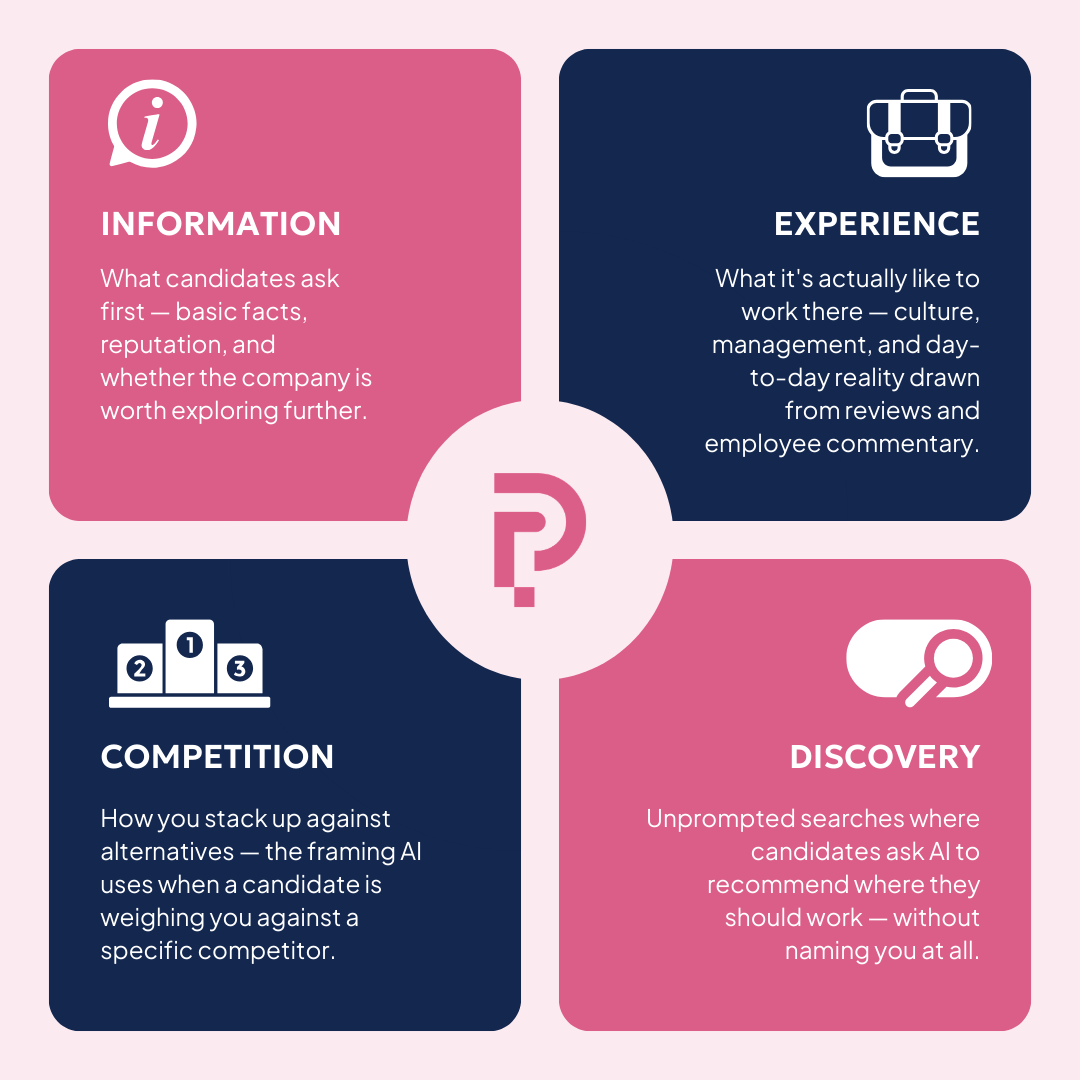
Informational prompts establish basic facts and first impressions. These are typically the first thing a candidate asks, before they've formed any real opinion. "What does [Company] do?" / "What is [Company] known for as an employer?"
Experiential prompts dig into what it's actually like to work there: culture, management, day-to-day reality. This is where Glassdoor reviews, Reddit threads, and employee commentary carry the most weight. "What is it like to work as a software engineer at [Company]?" / "What do employees say about the culture at [Company]?" / "What are the biggest challenges of working at [Company]?"
Competitive prompts reflect the moment a candidate is weighing options. This is where AI framing can win or lose a candidate you never knew you were competing for. "How does [Company] compare to [Competitor] for software engineers?" / "Is [Company] or [Competitor] better for career growth?"
Discovery prompts are broader, unprompted searches where a candidate asks AI to recommend where they should work, without naming you at all. "What are the best companies to work for in fintech in London?" / "Which tech companies are known for strong engineering culture?" Visibility here depends almost entirely on earned media and rankings, not your owned content.
Running all four types for each persona gives you a complete picture. Most employer brand audits focus only on informational and experiential, missing the competitive and discovery queries where perception gaps are often most damaging.
For a senior software engineer persona, a full prompt set might look like:
- "What is [Company] known for as an employer?" (Informational)
- "What is it like to work as an engineer at [Company]?" (Experiential)
- "What do engineers say about the culture at [Company]?" (Experiential)
- "How does [Company] compare to [Competitor] for software engineers?" (Competitive)
- "Is [Company] or [Competitor] better for career growth in engineering?" (Competitive)
- "What are the best tech companies for engineers who want to stay hands-on?" (Discovery)
For a finance director persona, the same structure shifts in tone and priority: stability, leadership and strategic influence become the dominant themes across all four types.
Run Across Models and Diagnose
With your prompt set ready, run each prompt across the major AI models, at minimum ChatGPT, Claude, Gemini, and Perplexity. Responses vary meaningfully across models because each draws on different source weightings and synthesis approaches. A gap that is invisible on one model may be significant on another.
For each response, look at four things:
Visibility. Is your company mentioned at all? In competitive prompts, does AI surface you or default to a competitor?
Sentiment. What is the overall tone? What specific themes come up consistently, and are they aligned with your EVP or diverging from it?
Competitive framing. When you appear alongside a competitor, how does AI characterize the difference? This framing is often the most consequential and least monitored aspect of AI employer brand perception.
Source patterns. What is AI drawing on? According to Glassdoor's employer branding research, 83% of job seekers research company reviews and ratings before deciding where to apply, and AI is synthesizing this same review content when building its narrative about you. Glassdoor reviews from three years ago, a Reddit thread, or a Forbes Best Employers list can all shape what a candidate hears.
We've written in detail about which sources AI references most for employer brand; the findings may surprise you. The sources tell you where the narrative is being built and where intervention is possible.
What the Gaps Tell You
The delta between your intended EVP and what AI is actually saying to each candidate persona is where the real work begins.
Common gap patterns include:
Temporal drift
Your EVP reflects a culture transformation that happened two years ago. AI is still synthesizing reviews and content from before that change because the newer narrative hasn't been established in the sources AI weights most heavily.
Persona blind spots
Your owned content speaks clearly to one candidate segment but is thin or absent for another. AI fills that gap with whatever it can find, which is often organic sources like Reddit or Blind that your communications team has never monitored.
Competitive misframing
AI consistently positions you as the conservative, stable choice when you are actively trying to attract candidates who want speed and innovation. The framing is being driven by media coverage and review content that predates your strategic repositioning.
Geographic gaps
Strong narrative in your headquarters market, thin or negative coverage in the cities where you are actively hiring.
Each of these gap patterns has a different remediation pathway, and understanding which ones apply to which personas is the foundation of an employer brand strategy that actually reaches the candidates you are trying to attract.
Why This Is Not a One-Time Exercise
How candidates use AI to research companies is not static. Personas evolve. AI models update their source weightings. Review platform content accumulates. A competitor launches a major culture initiative and shifts the comparative framing.
Gartner predicts that traditional search engine volume will drop 25% by 2026 as AI becomes the default answer engine. That threshold is now. The employer brand teams that will have a structural advantage are the ones that treat persona perception monitoring as an ongoing discipline rather than a periodic audit, running persona-led prompt sets across models on a regular cadence, tracking sentiment and source shifts over time, and building content strategies that respond to what AI is actually surfacing.
The starting point is understanding what your candidates are being told right now. Everything else follows from that.
Frequently asked questions

Find out how AI is shaping your employer brand — and what you can do about it.