What ChatGPT Ads Really Mean for Recruitment Marketing & Employer Brand

For years, recruitment marketing has been about three big levers: job boards, social, and search. You bought visibility, you told your story, and you hoped the right people clicked through to your careers site.
Now, there is a new starting point: candidates quietly asking ChatGPT and other AI assistants “which companies are best for X?” or “what’s it like to work at Y?” long before they see any of your ads. And soon, the answers to those questions will include ads.
1. The AI research window becomes ad inventory
OpenAI has now formally announced that it will start testing ads in ChatGPT for free and ChatGPT Go users, positioning advertising as a way to “make powerful AI accessible to everyone” while keeping a paid, ad‑free tier for people who prefer it. They lay out clear ad principles – mission alignment, answer independence, conversation privacy, choice and control, and long‑term value – and emphasise that answers are “optimized based on what’s most helpful” and that ads will be “separate and clearly labeled.”
Practically, that still means the place candidates already go to ask private, high‑stakes questions (“who should I work for?”, “is this company any good for parents?”) is about to become a new piece of recruitment ad inventory. For recruitment marketing, the “dark funnel” of research that used to live in search, review sites and group chats is now happening inside ChatGPT – and your first chance to show up may be as an organic recommendation, a sponsored unit, or both.
2. AI becomes the new recruitment ad network
Think about how search ads changed consumer marketing: you could show up exactly when someone typed “best running shoes” into Google. ChatGPT ads bring a similar intent layer into recruitment.
Candidates will ask things like:
- “Best remote employers for software engineers”
- “Graduate programs with real progression”
- “Companies that pay well in pharma sales”
- “Where should I work if I want flexible hours and impact?”
ChatGPT can answer with a mix of organic recommendations and paid placements embedded in a conversational response. That means recruitment marketing plans will need a specific line item for “AI assistant inventory”: campaigns targeted not at keywords like “software engineer jobs Dubai”, but at questions like “who are the top engineering employers in Dubai and why?”.
3. Imagine this, but with your jobs
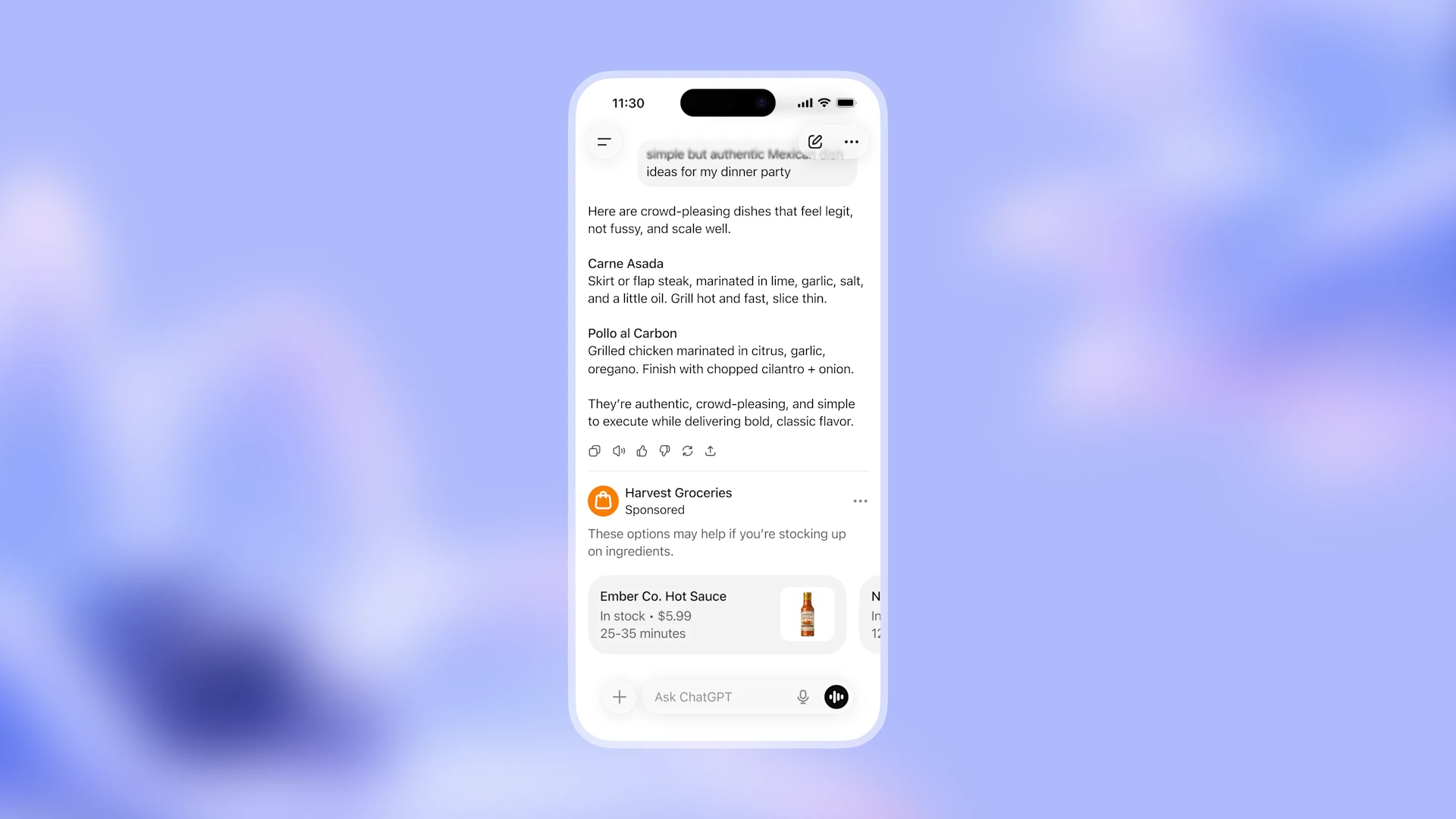
In OpenAI’s official announcement, there’s a clear mock of how ads will show up in ChatGPT: you ask for Mexican dinner ideas, get a natural‑language answer, and then – right underneath – see a clearly labelled “Harvest Groceries – Sponsored” card with relevant products you can buy.
Now swap out hot sauce for hiring.
Instead of a grocery card, imagine a sponsored block that appears right below an answer to “what are the best companies for junior software engineers in Berlin?” or “how do I pivot into a data role without a degree?”.
- The top of the screen is still the organic answer: the assistant explaining which employers are known for good training, strong leadership or real flexibility, based on the data it has about each brand.
- Underneath, in that same ad slot, could sit a sponsored card for a specific employer or role: “Sponsored: Acme Tech – Graduate Software Engineer, Berlin. Ranked highly for learning and development, hybrid working and visa support.”
That’s the mental model recruitment marketers need to design for. The conversation stays the primary experience; the ad is a contextual shortcut into a job or employer that fits what the candidate just asked.
4. Reputation and recruitment media finally collide
Here is the twist: unlike job boards or social feeds, ChatGPT still builds its answers from what it can read about you – reviews, forums, press, careers content, social conversations. Your ad will sit inside or alongside a narrative assembled from those signals.
- If your Glassdoor ratings are sliding, your press coverage is negative, and your career site is generic, the model will reflect that in how it describes you.
- If your EVP is clear, backed by proof, and reinforced across credible sources, the model will describe you in a way that supports your targeting and creative instead of undercutting it.
In other words, performance problems in “ChatGPT ads” will often be reputation problems wearing a media hat. You will not be able to buy your way past a weak underlying story, because the assistant is still reading the truth underneath the spend.
5. How recruitment marketing needs to adapt
So what does this actually mean for recruitment marketing teams building plans for 2026 and beyond?
Treat ChatGPT as a primary channel, not a tool
Most current content about ChatGPT and recruitment focuses on prompts and productivity hacks. That is useful, but it misses the bigger picture: ChatGPT is becoming a media channel where your employer story is discovered, shaped, and now, advertised.
- Give AI assistants their own budget line, creative, and KPIs – just like search or social.
- Design campaigns around high‑intent questions (“best employers for X”) rather than just job titles.
- Build a “ChatGPT ads playbook” with creative guidelines, targeting principles, and landing page templates that feel conversational instead of generic.
Design creative for answer‑level ads
AI ads will likely be woven into paragraphs of explanation, not dropped in as a banner. That changes how recruitment marketing needs to write.
- Your copy has to sound like a helpful contribution to the conversation – clarifying trade‑offs, sharing an example, or offering a next step – rather than a bolted‑on slogan.
- Context is everything: instead of “We’re hiring engineers,” it becomes “For engineers who care about working on climate risk, here’s what our team is building and why people join us.”
- Use conversational, benefit‑first language: “If you want to lead without hierarchy” or “If you’re tired of legacy stacks” – speak to the unspoken question the candidate just asked.
The goal is to make your paid unit feel like the obvious, useful answer to what the candidate just asked – because it literally appears inside that answer.
Align paid with your organic AI footprint
If ChatGPT already “thinks” you are an uninspiring employer, paid impressions will not convert.
- Use employer reputation tools to see how AI currently describes your culture, leadership, flexibility, and career paths, and how often you are recommended versus peers.
- Fix the inputs – reviews, EVP clarity, proof content, employee stories, PR – so the model has better material to work with before you start shifting budget into AI ads.
- Identify gaps: where are competitors being recommended and you are not? What themes (remote work, diversity, learning culture) is AI already associating with your brand, and which are missing?
Paid AI placements should amplify a strong organic narrative, not fight a weak one.
Make your careers ecosystem “AI‑readable”
Everything candidates land on after that AI interaction has to be just as intelligent.
- Structure your careers site and job descriptions so AI can easily parse key themes (culture, growth, flexibility, mission), using clear headings, consistent language and concrete proof points.
- Build landing journeys that continue the conversation – tailored pages, segment‑specific content, and on‑site chat – instead of dropping people straight into a bare ATS listing.
- Make job descriptions answer the questions candidates are asking in ChatGPT: “Will I grow here?”, “What’s the team culture really like?”, “Can I do this role remotely?”
If the click from ChatGPT lands in a dead end, the value of high‑intent AI inventory gets wasted.
Update your success metrics
Click‑through rate alone will not tell you whether you are winning in the AI era.
- Track “share of AI recommendation” – how often you appear in AI answers for the queries and themes that matter to your hiring strategy (e.g. “best places for early‑career developers in MENA”, “most flexible employers in pharma”).
- Correlate changes in that AI visibility with changes in applications, quality of hire, and media performance to show the C‑suite how reputation and spend interact, instead of treating them separately.
This reframes recruitment marketing from “buying traffic” to “shaping how and where AI routes demand.”
The bottom line for recruitment marketing
ChatGPT ads mean recruitment marketing is moving into a world where every campaign is judged twice: once by the candidate, and once by the model that decides whether to show your brand at all.
Teams that adapt will do three things well:
- Treat AI assistants as a core channel, not just a copywriting tool.
- Invest in the employer reputation signals that AI reads – reviews, EVP proof, career content, press, and employee advocacy.
- Use platforms like PerceptionX to understand and improve how often you are genuinely recommended, not just how often you appear as a sponsored block in the answer.
The ads are coming. The question is whether your employer brand is ready to be judged by an algorithm that reads everything – and whether your recruitment marketing can win by amplifying a real story instead of trying to manufacture one.

Find out how AI is shaping your employer brand — and what you can do about it.