Employer Perception Score: How AI Sees You as an Employer

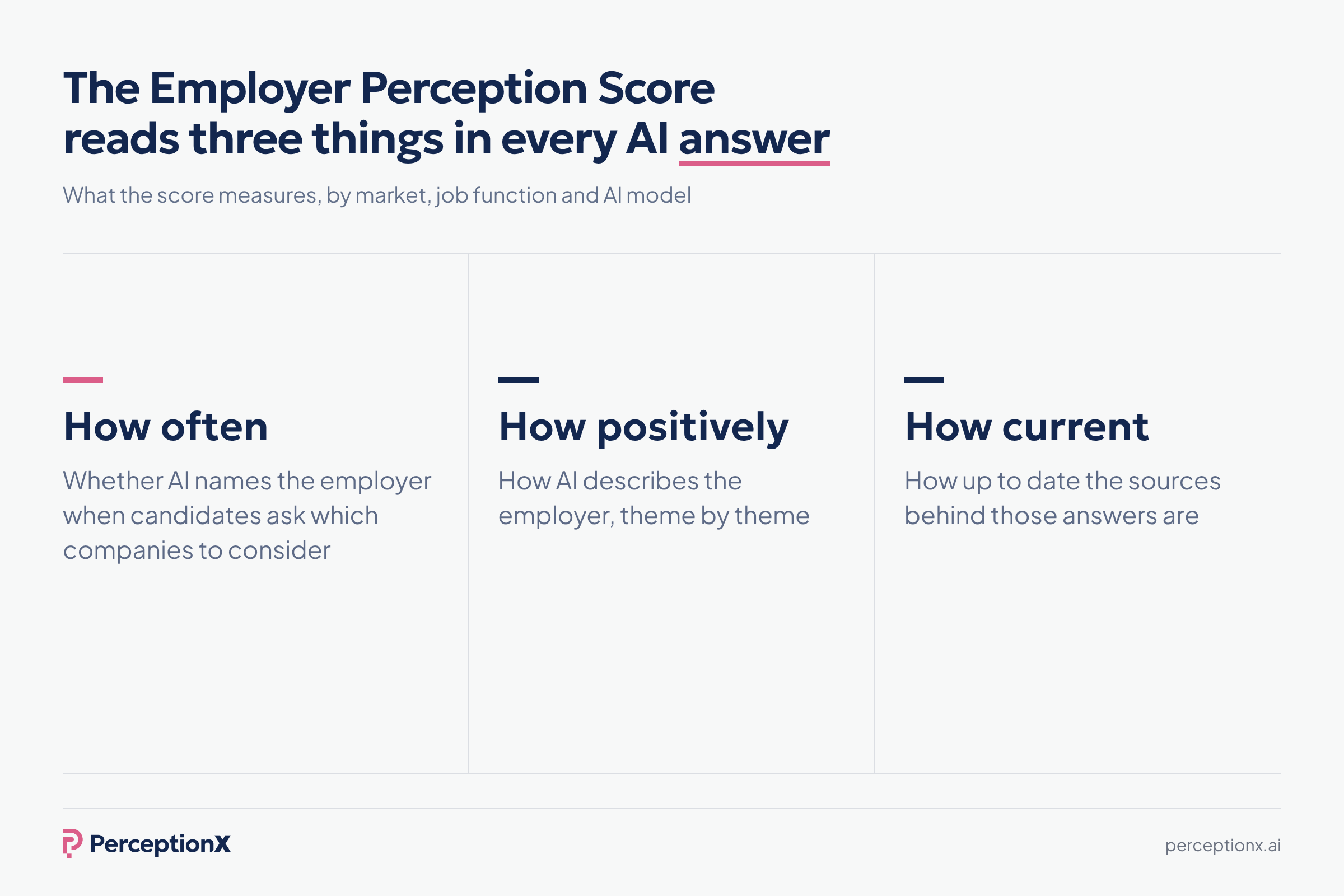
The Employer Perception Score is PerceptionX's score of how AI assistants describe an employer to candidates: how often the employer is named, how positively it is described, and how current the sources behind the answers are. It is read by market, by job function and by AI model, and every reading is traced to the sources that shaped it.
Employer perception is what candidates, employees and the wider market believe about a company as a place to work. More and more of it now forms in AI answers, and the Employer Perception Score turns that part of employer perception into a number you can track, compare and act on.
Where an employer brand index combines survey and review signals into a ranking, the Employer Perception Score measures what candidates are actually told when they ask AI about an employer. It is a new kind of employer brand score, made through the lens of AI, because that is where many job seekers now start forming opinions about where to work.
This guide covers what the Employer Perception Score measures, what an employer brand index is and how one works, how the two compare, and how to measure and improve employer brand perception from both the internal and the external side.
What is the Employer Perception Score?
The Employer Perception Score is an employer brand score built for the AI era: instead of an annual survey, it scores what AI assistants tell candidates, continuously and by market.
The score is PerceptionX's measure of external employer brand perception: how AI models such as ChatGPT, Perplexity, Google AI Mode and Google AI Overviews describe an employer when candidates ask about it. It is measured by market, by job function and by model, because perception of the same company differs between countries and roles.

The score is built on three pillars, each scored separately so you can see which one is moving:
- Visibility: how often AI recommends you, that is, how often you are named when candidates ask which employers to consider, without naming you. If you are absent, no other perception matters.
- Sentiment: of the points AI makes about you, the share that are positive. This is where employee perceptions of leadership, pay, culture and career development surface.
- Relevance: how up to date the sources behind the answers are, and whether it reflects what matters about working for you today.
Together they show whether the market perceives you the way you want to be perceived, and where the gap is. The Employer Perception Score covers the perception layer of an employer brand scorecard; the funnel, experience and cost measures that sit alongside it are in our guide to employer branding metrics.
Why a global employer needs readings by market
A global employer does not have one reputation. It has one per country and per talent group, and they can point in different directions.
The employer AI recommends to computer science graduates in one country may be barely mentioned to skilled professionals in another. Your talent competitors also change by market, so the score gives you an employer brand benchmark against the employers you actually compete with in each one, rather than against a single global list.
The Employer Perception Score is a score, not an index or a league table. It does not rank companies in a published list. It gives each employer its own reading, shows the same reading for the talent competitors in each market, and points to the sources behind it.
What is an employer brand index?
An employer brand index is a composite measure of brand strength for an employer: it combines several signals about how a company is perceived as a place to work into one score that can be tracked over time and compared with other employers. It is sometimes called an employer branding index, and it is one of the most common forms of employer brand measurement.
Depending on the method, the signals come from surveys of the target talent pool, company reviews, social and digital activity, hiring data and, more recently, AI tools. Most companies use an index for two things: as an employer brand benchmark against the employers they compete with for top talent, and to track whether their employer branding efforts are working.
Behind the headline number sit the components, such as awareness, consideration, review sentiment and how pay, company culture and career development are rated. They show which part of the employer brand is strong and where the biggest gaps are, which also makes an index a common starting point for the business case for employer brand investment.
How an employer brand index works
Every employer brand index follows the same basic steps, whatever its data source.
- Choose the signals. Decide what the index measures: for example awareness, consideration, sentiment, attribute ratings or how often an employer is recommended.
- Collect the data for each employer in scope, in the same way and over the same period.
- Normalise the scores so different signals can be combined, usually onto a 0 to 100 scale.
- Weight the components according to how much each should count, and keep the weighting stable over time.
- Calculate and rank by employer, and ideally by market, industry and talent group.
- Repeat on a fixed cadence so changes reflect reality, not a change in method.
The quality of an index depends almost entirely on step one. An index built on the wrong signals can be precise and still tell you very little about what candidates actually think.
Types of employer brand index
The main types differ by where the data comes from. Each one captures a different part of how an employer is perceived.
| Type | How it works | Strengths | Limits |
|---|---|---|---|
| Survey-based | Panels of students or professionals rate employers they know | Rich attribute detail; the "why" behind perception | Annual, slow, costly across markets; measures stated opinion |
| Review-based | Aggregates ratings and themes from employee review sites | Continuous; based on real employee experience | Skewed toward people with strong views; misses candidates |
| Digital and social footprint | Scores careers site, social reach, engagement and content | Easy to collect; shows marketing activity | Measures output, not perception |
| Brand valuation | Estimates the financial value of the employer brand | Speaks the language of finance | Model-dependent; hard to act on |
| AI-based | Scores what AI assistants tell candidates about each employer | Continuous; measures the answer candidates actually read; traceable to sources | Does not capture internal experience on its own |
Not the same as the QS employer reputation indicator
If you search for an employer reputation index, you will also find the employer reputation indicator used in the QS World University Rankings and QS Subject Rankings. That measures the opposite relationship: it is based on the QS Global Employer Survey, which asks employers which universities produce the best graduates, as a signal of graduate employability and graduate outcomes for prospective students. It rates universities, not companies, so it says nothing about how a company is seen as an employer.
Employer brand index vs Employer Perception Score
An employer brand index measures how strong an employer brand is by combining signals that people give when asked, or leave behind in reviews, into one score and usually a ranking. The Employer Perception Score measures something narrower and more direct: the answer a candidate receives when they ask an AI assistant which employers to consider, or what a company is like to work for.
| Question | Employer brand index | Employer Perception Score |
|---|---|---|
| What it measures | How strong the employer brand is, across several combined signals | What AI assistants tell candidates about the employer |
| Where the data comes from | Talent surveys, review sites, social and digital activity, hiring data | Answers from ChatGPT, Perplexity, Google AI Mode and Google AI Overviews to the questions candidates ask |
| What you get | A composite number, usually with a ranking of employers | A score for each employer on each pillar, with talent competitors measured the same way |
| How it is broken down | Often a national or global average | By market, job function and AI model |
| How often | Often annual, depending on the data source | Continuous |
| What you can act on | The components behind the number | The sources and themes behind each answer |
The Employer Perception Score is a score, not an index or a league table. An index ranks employers against each other on a blend of signals. The score reports what candidates are told about one employer, in one market, for one type of role, and shows the same reading for the employers it competes with there.
A score built on what AI tells candidates goes further for three reasons.
- It measures the answer, not the inputs. AI assistants read the careers site, job boards, review sites, news and employee content, then give candidates a single summary. That summary is the positive impression, or the negative one, that potential candidates take away.
- It is specific. The score is read by market, job function and AI model, so hiring teams can see where the gap is instead of an average across industry averages.
- It is traceable. Each reading links back to the sources behind the answer, so when the score moves you can see which source and which theme moved it.
The channel is already in use. In PerceptionX research with job seekers, 72% of AI-using job seekers used AI before deciding whether to apply, and 82% said an AI answer changed their mind about a company as a place to work. It is not always right either: 58% caught AI giving inaccurate information about an employer, which is a reason to measure what is being said.
The two are not mutually exclusive. An index built on surveys can still explain why people hold a view, and internal measures still cover the employee experience. For how single scores and composite scores are built, read our guide to the employer reputation score.
Using an employer brand benchmark alongside hiring data
Whichever measure you choose, it is most useful next to the key metrics your talent attraction work already reports: offer acceptance rate, cost per hire, employee referral rate, candidate NPS and first year retention. If perception improves in a market and more qualified applicants apply, more candidates accept and fewer declined candidates cite the employer's reputation, you have the start of a case for employer branding ROI.
That link to business outcomes is what turns measuring impact from a reporting exercise into a way to measure employer branding ROI. The right metrics are the ones that connect perception to accepted offers and retention rate, not job clicks alone. Our guide on how to measure employer brand sets out the full framework.
What a good employer brand index should include
These are the key elements to look for, whether you build an index yourself or buy one.
- External signals. It should measure what others say about you, not your own channels. A careers page full of stock photos tells you about your output, not about how you are perceived.
- Readings by market and talent group. A global average hides where your employer brand is weak.
- Attribute detail. Pay, career growth, culture, leadership, flexibility and purpose, scored separately, so you know what to fix. Some organisations add inclusivity and fairness as attributes of their own.
- A stable, transparent method. You need to know how it is calculated and trust that it means the same thing each period.
- A competitor benchmark built from the employers you actually compete with for talent.
- Explainability. When the score moves, you should be able to see why: which source, which theme, which market. Good explainability helps you identify areas of risk early, such as recurring comments about poor management or a difficult culture.
- Coverage of where candidates now research employers, which today includes AI assistants.
The limits of traditional employer brand indexes
Most established employer brand indexes were designed for a world where candidates formed opinions from campus events, job boards, review sites and word of mouth. They share four weaknesses:
- They are slow. An annual survey cannot show the effect of a change made last quarter.
- They measure what people say when asked, not what they read when they research you.
- They average across markets and roles, which hides the specific gaps that cost you hires.
- They cannot see AI answers. And that is now where many candidates meet your employer brand first.
None of this makes an employer brand index wrong. It makes it incomplete: strong employer brands on paper can still be described poorly, or not named at all, in the answers candidates read. That is the gap the Employer Perception Score was built to measure.
What is employer perception?
Employer perception, also called employer brand perception, is what employees, candidates and the wider market believe about a company as a place to work. It is not what the careers site says. It is the sum of employee perceptions, candidate opinions, review data and, increasingly, the answers AI assistants give when someone asks what a company is like to work for.
Measuring perception has always felt subjective. Employee surveys capture what current staff think, but not how the company is perceived externally. Brand trackers capture awareness, but not what candidates actually hear.
Employer brand perception has two sides, and most organizations only measure one of them.
- Internal perception: the internal brand, that is, how employees feel about the work environment, company culture, leadership, managers, career development opportunities, work life balance and pay. These drive job satisfaction, employee engagement and retention.
- External perception: what potential candidates, new hires, students and the market believe before they join. This drives whether top talent applies at all, and on what expectations.
The two are linked. Employees interpret information about their workplace, form opinions, and share them on review sites, Reddit and LinkedIn. Those opinions become the material candidates read, and the material AI models use to describe the employer.
Different employees in the same work situation can reach a different interpretation, which is why perception has to be measured at scale rather than inferred from a few conversations.
Why employer perceptions and a company's reputation matter
Perception is not a soft metric. It shows up in hard outcomes. In a PerceptionX survey of active job seekers across seven countries, 82% said an AI answer had changed their mind about a company as a place to work.
- Attraction: a positive perception gets you onto candidates' shortlists. Peer-reviewed research links employer branding, organizational image and reputation to candidates' intention to apply.
- Retention: when the employee experience matches the external perception, new hires stay. When it does not, they leave early, and the cost of hiring them is lost. Early turnover is often the first place a gap between promise and reality shows up.
- Engagement: employee satisfaction and staff satisfaction rise when people believe the organizational values they were sold are real.
- Hiring cost: a strong employer brand helps attract talent without paying a premium for every hire. When qualified candidates already want to work for you, you rely less on agencies and advertising, which helps reduce hiring costs and recruitment costs.
- Organizational success: leadership teams use perception data to see whether investments in workplace culture, benefits and management are landing.
The employee perception impact is two-way: a positive work culture improves perception, and an accurate positive perception attracts people who will thrive in that culture.
A bad reputation works the same way in reverse. It affects inbound candidate flow, because fewer people apply, and outbound flow, because more of the people your recruiters approach decline to talk. It can even reach customers, since an organization's reputation as an employer feeds the trust people place in the company as a whole.
Where candidates research employers
Job seekers rarely rely on one source. Before they apply, many candidates check several places to see whether what the company offers matches what employees say.
- Review sites: employee reviews, including negative reviews and how the employer responds to them.
- Social media: LinkedIn posts, employee testimonials and employee generated content, which candidates tend to trust more than corporate posts.
- Job postings and the careers site: the brand promise, the employee value proposition, employee benefits such as flexible hours, and the hiring process as the employer describes them.
- AI assistants: a single answer that summarises all of the above, often the first impression a candidate gets.
The overall perception a candidate forms is the combination of these sources. Your own employer brand content is only one input, so measuring perception means looking at all of them, not only the channels you control.
How to measure employer perception
No single method captures it. The practical approach is to combine internal feedback with external evidence.
| Method | Who it covers | What it tells you |
|---|---|---|
| Employee perception survey | Current employees | Job satisfaction, engagement, how values are lived |
| Focus groups and interviews | Employees, new hires, leavers | The reasons behind the scores |
| Candidate surveys | Applicants and new hires | Expectations before joining, hiring experience |
| Review data analysis | Current and former employees, publicly | The perception candidates read |
| AI answer measurement | The market, as AI describes you | Visibility, sentiment and relevance in the answers candidates get |
To measure employee perception, run a regular employee perception survey with consistent survey questions, then use focus groups to gather feedback on the themes that move.
Collecting feedback from new hires in their first ninety days is especially useful, because they can compare expectations with reality. Exit interviews do the same job at the other end: they show which promises did not hold.
To measure external perception, look at what is said about you where candidates look. Review sites, forums and AI answers are where the external perception now forms, and data analysis across them shows which concerns repeat.
Candidate experience and offer acceptance rate
Funnel data shows the effect of perception on hiring. Track candidate experience feedback, the offer acceptance rate, retention rates of new hires and feedback from hiring managers on the quality of hire.
These numbers will not tell you why perception is what it is, but they show where it costs you. A falling offer acceptance rate in one market is a key question to investigate before it becomes a trend.
How reviews shape employer brand perception
Review sites carry real weight in external perception, especially once a candidate already has you in mind. PerceptionX data from July to September 2026 shows Glassdoor appearing in 62% of AI answers to questions about what it is like to work at a specific employer, and Indeed in 50%. The full source breakdown is in how to improve your employer brand in ChatGPT.
That makes review management part of perception management. Recent feedback, positive or negative, feeds the answers candidates get.
Responding to reviews with transparent communication shows candidates and employees that concerns are heard.
How to improve employer perception
- Measure both sides first. Run the employee perception survey and measure the external perception. The gap between them is the brief for your employer brand strategy.
- Fix the experience, not just the message. If employees say management or work life balance is poor, a campaign will not change perception for long. Leadership and managers have to act on the feedback.
- Make claims specific. Replace general statements about culture with facts: how promotion works, what the benefits are, how the hiring process runs. A compelling employer brand names the unique benefits and employee development paths the company offers, instead of repeating the company's values in general terms.
- Speak to your target audience. Talented employees in different roles have different career ambitions. Engineers, sales teams and graduates need different evidence, so your employee value proposition should be proven separately for each group you hire.
- Give employees a voice. Employee advocacy works because it is believed. Authentic employee stories on LinkedIn and review sites shape perception more than corporate marketing. Engaging content written by employees carries more weight than polished campaigns.
- Use transparent communication. Respond to reviews and share how employee input changed decisions. Transparency builds trust inside and outside.
- Track over time. Perception moves slowly and then quickly, after a layoff, an acquisition or a viral post. Measure quarterly at least.
A strong employer is one whose reputation matches its reality, so the right talent self-selects in and the wrong fit self-selects out. In a competitive talent market, that match is what supports employee retention, not the volume of employer branding efforts.
Tracking the Employer Perception Score alongside hiring data also helps you calculate ROI on that work: you can see whether a change in perception was followed by a change in applications, acceptance or retention.
How to run an employer brand perception survey
An employer brand perception survey asks a defined group of people what they believe about you as an employer, using the same questions every time so results can be compared.
Run two versions: one internal, for current employees, and one external, for candidates, new hires and the wider talent market. For how surveys compare with review mining, social listening and AI answer measurement, see employer brand research methods compared.
Who to survey
- Current employees: the internal view of culture, leadership, pay and career development.
- New hires in their first ninety days: the gap between what they expected and what they found.
- Candidates, including those you rejected: how they heard about you, what the company name meant to them before they applied, and what shaped their decision at each hiring stage.
- The target talent market: people in the roles and countries you hire for who have never applied, to measure awareness and reputation from the outside.
Employee perception survey: example questions
A short, consistent set of survey questions makes results comparable over time. Example questions for an employee perception survey:
- How likely are you to recommend this company as a place to work?
- Does the company live up to the values it describes?
- Do you see clear career development opportunities here?
- How would you describe the company culture to a friend?
- Did the reality of the job match what you expected when you joined?
- How much do you trust leadership's communication?
Candidate and external perception survey: example questions
- What had you heard about this company as an employer before you applied?
- Where did you hear it: reviews, LinkedIn, friends, news, or an AI assistant?
- Which three words would you use to describe working here?
- How does this company compare with the other employers you considered?
- What almost stopped you from applying?
- How likely are you to recommend applying here to someone in your field?
Survey design tips
- Keep it short. Ten to fifteen questions is enough. Long surveys lower response rates and quality.
- Use a consistent scale. A five-point agreement scale plus one or two open questions makes trends easy to read.
- Keep it anonymous. Employees answer more honestly when they know individual responses are not visible to managers.
- Segment the results. Report by country, job function, seniority and tenure. An average hides the groups where perception is weakest.
- Run it on a fixed cadence. Twice a year for the full survey, with short pulse checks in between, so you can see whether changes worked.
Turning survey results into action
Compare what the survey says with what candidates actually see. If employees rate career development highly but reviews and AI answers describe limited growth, the problem is visibility, not the experience: publish the evidence.
If both are negative, fix the experience before changing the message. Close the loop by telling employees what changed because of their feedback; it lifts response rates next time.
For candidates, the answer to "where did you hear about us?" increasingly includes an AI assistant. The Employer Perception Score measures that channel directly, so the survey and the score together cover both sides of perception.
Where to go from here
For what employer reputation is, why it matters and how it forms, start with our full guide. For the difference between the brand you publish and the reputation you hold, read employer brand vs employer reputation. For the full measurement framework, see how to measure employer reputation and how to measure employer brand.
Frequently asked questions
What is employer perception?
Employer perception is what candidates, employees and the wider market believe about a company as a place to work. It forms from employee experience, reviews, word of mouth, news and, increasingly, the answers AI assistants give when candidates ask about an employer.
How do you measure employer perception?
Combine internal measures, such as an employee perception survey, with external ones: candidate surveys, review analysis and measurement of what AI assistants tell candidates. The Employer Perception Score covers the AI part, by market, job function and AI model.
What is the Employer Perception Score?
The Employer Perception Score is PerceptionX's score of how AI assistants describe an employer to candidates. It is built on three pillars: how often the employer is named (visibility), how positively it is described (sentiment) and how current the sources are (relevance). It is read by market, job function and AI model, and traced to the sources behind each answer.
What is an employer brand index?
An employer brand index is a composite measure of how strong an employer brand is. It combines signals such as awareness, review sentiment and attribute ratings into one score that can be tracked over time and compared with other employers, usually as a ranking.
How is an employer brand index calculated?
Choose the signals, collect the same data for every employer, normalise each signal to a common scale, weight the components, calculate and rank the results by employer, market and talent group, and repeat the measurement on a fixed cadence.
How is the Employer Perception Score different from an employer brand index?
An employer brand index blends survey, review and activity signals into a ranking of employers. The Employer Perception Score is a score, not an index or league table: it measures what AI assistants actually tell candidates about one employer, by market, job function and AI model, and shows which sources shaped the answer.
How often should an employer brand index be measured?
Quarterly is enough for most employers to see the effect of changes. Survey-based indexes usually run annually, while review-based and AI-based measures can be refreshed more often. Whatever the cadence, keep the method the same so that changes reflect reality.
What is employer brand perception?
Employer brand perception is what employees, candidates and the market believe about a company as a place to work. It includes internal employee perceptions of culture, leadership and career development, and the external perception formed from review sites, word of mouth and AI answers.
What questions should an employer brand perception survey include?
Ask whether employees would recommend the company, whether it lives up to its values, whether career development opportunities are clear, how they would describe the culture, whether the job matched their expectations, and how much they trust leadership.
How often should you run an employer brand perception survey?
Run a full survey twice a year and short pulse surveys in between. Use the same core questions each time so you can compare results and see whether changes to the employee experience or employer brand had an effect.
Why do employee perceptions matter?
Employee perceptions drive job satisfaction, engagement and retention, and they become the reviews and posts that shape how candidates and AI models perceive the employer.

Find out how AI is shaping your employer brand — and what you can do about it.