Employer Reputation for Global Employers: What It Is, How It Forms, and How to Measure It

Most large employers can tell you what their employer brand says. Far fewer can tell you what their employer reputation is, in each of the countries they hire in, for each of the functions they struggle to fill, on the surfaces candidates now use to decide whether to apply.
This page is about the second thing. It is written for people who run employer brand, talent acquisition or recruitment marketing across multiple markets, and who are being asked by leadership a question that sounds simple: how are we actually perceived as an employer, and is it getting better?
A note on the term. If you search "employer reputation" you will find the QS World University Rankings, which use the phrase for a survey of how employers rate graduates. That is a different subject. This page is about the reputation a company holds as a place to work.
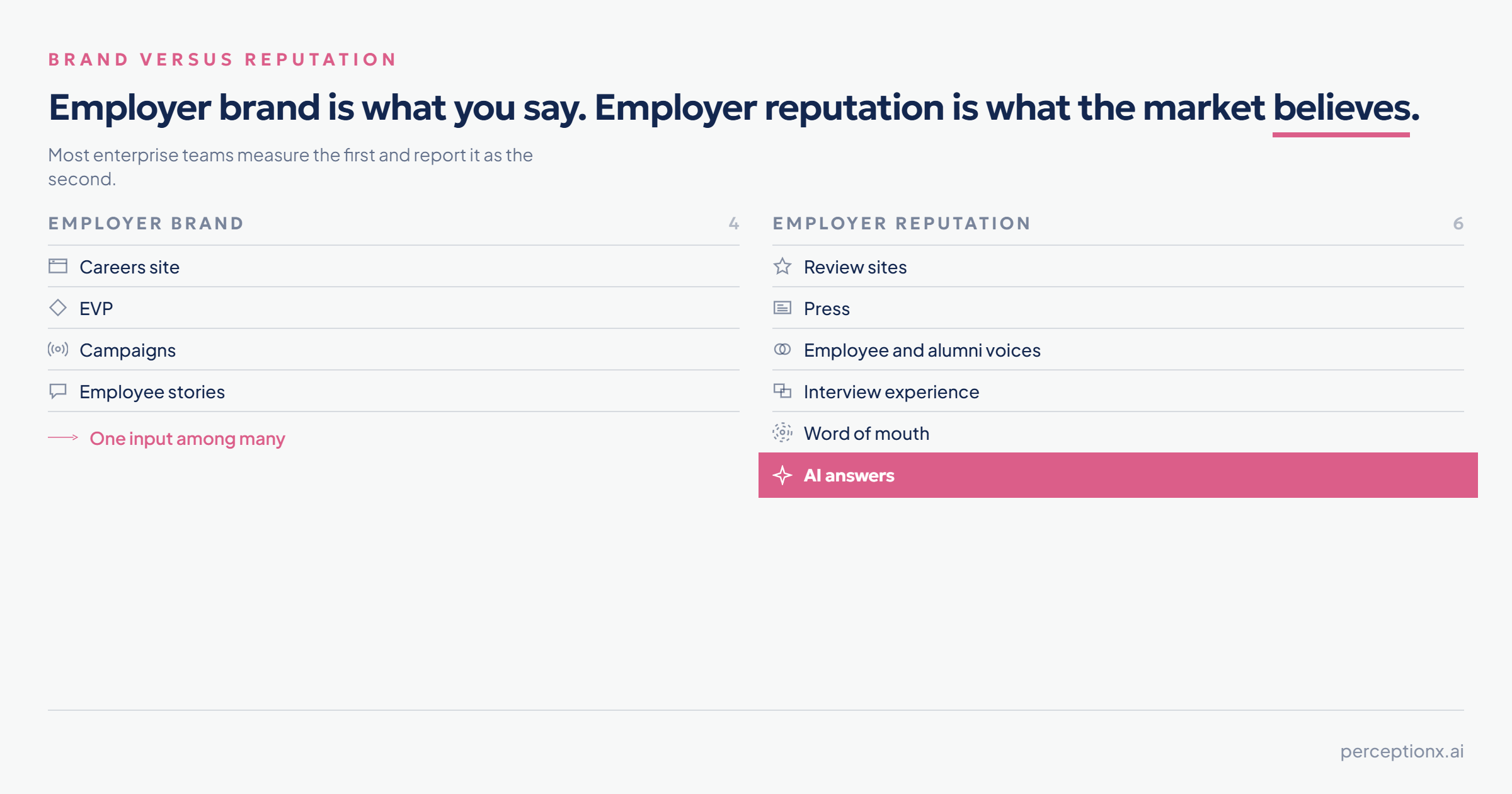
Employer brand and employer reputation are not the same thing
An employer brand is the position an organisation chooses and communicates: the employee value proposition, the careers site, the campaigns, the stories it selects and the language it uses. It is owned, it is intentional and it is measurable in terms of output and reach.
Employer reputation is what candidates, employees, alumni and the wider market actually believe. It is formed from the brand, but also from review sites, press coverage, employee posts, word of mouth, recruiter behaviour, interview experience and, increasingly, the summaries generated by AI assistants when someone asks "what is it like to work at this company".
The two can diverge badly. An organisation can run a well-funded brand programme with a reputation that has stalled in its second-largest market because of a single well-publicised event three years ago. It can have a strong reputation with engineers and a poor one with sales. It can be described positively by one AI assistant and vaguely by another. Brand metrics will not show any of this, because brand metrics measure what the company put out, not what the market absorbed.
Most employer brand measurement in large organisations is still measurement of brand: impressions, followers, careers page traffic, campaign engagement, cost per application. These are useful. They are not reputation.
Where employer reputation now forms
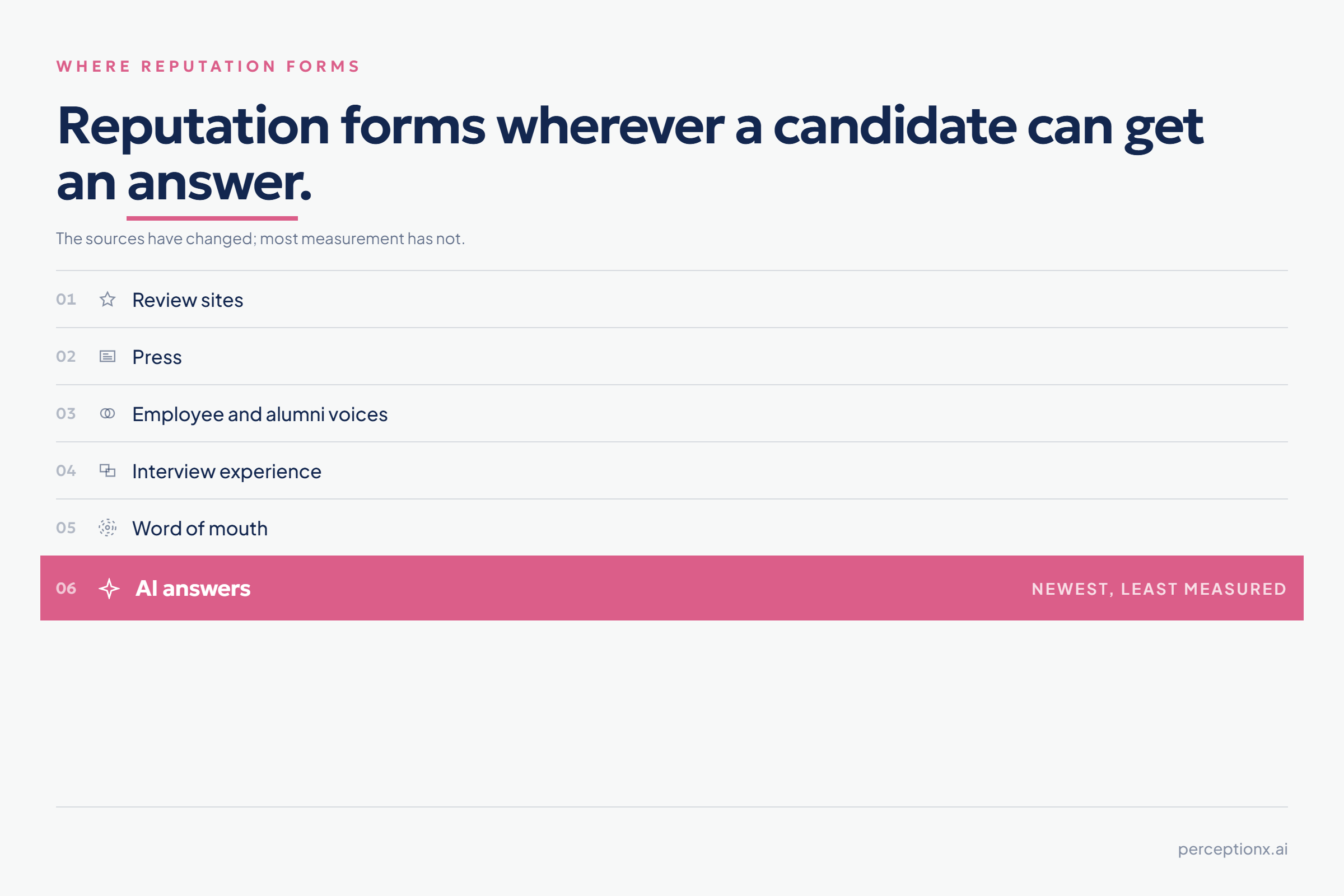
For a decade the dominant third-party surface was the review site. Glassdoor and Indeed ratings became a proxy for reputation, and "improve our Glassdoor score" became a standing objective in many employer brand plans.
That model is incomplete. Reputation forms wherever a candidate can get an answer to the question "should I work there", and the list of places that answer the question has changed.
In May 2026 PerceptionX surveyed 306 active job seekers who already use AI tools. Of that group, 96% had used AI to research an employer, learn about a role or prepare for an interview in the previous twelve months, and 74% did so always or often. 82% said AI had changed their mind about pursuing a role at a company. Trust was calibrated rather than blind: only 5% took AI answers at face value, and 58% had caught an AI tool giving inaccurate information about an employer. The most common use was interview preparation (70%), followed by validating an employer before applying (54%).
The figures describe AI-using job seekers, not all candidates. Even so, they point at a surface most employer brand teams do not monitor and do not control. An AI assistant does not repeat the careers site. It synthesises whatever sources it has learned to trust about employers, weights them in ways the employer cannot see, and delivers a confident summary. The summary is the reputation, as far as that candidate is concerned.
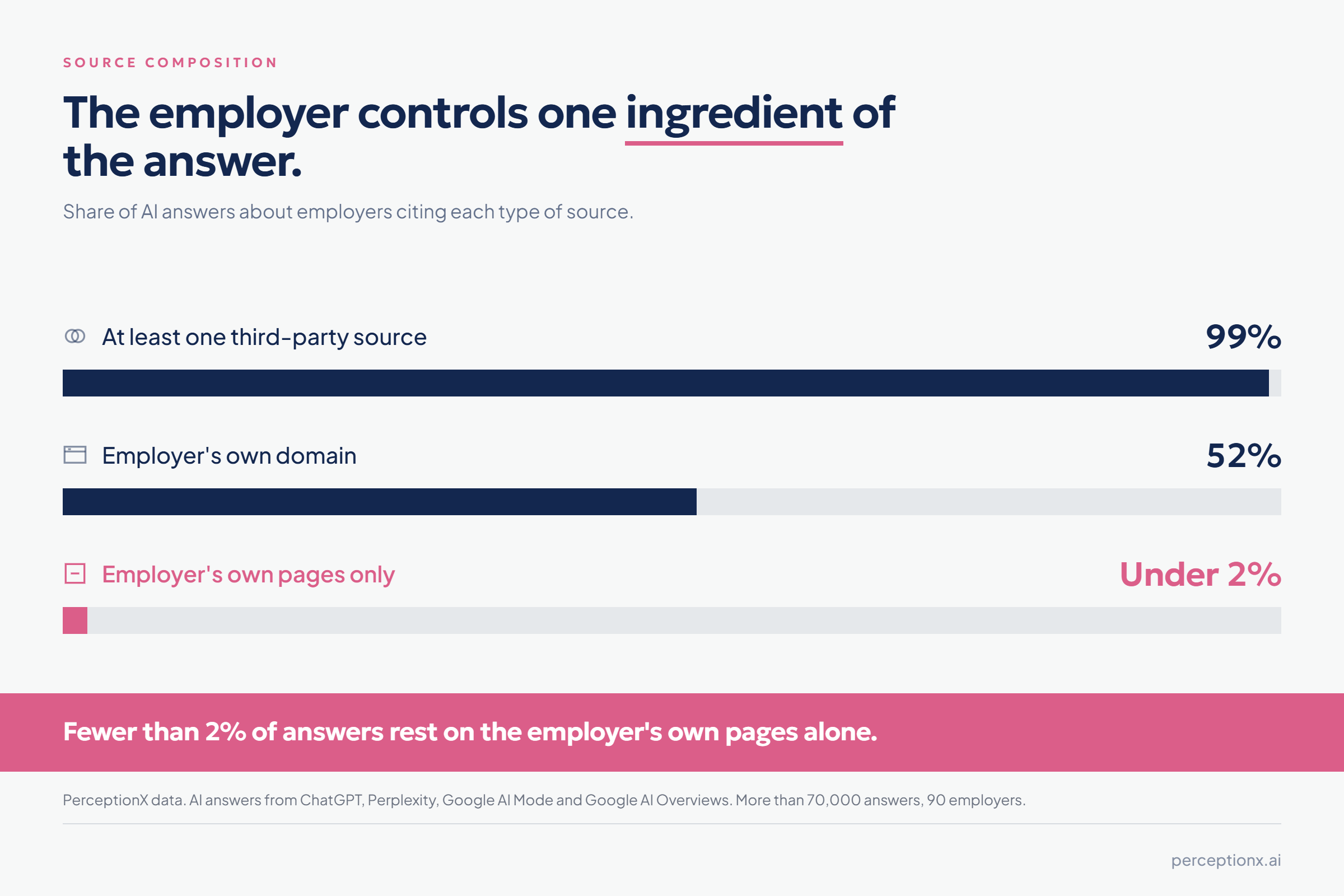
PerceptionX's own data makes the point more sharply. Across more than 70,000 AI answers about 90 employers, collected from ChatGPT, Perplexity, Google AI Mode and Google AI Overviews, 99% drew on at least one third-party source. Fewer than 2% relied on the employer's own pages alone. The employer's own domain appeared in about half of answers, which sounds reassuring until you notice that it almost never appeared by itself. Whatever the careers site says, the answer the candidate reads is a blend, and the employer controls one ingredient.
Why a global employer has many reputations
The instinct is to treat employer reputation as a single number. It is not one thing, for three reasons.
It varies by market. The sources that shape perception differ by country. Review-site coverage, press interest, local competitor sets and the language of the answer all change at the border. An employer's sentiment in one country can sit well above its sentiment in another, driven by different events and different sources. Regional averages hide this, which is why every market should be read on its own.
One consumer goods employer in the PerceptionX dataset, measured between July and September 2026, held 83% sentiment in Brazil, 71% in India and 58% in the United States. Same company, same quarter, a 25-point spread. A global average would have reported something in the low seventies and told the team nothing.
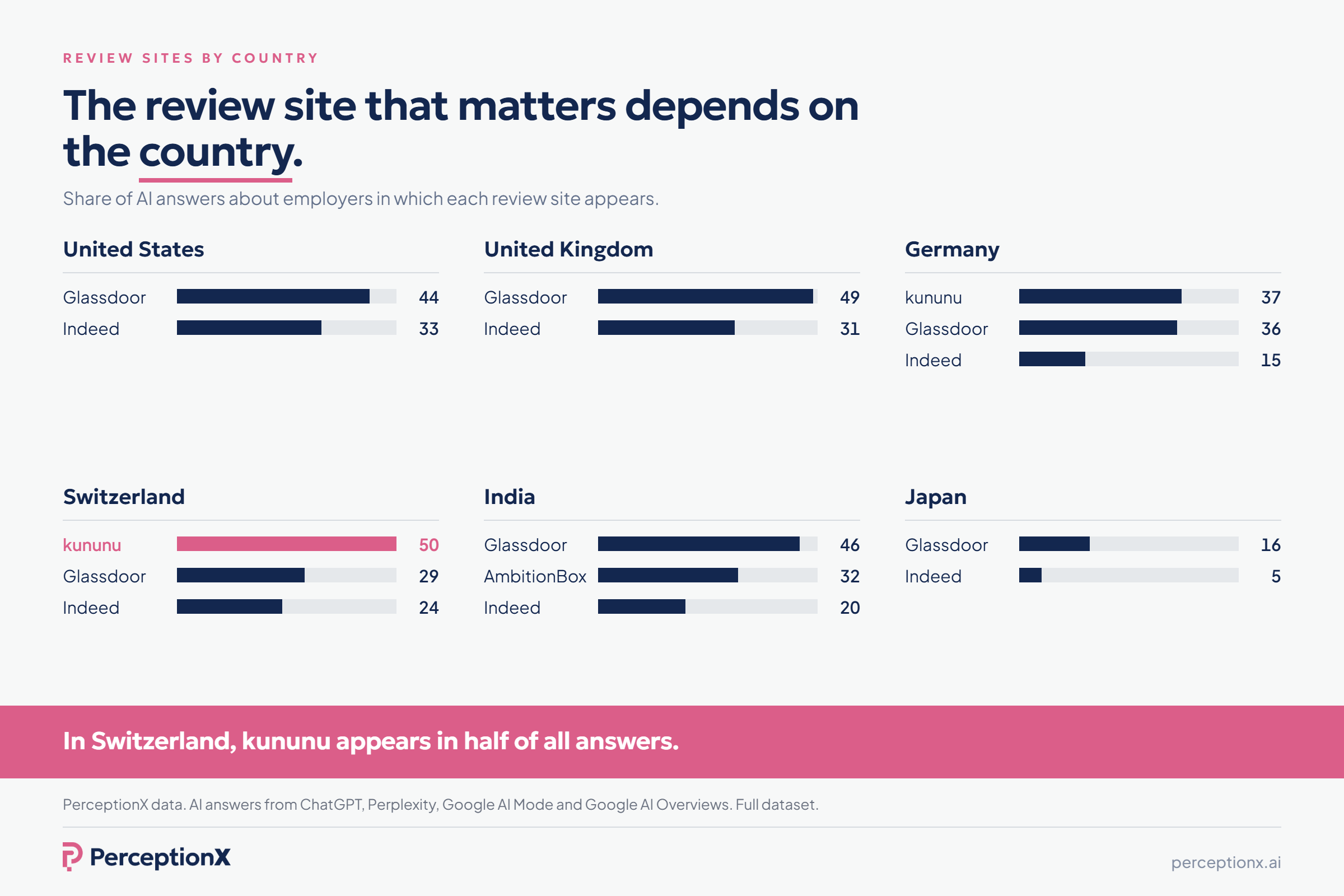
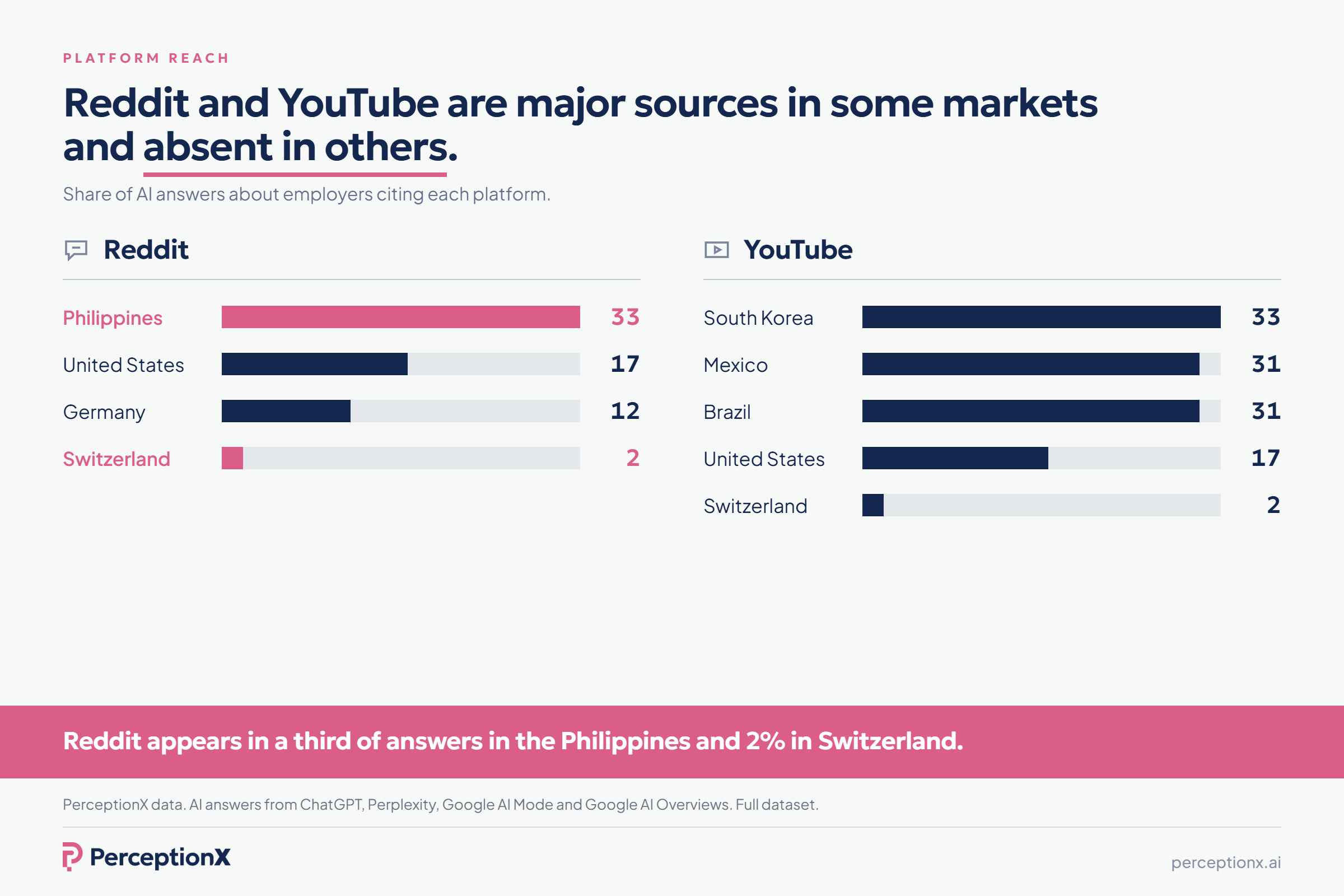
The sources behind the answers differ just as much. Glassdoor appears in 44% of AI answers about employers in the United States and 49% in the United Kingdom, but only 16% in Japan and 23% in South Korea. In Germany, kununu appears in 37% of answers, slightly ahead of Glassdoor; in Switzerland it is 50%. In India, AmbitionBox appears in 32%. Reddit is in a third of answers in the Philippines and in 2% in Switzerland. YouTube appears in roughly three in ten answers in Brazil, Mexico and South Korea. A team that manages its review-site presence as if the world were the United States is managing the wrong sources in half its markets.
It varies by function. A candidate asking about a company as an engineering employer gets a different answer from one asking about it as a sales employer, because the underlying sources differ. Compensation, career progression, leadership quality and culture all carry different weight by function. One employer can hold several reputations at once.
It varies by surface. ChatGPT, Perplexity, Google AI Mode and Google AI Overviews do not draw on identical sources and do not summarise the same way. Between July and September 2026, when candidates asked discovery questions (which companies are good employers for this role in this market), the employers PerceptionX tracks were mentioned in 24% of Google AI Mode answers, 18% of Google AI Overviews, 14% of ChatGPT answers and 13% of Perplexity answers. The same employer can be present on one surface and absent on another.
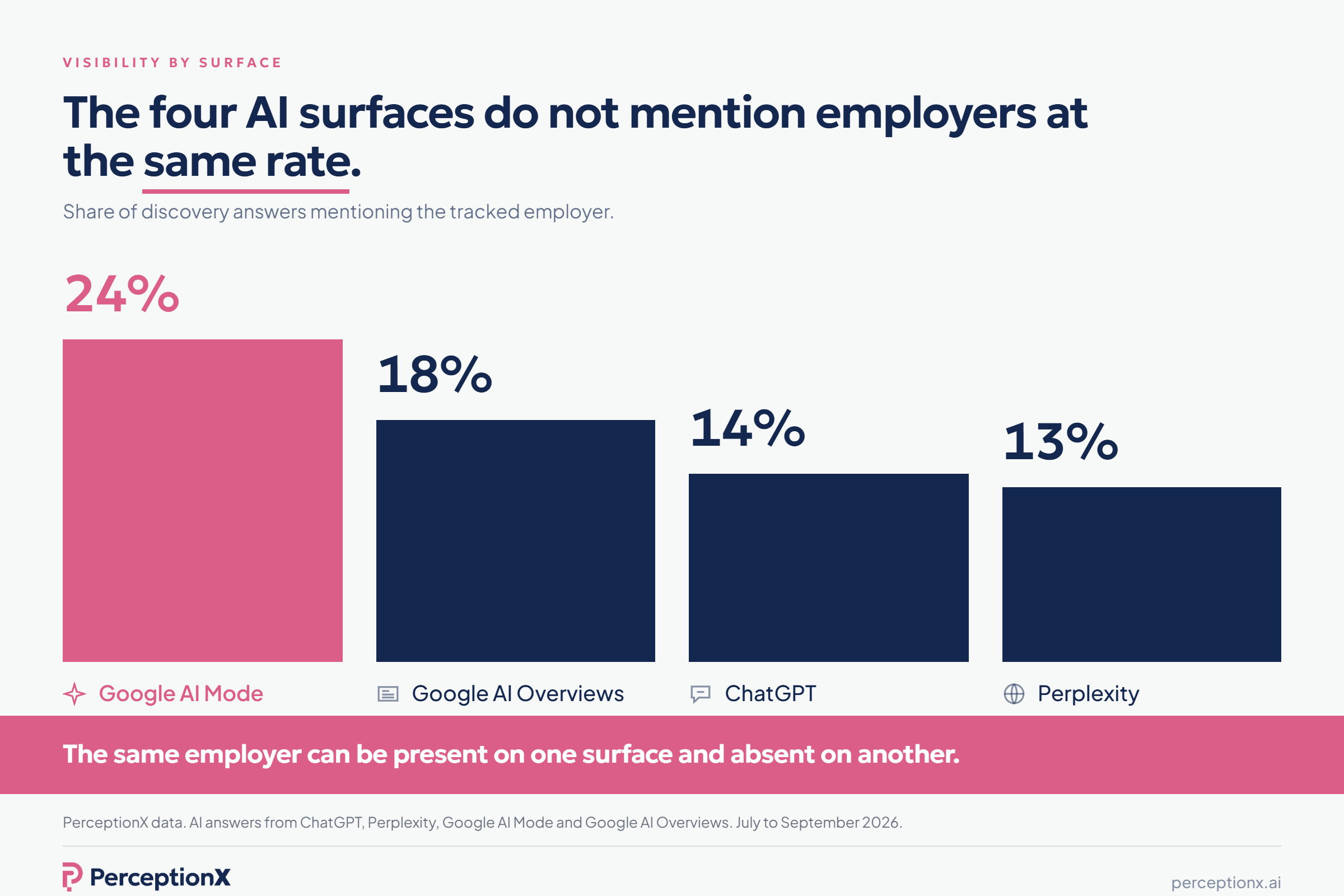
An employer reputation programme that does not read by market, function and surface is reading an average that nobody experiences.
What employer reputation is made of
PerceptionX measures employer reputation through three signals.
Visibility is whether the employer appears at all when candidates ask the questions they actually ask: who hires for this role in this market, which companies are good to work for in this field, what is it like to work at this company. An employer that is not mentioned has no reputation on that surface, good or bad.
Sentiment is the share of themes in those answers that are positive. It is expressed as a percentage, positive themes over total themes, and it is read per market and per function rather than as a global figure.
Relevance is how current the sources behind the answers are. AI assistants cite what they can find, and an employer whose answers are built on three-year-old articles and stale review pages is being described by a version of itself that no longer exists. Relevance measures the freshness of that evidence.
Each signal is then examined by market, by job function, by reputation attribute (thirteen of them, from culture and compensation to leadership, job security and interview experience), by AI surface, by source and against a named set of talent competitors. That last cut is the one leadership tends to ask for first: not "how are we doing" but "how are we doing against the companies we lose offers to".
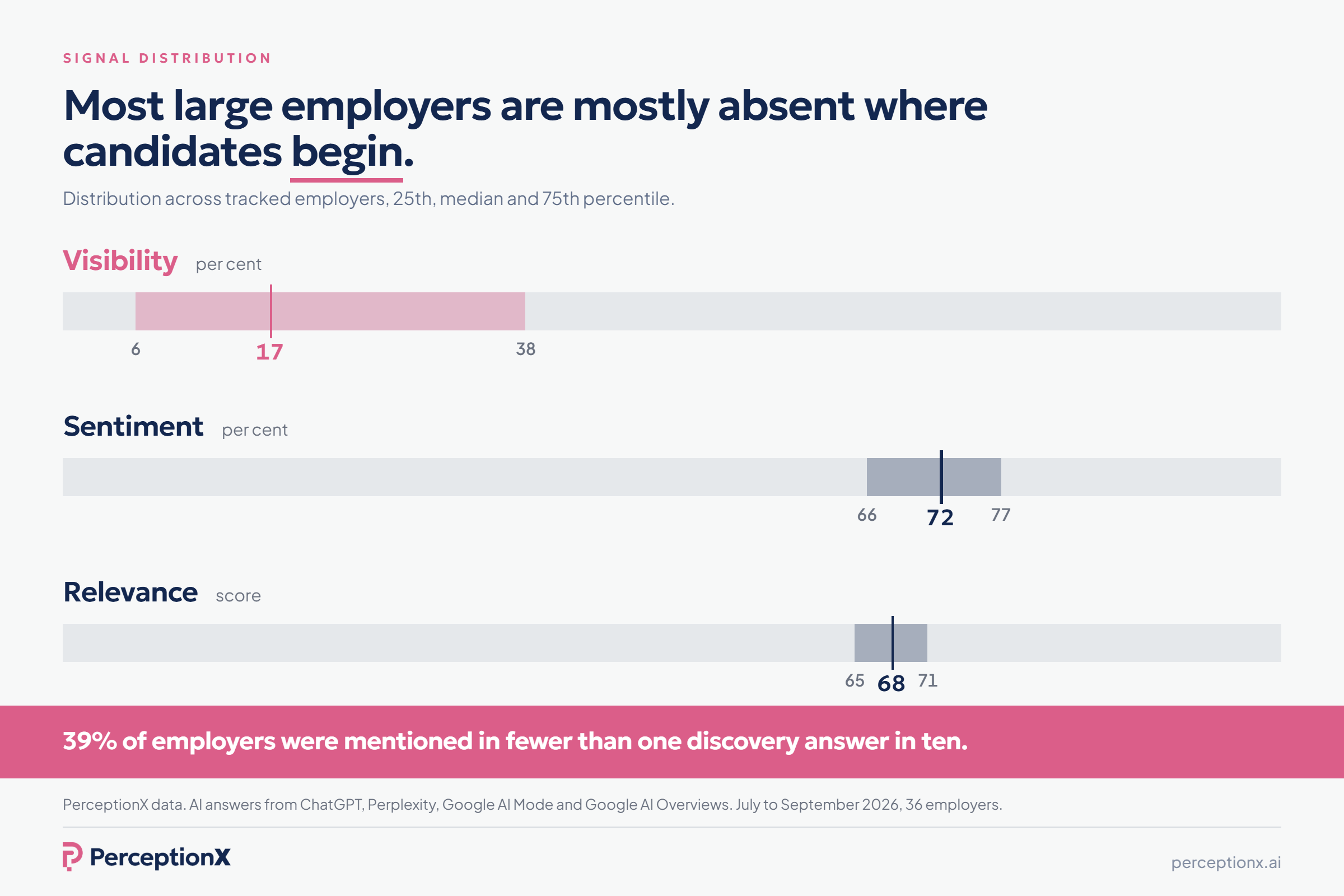
The Visibility figures are the ones that tend to surprise. Between July and September 2026, the median employer tracked by PerceptionX was mentioned in 17% of the discovery answers where it could have appeared. Roughly four in ten were mentioned in fewer than one answer in ten. These are large, well-known employers with established brand programmes. On the surface where candidates now begin, most of them are mostly absent.
What employer reputation management actually means
The phrase "employer reputation management" borrows from online reputation management, which is mostly about suppressing bad reviews. That is not what large employers need, and it does not work on AI surfaces, which do not respond to review-gating.
Managing employer reputation at enterprise scale means four things.
First, measuring it independently of owned channels, so that the reading is not a reading of the brand's own output.
Second, reading it at the level at which decisions are made: the country, the function, the attribute, the competitor. A global score is a board slide, not a plan.
Third, identifying which sources are driving each reading. If sentiment in one market is being pulled down by a specific class of source, the intervention is different from the one needed when the problem is that the employer is simply absent.
Fourth, intervening and re-measuring. Reputation moves slowly and unevenly, and the only way to know whether an intervention worked is to measure the same signals, in the same market, on the same surfaces, a quarter later. Measurement that is not repeated is an audit. Measurement that is repeated is management.
Where to go from here
The measurement framework, including how each signal is defined and how the cuts are constructed, is set out in How to Measure Employer Reputation: A Framework for Global Employers.
If the question is which research method to use, Employer Brand Research: Survey Panels vs Always-On AI Measurement compares the options.
If the question is what a candidate currently sees when they ask an AI assistant about you, What AI Says About You as an Employer explains how to check.

Find out how AI is shaping your employer brand — and what you can do about it.