Employer Brand Research: Survey Panels vs Always-On AI Measurement
Employer brand research has meant one thing for twenty years: a survey. A panel of students, graduates or professionals is asked which employers they know, which they would consider, and which attributes they associate with each. The results arrive annually, by country, as a ranking and a report.
That model produced most of what the industry knows about employer attractiveness, and it still has real uses. But if you are commissioning research for a global employer in 2026, the question is no longer "which survey". It is which combination of methods answers the questions leadership is actually asking, at the granularity and cadence at which decisions get made.
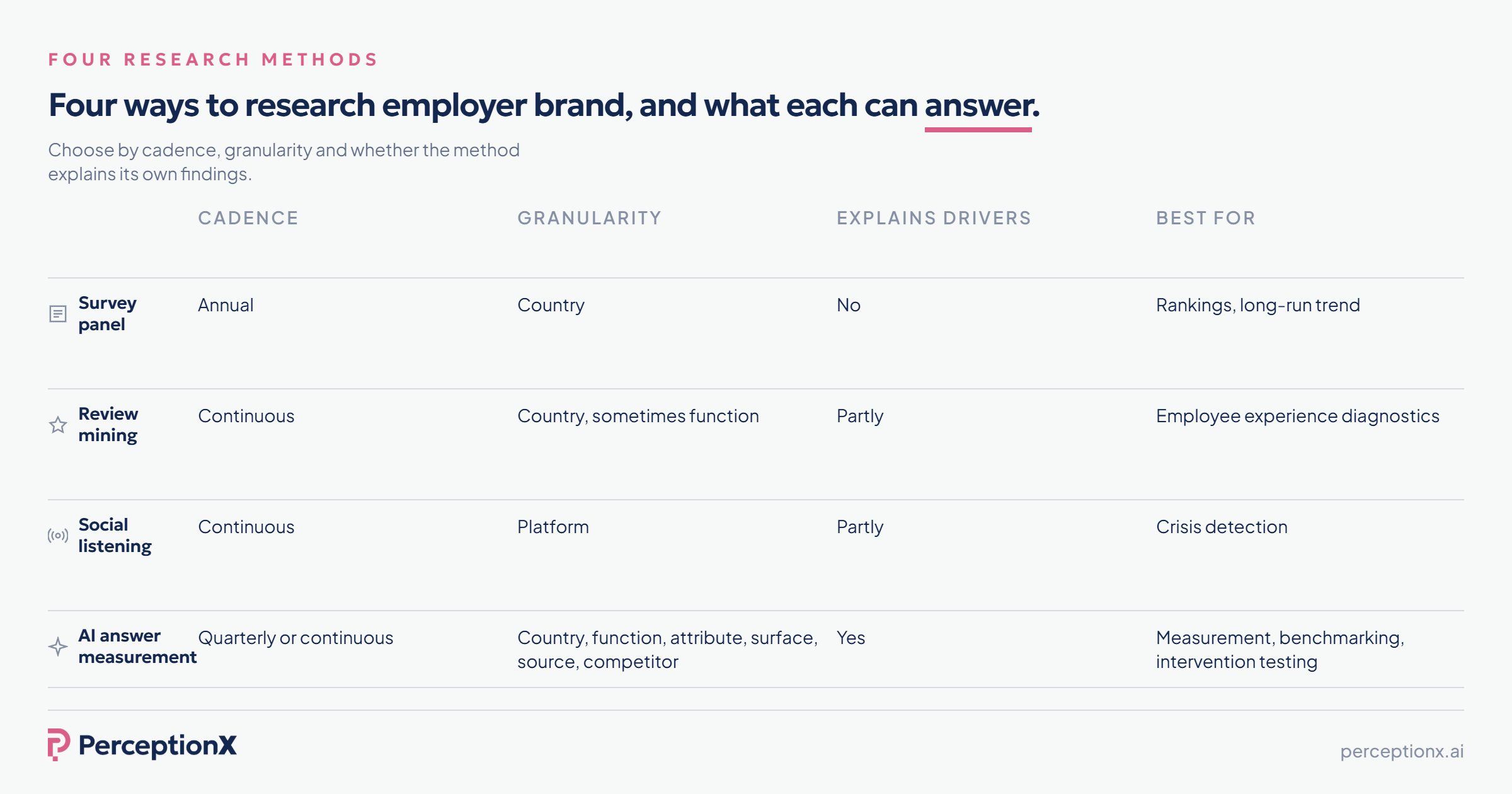
This page compares the four methods available, sets out what each can and cannot tell you, and describes what a PerceptionX measurement report contains.
The questions the research has to answer
Before choosing a method, be precise about the questions. In most enterprise employer brand teams they come down to five:
- Are we visible to the candidates we want, in the markets and functions that matter?
- How are we described, and is that description improving?
- Which attributes are we known for, and do they match the EVP?
- How do we compare with the named competitors we lose offers to, per market?
- What is driving the answers to 1 to 4, so we know what to change?
Most research methods answer one or two of these well. None of the traditional ones answers question 5.
Four methods compared
Survey panels. A sample of the target population is asked structured questions about awareness, consideration and attribute association. Strengths: direct measurement of stated perception, established methodology, comparability year on year, and rankings that leadership recognises. Limitations: annual cadence, national granularity (rarely by function, never by surface), sample composition that skews toward students and early-career professionals, cost that scales with every additional market, and a lag of months between fieldwork and report. A panel survey tells you what a sample said last year. It cannot tell you what changed this quarter or why.
Review-site mining. Ratings and review text from Glassdoor, Indeed, Kununu and equivalents are aggregated and analysed. Strengths: continuous, cheap, textured, and it captures current and former employees rather than outsiders. Limitations: it measures one source, with coverage that varies sharply by country and function; the population is self-selected; it says nothing about visibility or about how candidates who have never worked there perceive the employer. Review mining is a source-level diagnostic, not a reputation measure.
Social listening. Mentions of the employer across social platforms and press are collected and scored. Strengths: continuous, catches events and crises early, useful for corporate communications. Limitations: employer-related mentions are a small fraction of all brand mentions and are hard to isolate; sentiment scoring on short posts is noisy; coverage is dominated by a few platforms; and it measures what was said about the employer, not what a candidate would conclude.
AI answer measurement. The questions candidates actually ask are put to the AI surfaces they use (ChatGPT, Perplexity, Google AI Mode, Google AI Overviews), in each market, for each function, and the answers are measured for Visibility (is the employer mentioned), Sentiment (positive share of what is said) and Relevance (how current the cited sources are), with the sources behind each answer identified and every theme classified against thirteen reputation attributes. Strengths: it measures the synthesised reputation a candidate would encounter, continuously, at market and function granularity, with a source layer that explains the reading. Limitations: it measures what AI surfaces say, which is a synthesis of sources rather than a direct reading of individual candidates' minds; it depends on the prompt design being faithful to real candidate behaviour; and it is new, so year-on-year comparability is shorter than a twenty-year survey series.
Why cadence matters more than it used to
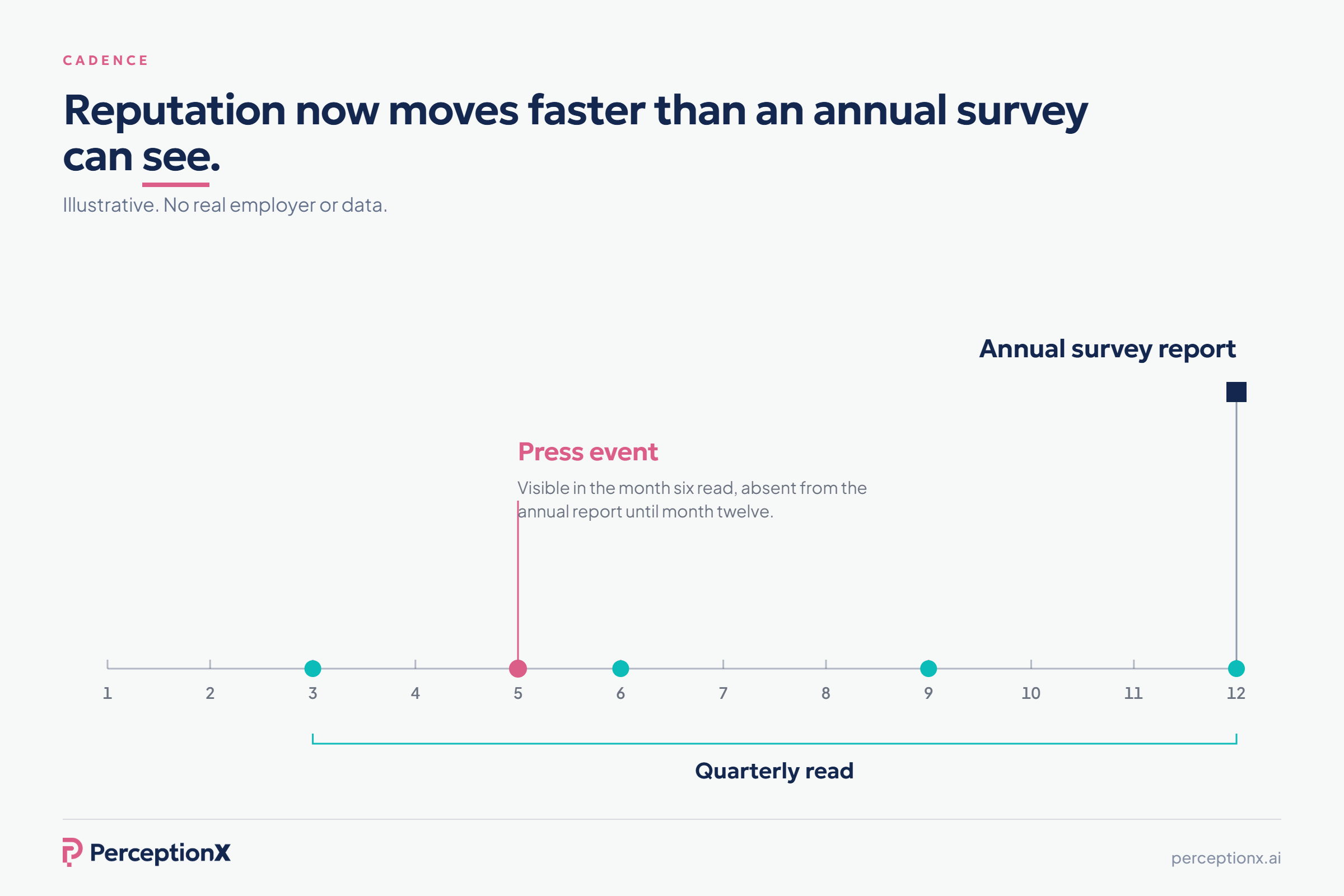
The strongest argument for the annual survey was that reputation moved slowly. That is no longer reliably true. A press event, a layoff, a leadership change or a viral employee post can move how an employer is described within weeks, and AI surfaces absorb those sources quickly.
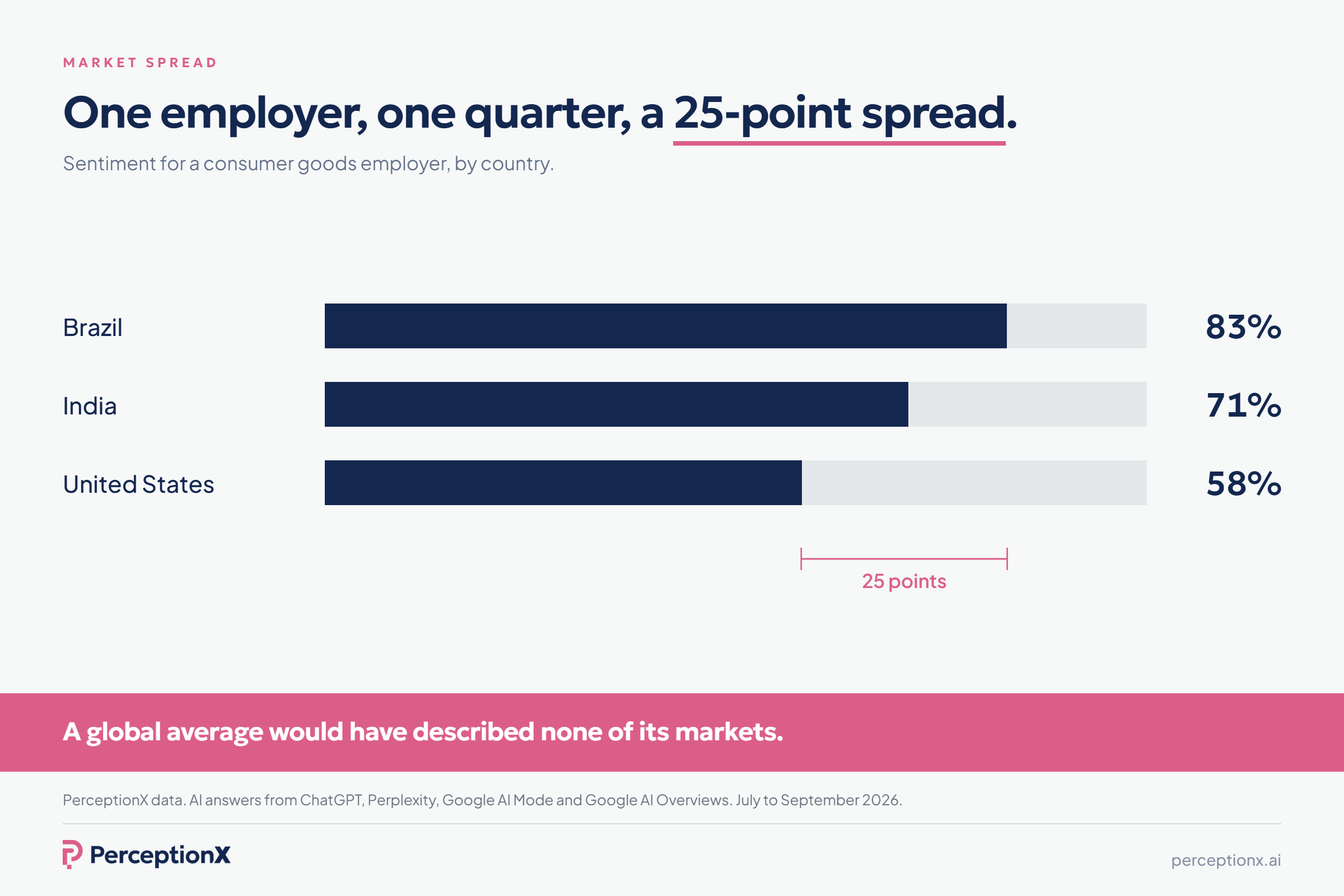
The market dimension makes the same point. One consumer goods employer in the PerceptionX dataset, measured between July and September 2026, held 83% sentiment in Brazil, 71% in India and 58% in the United States. A national panel survey in one of those countries would have been accurate for that country and silent about the other two. An annual global report would have averaged them into a figure that described none of them.
In PerceptionX's May 2026 survey of 306 job seekers who use AI tools, 72% used AI for employer research before applying and 82% said AI had changed their mind about pursuing a role. Research that reads the surface those decisions are made on, at the speed they are made, is a different product from research that reads a panel once a year.
What a PerceptionX measurement report contains
A PerceptionX measurement report covers the employer's reputation on the four AI surfaces, in each market and function agreed, against a named competitor set per market. The output is a report structured around the three signals and the six cuts:
- Visibility, Sentiment and Relevance per market, never grouped into regions
- The reputation attributes the employer is associated with, and how each is described, per market and function, set against the EVP
- The competitor gap per market, on each signal
- The sources appearing in answers about the employer, as the share of answers in which each appeared, per market
- Platform differences, where one surface diverges from the others
- The three to five interventions the data supports, by market
The report is delivered with a quarterly re-measurement so that interventions can be tested. All figures are expressed as percentages or growth multiples. Raw answer volumes are not reported.
When to combine methods
The methods are not exclusive. A sensible enterprise research design in 2026 often looks like this:
- A panel survey every one to two years in the three or four largest markets, for rankings and long-run trend.
- Review-site data monitored continuously as one source among several.
- AI answer measurement quarterly across all markets and priority functions, as the primary reputation measure and the diagnostic layer.
- Social listening owned by corporate communications, with employer-related alerts shared.
The panel survey is the long, slow baseline. The AI measurement is the instrument you steer by.
Where to go from here
If the need is a one-time reading rather than a programme, The Employer Brand Audit describes the structure. The measurement framework itself is set out in How to Measure Employer Reputation.

Find out how AI is shaping your employer brand — and what you can do about it.