The Employer Brand Audit: What Global Talent Leaders Should Check Across Markets, Functions and AI Surfaces

Most employer brand audit templates are inventories of owned channels. Is the careers site current? Are job descriptions consistent? Do social profiles match the EVP? Are review-site responses up to date? Useful housekeeping, and largely irrelevant to the question an audit is supposed to answer, which is how the organisation is actually perceived as an employer and where the gaps are.
An audit that only inspects what the organisation controls is an audit of the brand. This page sets out an audit of the reputation, structured in three layers, designed for an employer that hires across multiple countries and needs the result to hold up in front of leadership.
Why audit at all
An audit is a single reading. It does not replace ongoing measurement, and it cannot show change. It does three things well.
It establishes a baseline before a major investment: an EVP refresh, a careers site rebuild, a new market entry, an agency appointment. Without a baseline, the investment cannot be evaluated afterwards.
It surfaces gaps the team cannot see from inside owned channels: a market where the employer is invisible, a function where sentiment is poor, an attribute the EVP claims that the market does not associate with the employer.
It gives regional teams a common instrument. A global lead with eight regional teams typically has eight narratives. One audit, one structure, one set of signals, gives them something to compare.
Layer one: what you say
This is the layer most templates cover, so it is dealt with briefly.
Check that the EVP is stated consistently across the careers site, job descriptions, recruiter messaging and social channels, in every market and language. Note where regional teams have adapted it and whether the adaptation was deliberate. Record which attributes the EVP claims. PerceptionX classifies every theme in an AI answer against thirteen: company culture, career opportunities, mission and purpose, compensation, wellbeing and balance, interview experience, innovation, job security, inclusion, leadership, application communication, onboarding and candidate feedback. Most EVPs claim four or five of them. That list becomes the test in layer three.
Output of this layer: the set of attributes the organisation intends to be known for, per market.
Layer two: what third parties say
This is where most audits stop being useful, because they treat one review site as the whole of the external world.
For each market, identify the sources that actually shape employer perception: review sites, national and trade press, professional communities, employee and alumni voices, industry rankings. Coverage varies by country. A review site that dominates in one market may be marginal in another, and the press environment differs everywhere.
For each source, record what it says about the employer and, where possible, which attributes it emphasises. Do this per function where the sources allow it, because the review and community sources for engineers are not the sources for sales or for nursing.
PerceptionX's source data shows how far the source map moves between countries. Glassdoor appears in 44% of AI answers about employers in the United States and 55% in the Philippines, but 16% in Japan. In Germany, kununu appears in 37% of answers and Glassdoor in 36%; in Switzerland kununu is in half of all answers. In India, AmbitionBox appears in 32%, alongside Glassdoor at 46% and LinkedIn at 34%. Reddit appears in a third of answers in the Philippines and 2% in Switzerland. YouTube appears in roughly three in ten answers in Brazil, Mexico and South Korea. An audit that checks Glassdoor and Indeed and stops has covered the United States and the United Kingdom reasonably well and most other markets badly.
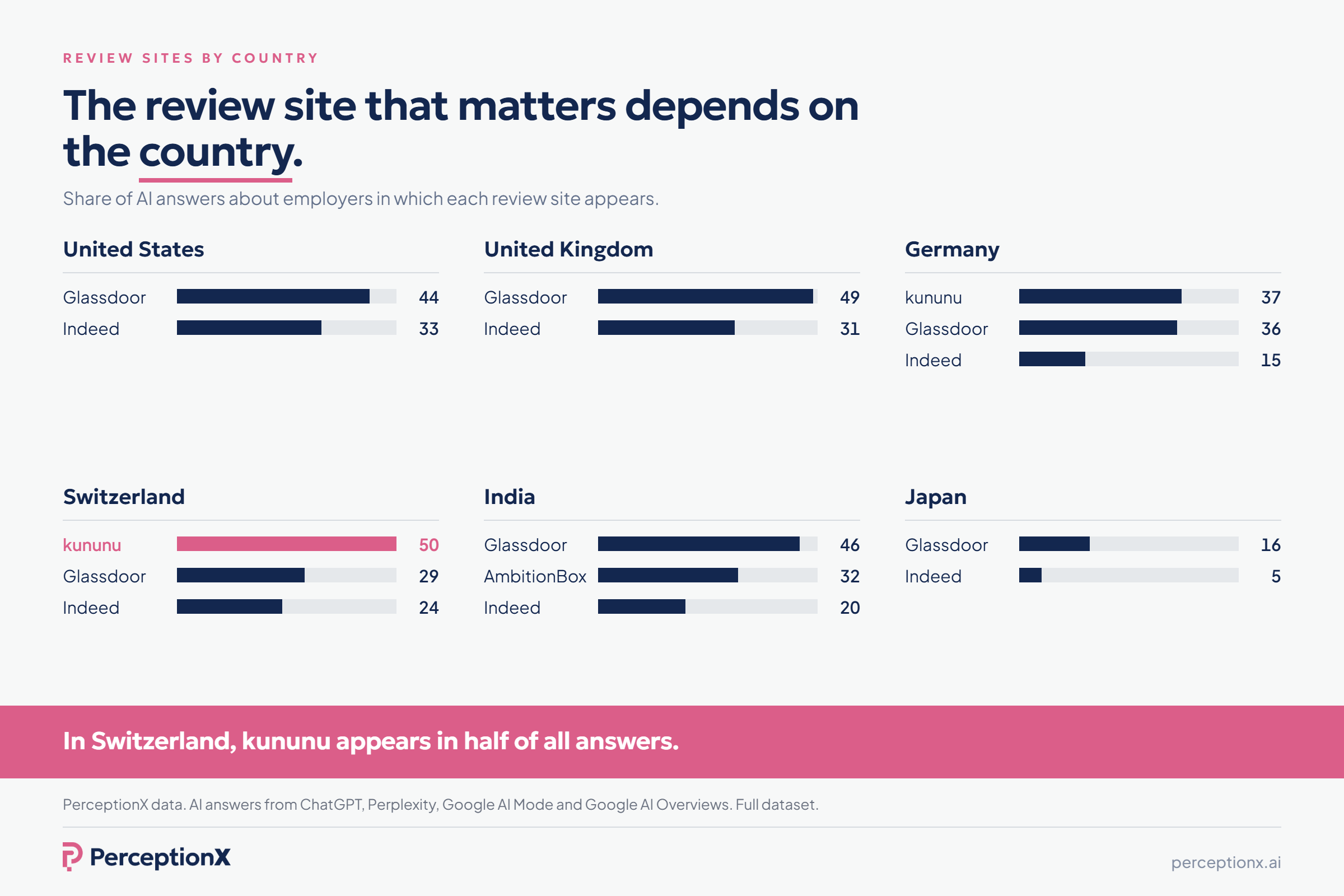
Output of this layer: the sources driving perception in each market, and what they say.
Layer three: what AI says
This is the layer almost no template includes, and the one that most directly reflects what a candidate encounters today.
For each market and priority function, put the questions candidates actually ask to the AI surfaces they use: ChatGPT, Perplexity, Google AI Mode, Google AI Overviews. The questions are not "tell me about Company X". They are the discovery, validation and comparison questions a candidate asks before applying: which companies are good employers for this role in this country, is Company X a good place to work in this function, how does Company X compare with Company Y.
For each answer, record four things.
Visibility. Was the employer mentioned at all? Absence is a finding.
Sentiment. Of the themes raised, what share was positive? Express it as a percentage.
Relevance. How current were the sources the answer drew on? An answer built on old press and stale review pages is describing a former version of the employer.
Attributes. Which of the thirteen attributes did the answer raise, and how was each described? Set that list against the attributes from layer one. Where the EVP claims an attribute the answers never mention, or the answers emphasise an attribute the EVP ignores, there is a gap.
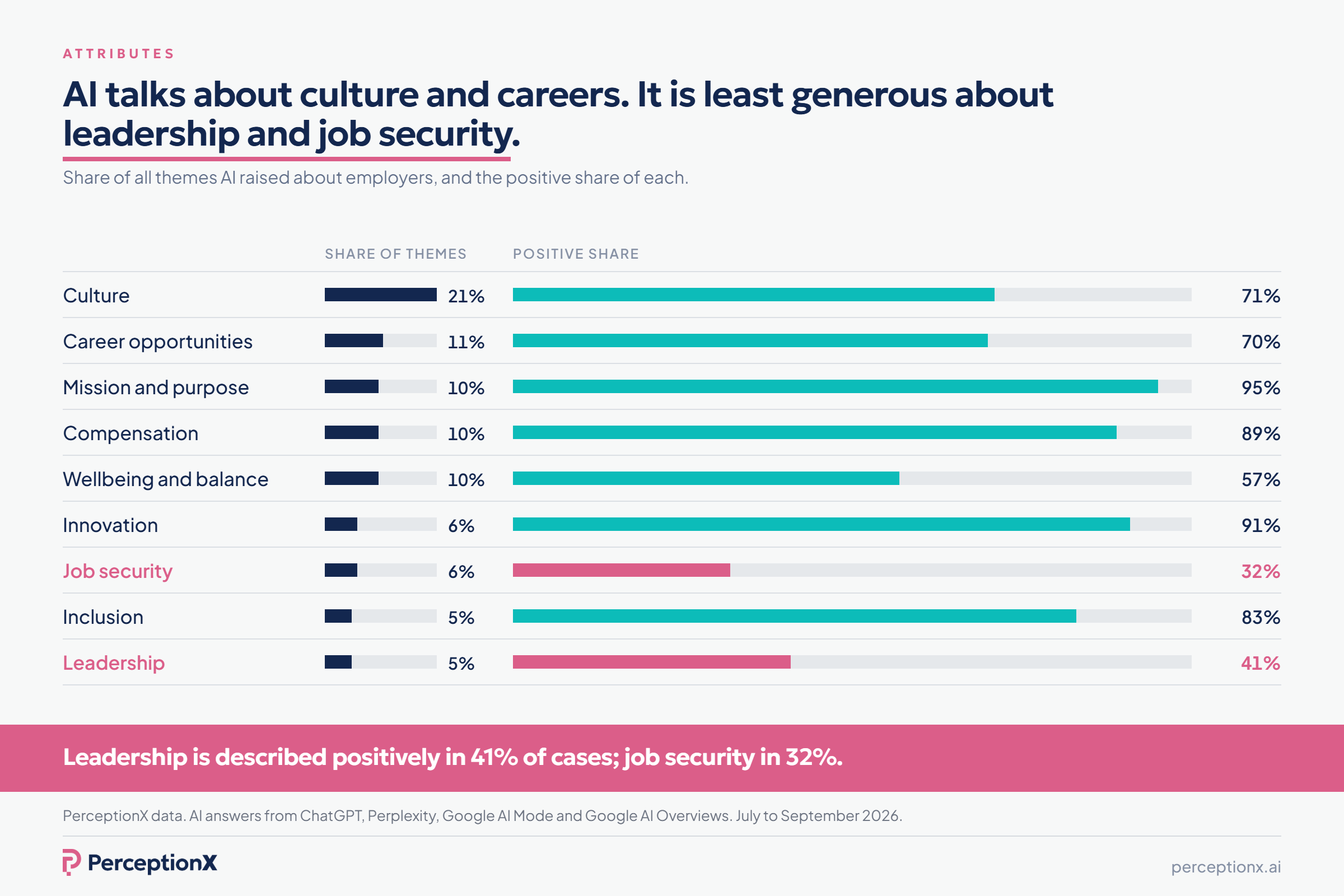
The gap is common because the attributes AI talks about are not the ones EVPs tend to lead with. Across all employers PerceptionX tracked between July and September 2026, culture made up 21% of everything AI said about employers and career opportunities 11%. Compensation, mission and innovation were described positively almost everywhere (89%, 95% and 91% sentiment). Leadership was described positively in only 41% of cases and job security in 32%. An EVP built on "strong leadership" or "a stable career" is claiming exactly the attributes AI answers are least generous about, which is not a reason to drop the claim, but it is a reason to know before the audit what the answers currently say.
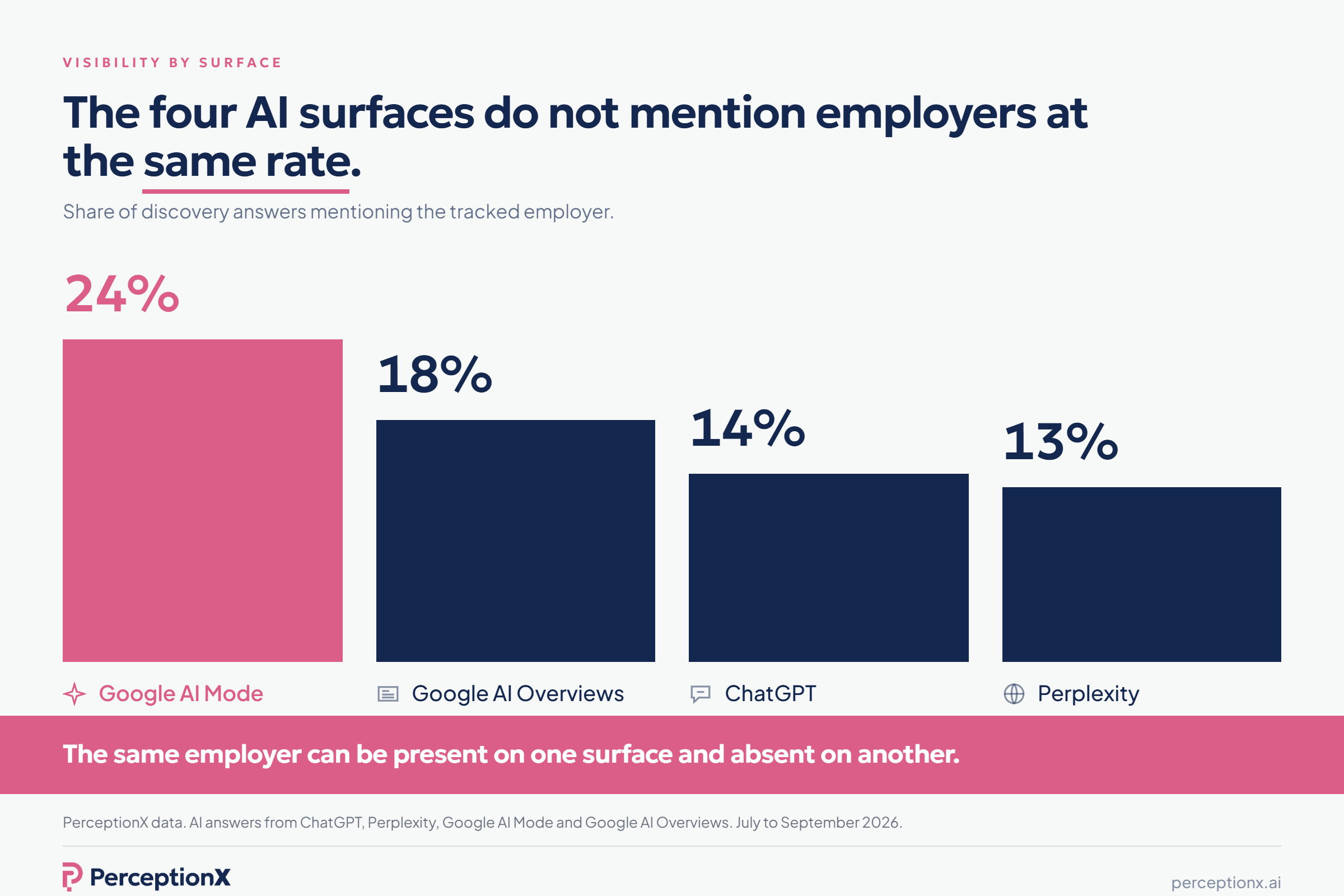
Then record the sources the answers drew on, and compare across surfaces. The four surfaces do not draw on the same sources and do not describe employers the same way. In the same period, tracked employers were mentioned in 24% of Google AI Mode discovery answers, 18% of Google AI Overviews, 14% of ChatGPT and 13% of Perplexity.
Output of this layer: Visibility, Sentiment and Relevance per market, per function, per surface, with the attribute gap against the EVP and the source map.
Layer four: the competitor set
Strictly, this is a cut through layers two and three rather than a layer of its own, but it deserves its own step because it is the one leadership will ask about.
For each market, name the two to four employers the organisation loses offers to. Not the companies it admires; the ones it competes with for the same candidates. Run layers two and three for them as well. The result is a per-market gap on each signal, which is a far more useful audit output than an absolute score.
The checklist
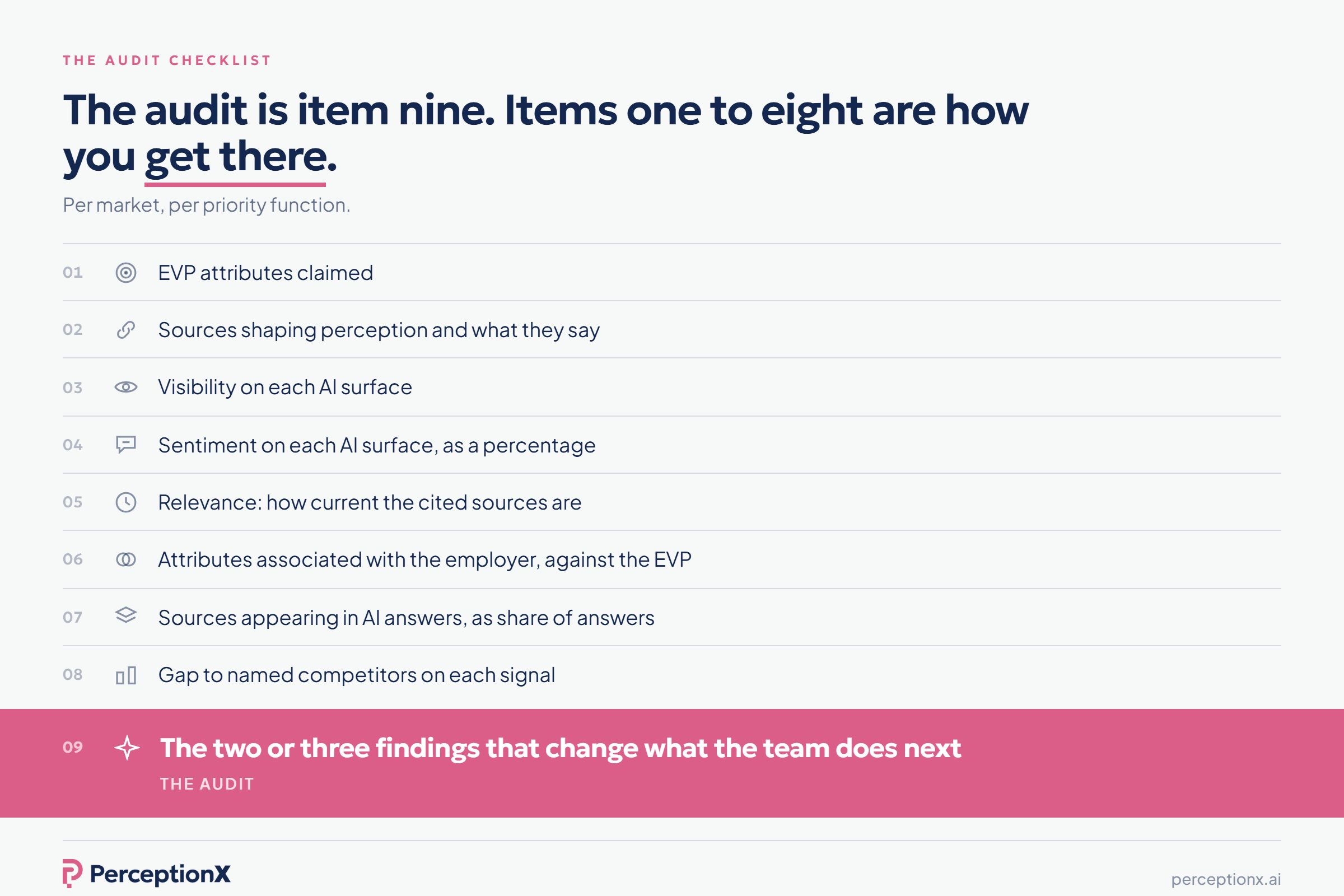
For each market, and for each priority function within it:
1. EVP attributes claimed (layer one)
2. Sources shaping perception, and what they say (layer two)
3. Visibility on each AI surface (layer three)
4. Sentiment on each AI surface, as a percentage (layer three)
5. Relevance: how current the cited sources are (layer three)
6. Attributes associated with the employer, against the EVP (layer three)
7. Sources appearing in AI answers, as share of answers (layer three)
8. Gap to named competitors on each signal (layer four)
9. The two or three findings that would change what the team does next
Item 9 is the audit. Items 1 to 8 are how you get there.
Doing it manually versus automated
A manual audit of three layers across, say, eight markets, three functions, four surfaces and three competitors per market is a substantial project, and it goes stale the moment it is finished. It is worth doing once if the alternative is nothing.
The automated version runs the same structure on a fixed prompt set, in every market and function, on all four surfaces, against the named competitor set, and repeats it quarterly. That is what turns an audit into measurement.
Where to go from here
The measurement framework the audit is built on is set out in How to Measure Employer Reputation. If the question is which research method fits, Employer Brand Research: Survey Panels vs Always-On AI Measurement compares them.

Find out how AI is shaping your employer brand — and what you can do about it.