Employer Reputation Score: Types and How to Build One

An employer reputation score is a single number that summarises how an organisation is perceived as a place to work, so it can be tracked over time and compared with other employers. Scores are built from different inputs depending on the method: employee reviews, survey results, employee net promoter scores or, increasingly, what AI assistants tell candidates about the employer.
This guide explains the main types of employer reputation score, what each one captures and misses, how to build a useful score and how the PerceptionX Employer Reputation Index works.
For the bigger picture, see our guide to employer reputation.
Employer reputation score vs the QS employer reputation indicator
Search for "employer reputation score" and you will also find university rankings.
The QS World University Rankings include an employer reputation indicator, built from the QS Global Employer Survey, in which employers nominate the institutions whose graduates they prefer to recruit.
Nominations are weighted over several years for stability, and the indicator is one of the measures behind the overall rankings and QS subject rankings, reflecting graduate employability.
Students use it when choosing where to study, because employer perceptions of a university influence future employment opportunities.
That is a score for universities, as rated by employers. This guide is about the opposite direction: a score for employers, as perceived by employees, candidates and the market. The two share a name but answer different questions.
The QS methodology is a useful reminder of what makes any reputation score credible: a clear methodology, a large base of responses, weighting that gives confidence in the result, and separate readings by region, subject and sector.
Prospective students use it to judge graduate outcomes and plan career ambitions in fields such as computer science or medicine; employers use their own reputation scores in a similar way, to judge how they are seen across sectors, regions and seniority levels.
Why use an employer reputation score?
- Track change. A consistent score shows whether reputation is improving quarter by quarter.
- Compare. It benchmarks you against the employers you compete with for talent.
- Report. Leadership wants one number, with the detail behind it available on request.
- Prioritise. Breaking the score down shows which market, role or theme needs attention first.
Types of employer reputation score
| Score type | What it captures | What it misses |
|---|---|---|
| Review site rating | Average star rating from employee reviews | Why people rate you that way; markets with other review sites; candidates |
| Employee NPS (eNPS) | How likely employees are to recommend you | How outsiders and candidates see you |
| Survey-based index | Stated perception of a target audience, by attribute | What candidates actually read; changes between surveys |
| AI-based index | What AI assistants tell candidates, how often they recommend you and which sources they use | Internal experience detail, which surveys provide |
No single score captures everything. The useful question is which one reflects what candidates actually encounter when they decide whether to apply, and that is increasingly the AI answer.
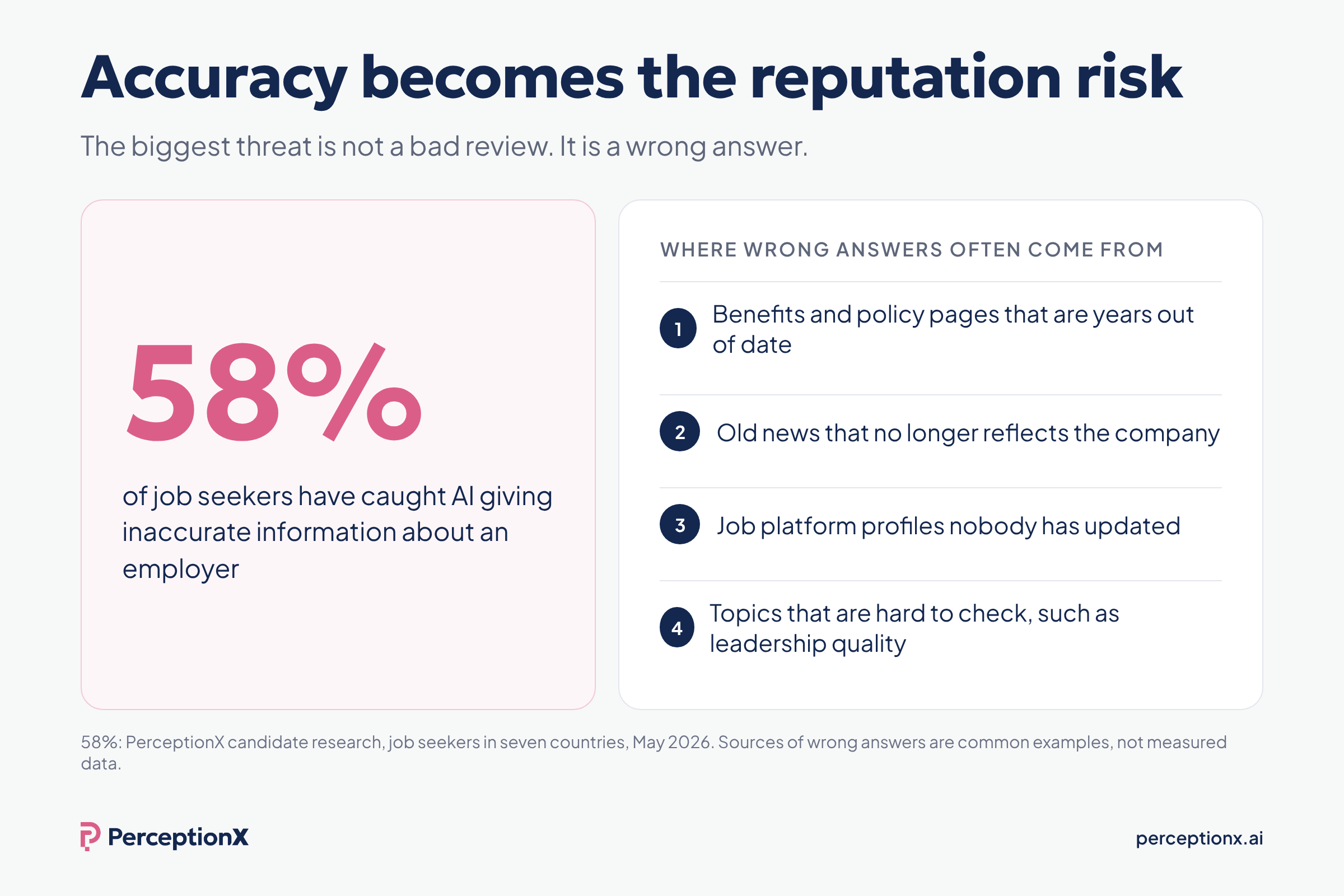
In PerceptionX research across seven countries, 72% of AI-using job seekers used AI before deciding whether to apply, and 82% said an AI answer had changed their mind about a company.
The signals behind a score
Whatever method you use, an employer reputation score is only as good as its inputs. The most common signals are:
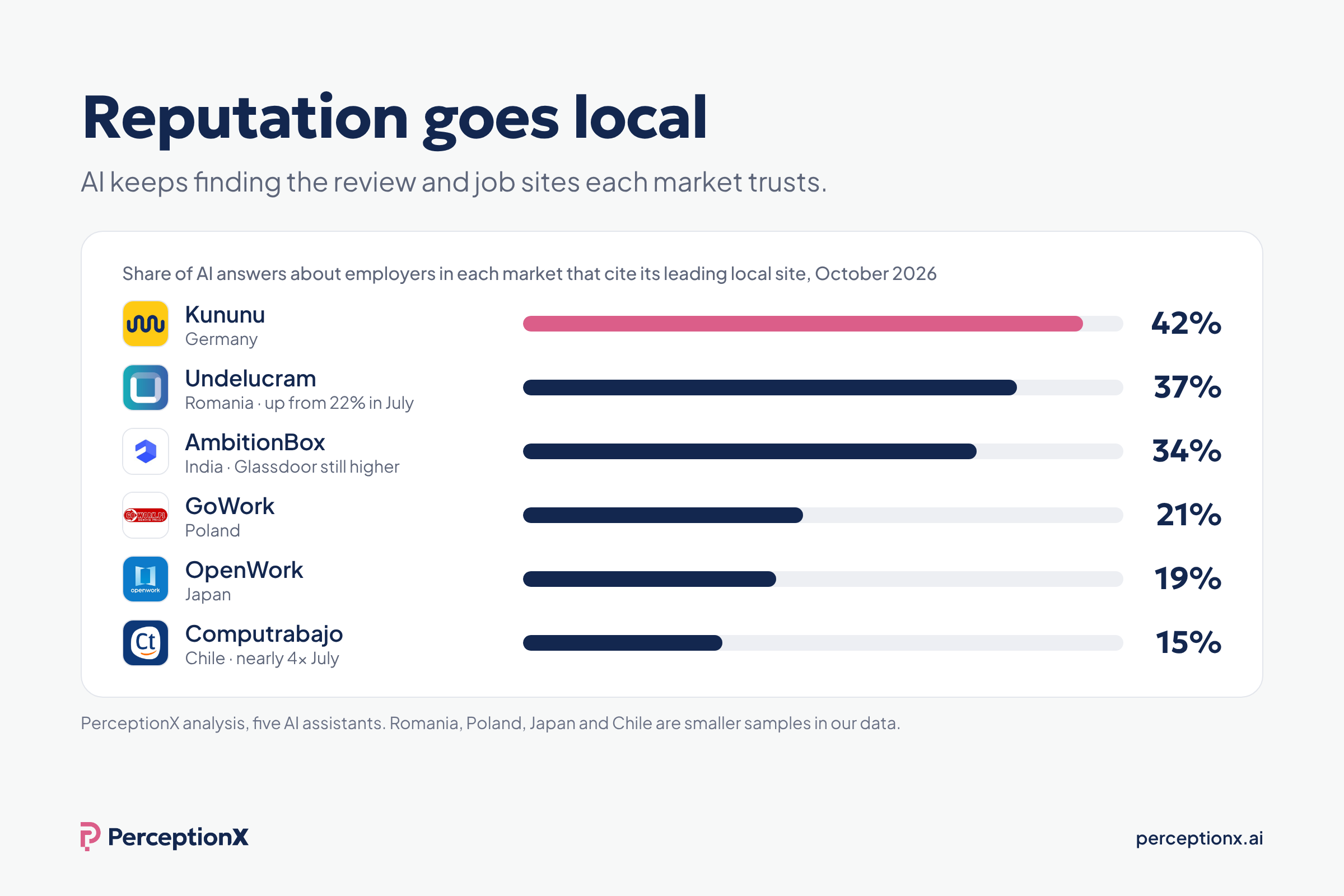
- Employee reviews and ratings on platforms like Glassdoor, Indeed and local review sites, including volume and recurring themes.
- Employee net promoter score (eNPS), which measures internal pride and whether employees would recommend the company to a friend.
- Survey results from candidates, alumni and the wider talent market, by attribute: pay, career growth, culture, leadership, inclusion, flexibility and job security.
- Hiring outcomes such as applicants per role, offer acceptance and early turnover. High reputation scores tend to go with lower turnover and lower spending on recruitment advertising.
- AI answers: whether AI assistants name the employer, how they describe it and which sources they rely on.
- Media and social signals: news coverage, social media sentiment and forum discussion.
What makes a good employer reputation score
- External. It measures what others say, not your own channels.
- Broken down. It can be read by market, job function and theme, because a global average hides where problems are.
- Repeatable. The same method, every period, so changes are real.
- Explainable. You can see which sources and themes drive it, so you know what to do.
- Benchmarked. It compares you with the employers you lose candidates to.
How to build an employer reputation score
- Choose your inputs. Decide which signals you will combine, such as review ratings, survey results and AI answers.
- Define each component. For example: how often you are recommended, how positively you are described and how current the information is.
- Weight them. Decide how much each component counts, and keep the weighting stable.
- Measure by segment. Calculate the score per market and function before rolling it up.
- Benchmark and repeat. Score your competitors the same way and recalculate every quarter.
A simple example
Imagine an employer that wants one quarterly score.
It could combine three components, each scaled from 0 to 100: how often AI assistants name it when candidates ask which employers to consider in its field, the share of positive themes in what AI and reviews say about it, and how up to date the sources behind those answers are.
It weights each component, calculates the score separately for each market and job function, and compares it with five competitors scored the same way.
The global number goes to the leadership team; the breakdown tells the employer brand team that, for instance, engineering candidates in one country hear a weaker story than sales candidates elsewhere, and why.
The weights matter less than keeping them stable. A score whose method changes every quarter cannot show progress.
Common mistakes with employer reputation scores
- One global number only. Averages hide the market or function where the problem really is.
- Inputs you control. Careers site traffic and campaign reach measure output, not reputation.
- No benchmark. A score means little without the employers you compete with for talent.
- Changing the method. New weights or inputs break the trend line.
- No link to action. If the score cannot tell you which sources or themes moved it, it cannot tell you what to do.
The PerceptionX Employer Reputation Index (ERI)
The PerceptionX Employer Reputation Index scores what AI assistants tell candidates about an employer.
It runs the questions candidates actually ask across ChatGPT, Google AI Overviews, Google AI Mode and Perplexity, in each market's own language, and combines three things into one score:
- Visibility: how often AI recommends you when candidates ask which employers to consider.
- Sentiment: how positively AI describes you, across themes from pay and career growth to culture and leadership.
- Relevance: how up to date the sources behind the answers are.
The index is scored per market and per job function, benchmarked against the employers you compete with, and traced back to the sources that shape each answer, so a change in the score always comes with a reason.
Our scores are independent: they come from what AI actually says, not from what employers tell us. The full method is in our employer reputation measurement framework.
Who uses employer reputation scores
Employer brand and talent acquisition teams use them to set priorities and prove impact. HR leaders use them alongside engagement data to spot problems early. Leadership teams use them as a board-level indicator of the company's standing with talent.
And communications teams use them to see how news events affect the company's reputation as an employer.
Each group needs the same score at a different level of detail, which is why a good score can be broken down from one global figure to a single market, function and theme.
How often to measure, and what it costs
Quarterly measurement suits most organisations: often enough to see the effect of changes, not so often that noise looks like a trend.
Survey-based scores cost more per reading and usually run once or twice a year; review-based and AI-based scores can be refreshed monthly.
Whatever the method, transparency about how the score is calculated builds confidence with the leadership team and the workforce, and makes it easier to use the score to drive performance rather than argue about it.
What a score cannot tell you
A score summarises; it does not explain on its own. Pair it with employee feedback, open survey answers and the specific sources behind AI answers so you can see why it moved.
Treat it as one input into decisions about your employer branding, management practices and talent strategy, alongside the qualitative insight that only conversations with employees and candidates provide.
Used that way, a reputation score helps attract the professionals you need and shows which management changes contribute most to your standing in each industry and region.
How to improve your employer reputation score
Improve the experience behind it, then make sure the evidence reaches the sources AI and candidates read.
Our guide on how to improve employer reputation sets out the steps, and employer reputation monitoring shows how to track the score between reviews.
Key takeaways
- An employer reputation score summarises how you are perceived as an employer in one trackable number.
- Review ratings, eNPS, survey indices and AI-based indices each capture a different part of the picture.
- A good score is external, broken down by market and role, repeatable, explainable and benchmarked.
- The PerceptionX Employer Reputation Index scores what AI tells candidates, by market and function, and shows why.
Frequently asked questions
What is an employer reputation score?
An employer reputation score is a single number summarising how an organisation is perceived as a place to work, built from inputs such as employee reviews, surveys, employee net promoter scores or what AI assistants tell candidates.
How is an employer reputation score calculated?
Choose the inputs, define each component, weight them consistently, calculate the score per market and job function, then benchmark against competitors and repeat every quarter.
What is the Employer Reputation Index?
The Employer Reputation Index (ERI) is PerceptionX's score of what AI assistants tell candidates about an employer. It combines how often AI recommends the employer, how positively it describes it and how up to date its sources are, by market and job function.
Is a Glassdoor rating an employer reputation score?
It is one input. A review rating shows what employees say on one platform, but it misses candidates, other review sites in other countries, and what AI assistants tell job seekers.

Find out how AI is shaping your employer brand — and what you can do about it.