Employer Reputation Monitoring: What to Track and How
Employer reputation monitoring is the continuous tracking of what employees, candidates and the market say about your organisation as a place to work, across review sites, social media, forums, news and AI assistants. It tells you how your employer reputation is changing, where, and why, early enough to act.
Most teams monitor something: a Glassdoor rating, a social listening dashboard, an annual survey. Few monitor the full picture, and almost none monitor the place many candidates now start: the AI answer.
This guide covers what to monitor, how often, which signals matter and how to turn monitoring into action.
Employer reputation monitoring vs employer reputation management
Monitoring is the listening half of employer reputation management.
Monitoring tells you what current and former employees, job seekers and AI tools are saying; management is what you do about it. Without monitoring, reputation management is guesswork. Without management, monitoring is just a dashboard.
Why monitor employer reputation?
- Catch problems early. A wave of negative reviews about one team, a viral post or a layoff story spreads fast. Monitoring gives you time to respond.
- See what candidates see. Your careers site is only one of the sources a candidate reads before applying.
- Protect the company's reputation. Customers and investors read the same review sites and news as candidates, so employer issues rarely stay contained.
- Prove impact. Without a baseline and a trend, you cannot show leadership that employer brand work changed anything.
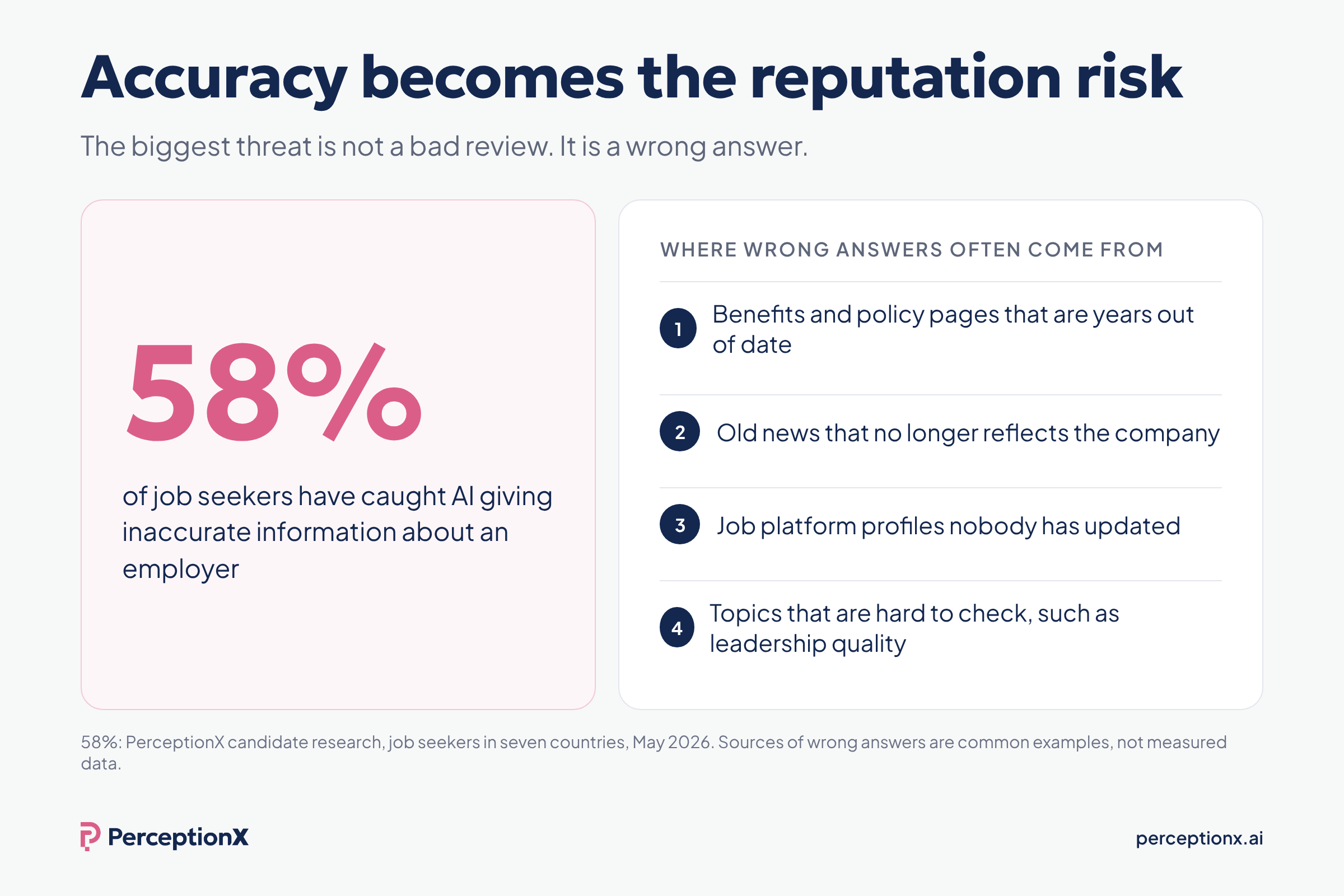
- Keep up with AI. In PerceptionX research across seven countries, 72% of AI-using job seekers used AI before deciding whether to apply, and 58% had caught AI giving inaccurate information about an employer. If you do not check those answers, nobody on your side does.
What to monitor
Employee review sites
Ratings, review volume, recurring themes and your response rate on Glassdoor, Indeed and the local platforms that matter in each market, such as kununu in Germany and AmbitionBox in India.
Track themes, not just stars: a stable rating can hide a growing complaint about one manager group or one location.
Watch review volume too. A sudden spike in one star ratings or negative employee reviews usually signals a specific event, and a long silence means your company profile is going stale.
Encourage current employees to leave honest reviews so the picture stays current.
Social media and forums
Mentions of your company as an employer on LinkedIn, Reddit, X, TikTok and industry forums. Pay particular attention to Reddit: in PerceptionX data it was cited in 13% of AI answers about employers, mostly on candidate experience topics.
Our guide to Reddit and employer brand explains why.
News and press
Coverage of layoffs, leadership changes, legal issues, awards and workplace stories. Old coverage matters too, because AI assistants and search results keep surfacing it.
AI answers
What ChatGPT, Google AI Overviews, Google AI Mode and Perplexity tell candidates when they ask which employers to consider for a role and what it is like to work for you.
Monitor four things: whether you are named, how positively you are described, whether the facts are accurate, and which sources the answer relies on.
In October 2026 PerceptionX data, Glassdoor appeared in 63% of AI answers about what it is like to work somewhere, and Indeed in 44%.
Your own experience data
Engagement surveys, employee net promoter score (eNPS), stay and exit interviews, candidate experience surveys and offer acceptance.
Stay and exit interviews are especially useful because they uncover the issues behind employee retention before they show up in reviews. These explain why the external picture looks the way it does, and often predict where it is heading.
Your own content
Check that your career pages, job postings and job descriptions are current and consistent with what employees say. Out-of-date pay ranges, benefits or policies are a common reason AI tools describe an employer inaccurately.
What good monitoring reveals
Paying attention to the right signals gives real insight into how current and potential employees see you. Good monitoring shows:
- Where your workplace culture is praised or criticised, and whether company culture themes match what you promise.
- How candidates describe the hiring process, from job postings to interviews, and where top candidates drop out.
- What employees feel about career growth, pay, managers and employee experience, through employee feedback, employee satisfaction surveys and online reviews.
- How you compare with industry peers that compete with you for top talent.
- Whether potential employees considering their next employer see you at all, in AI answers, search results and online review sites.
Survey data, review themes and AI answers together give talent acquisition teams the evidence they need to manage a strong reputation, attract top quality applicants and build a positive reputation over time.
Authenticity matters: marketing that does not reflect the real employee experience shows up quickly in what people leave in reviews, and a strong company culture shows up just as clearly.
Key employer reputation monitoring metrics
| Metric | What it tells you | How often |
|---|---|---|
| AI recommendation rate | How often AI names you when candidates ask which employers to consider | Monthly |
| AI sentiment | How positively AI describes you, by theme | Monthly |
| Source mix | Which websites shape the answers about you | Quarterly |
| Review rating and themes | What employees say, and about what | Monthly |
| Review response rate | Whether you are visibly listening | Monthly |
| Social and forum sentiment | Emerging issues before they reach reviews | Weekly |
| Offer acceptance and candidate NPS | Whether reputation is affecting hiring | Monthly |
How to set up strong employer reputation monitoring
- Pick your markets, roles and competitors. Monitor where you hire and against the companies you lose candidates to.
- Write the candidate questions. List the questions candidates actually ask, in each market's language, from "best companies to work for in my field" to "what is the interview process like at your company".
- Set a baseline. Record where you stand on each metric before you change anything.
- Automate the routine. Use tools for review tracking, social listening and AI answer tracking, rather than manual spot checks that miss changes.
- Set alert thresholds. Agree what triggers action: a drop in AI sentiment on a theme, a spike in negative reviews, a new news story.
- Report and act. Share a short monthly view with the teams who can fix things, and a quarterly trend with leadership.
Plan for a reputation crisis
Monitoring is your early warning system. Agree in advance who responds when a negative story breaks, how the leadership team communicates with employees first, and how you will update public information afterwards.
A proactive crisis response plan, with open communication inside the company, limits reputational damage and shortens the time AI answers and search results lean on the bad news.
Positive signals worth tracking
Monitoring is not only about problems. Track employee advocacy, positive employee testimonials, employer recognition and awards, and moments when AI tools name you as a top employer in your field.
Celebrating real employee achievements and sharing them on the channels candidates read builds credibility that marketing alone cannot.
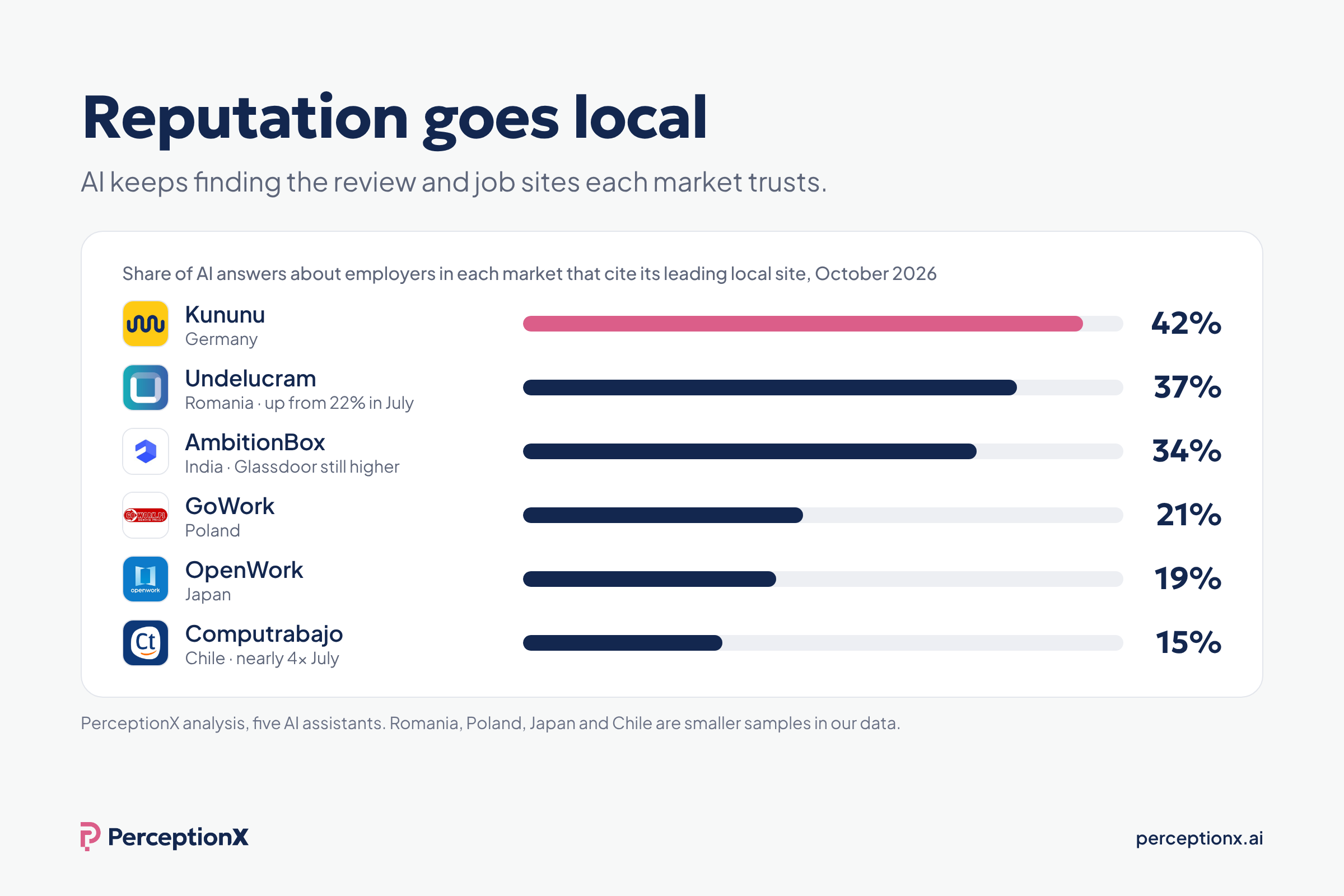
Monitor by market, not just globally
The sources behind your reputation change at every border. In October 2026 PerceptionX data, kununu appeared in 42% of AI answers about employers in Germany and AmbitionBox in 34% in India.
A monitoring set-up built around US review sites will miss what candidates read in half your markets. Track each market on its own and in its own language.
Turning monitoring into action
Monitoring only matters if it leads to change. For each issue, decide whether it is an experience problem to fix, an information gap to close or a source to update, and assign an owner.
Our guide to employer reputation management sets out the full process, and employer reputation management software compares the tools.
Monitoring tools compared
No single tool covers everything. Review site dashboards track ratings and responses. Social listening covers social media and forums. Online reputation management tools focus on search results and consumer reviews.
Employee survey platforms capture internal sentiment. An AI employer reputation platform shows what AI assistants tell candidates and why. Most teams combine two or three and bring the results into one monthly view for the business.
How PerceptionX helps
PerceptionX is the only employer reputation platform built for how candidates now research employers.
It monitors what ChatGPT, Google and other AI assistants tell job seekers about working for a company: whether they recommend it, what they say about it and which websites those answers come from, in every market and for every type of role.
Our scores are independent: they come from what AI actually says, not from what employers tell us.
Key takeaways
- Employer reputation monitoring tracks reviews, social media, forums, news and AI answers continuously.
- AI answers are now a core channel to monitor: whether you are named, how you are described, whether it is accurate and which sources it uses.
- Monitor by market and role, with a baseline, alert thresholds and clear owners.
- Monitoring is only useful if it feeds a regular cycle of action and re-measurement.
Frequently asked questions
What is employer reputation monitoring?
Employer reputation monitoring is the continuous tracking of what employees, candidates and the market say about an organisation as a place to work, across review sites, social media, forums, news and AI assistants.
How do you monitor your employer reputation?
Choose your markets, roles and talent competitors, list the questions candidates ask, set a baseline, then track review sites, social media, news and AI answers with automated tools, alert thresholds and a monthly report to the teams who can act.
How often should you monitor employer reputation?
Social media and forums weekly, reviews and AI answers monthly, and a fuller review of sources and trends every quarter.
Why monitor what AI says about your company?
Many candidates now ask AI assistants about employers before they apply. In PerceptionX research, 72% of AI-using job seekers used AI before deciding whether to apply and 58% had caught AI giving inaccurate information about an employer.

Find out how AI is shaping your employer brand — and what you can do about it.