Employer Reputation Management: A 6-Step Process

Employer reputation management is the ongoing work of measuring how an organisation is perceived as a place to work, understanding what drives that perception, changing it and measuring again. It covers what employees, candidates and the wider market say and believe about you as an employer, on review sites, social media, in the press and, increasingly, in the answers AI assistants give job seekers.
Strong employer reputation management is a powerful tool for attracting top quality applicants and keeping a positive reputation with current and potential employees. It is often confused with employer branding and with online reputation management. It is neither.
This guide explains what employer reputation management is, how it differs from those two disciplines, and how to run it as a repeatable process. For the fundamentals, start with our guide to employer reputation.
What is employer reputation management?
Your employer reputation is what people actually believe about you as an employer. Employer reputation management is the discipline of looking after that belief on purpose rather than leaving it to chance. In practice it has four parts:
- Measure how you are perceived, independently of your own channels.
- Diagnose what is driving that perception: which experiences, which sources and which markets.
- Act on the causes, from the employee experience to the information candidates can find.
- Re-measure to check whether the change reached the places candidates look.
Measurement that happens once is an audit. Measurement that is repeated and acted on is management.
What shapes your employer reputation
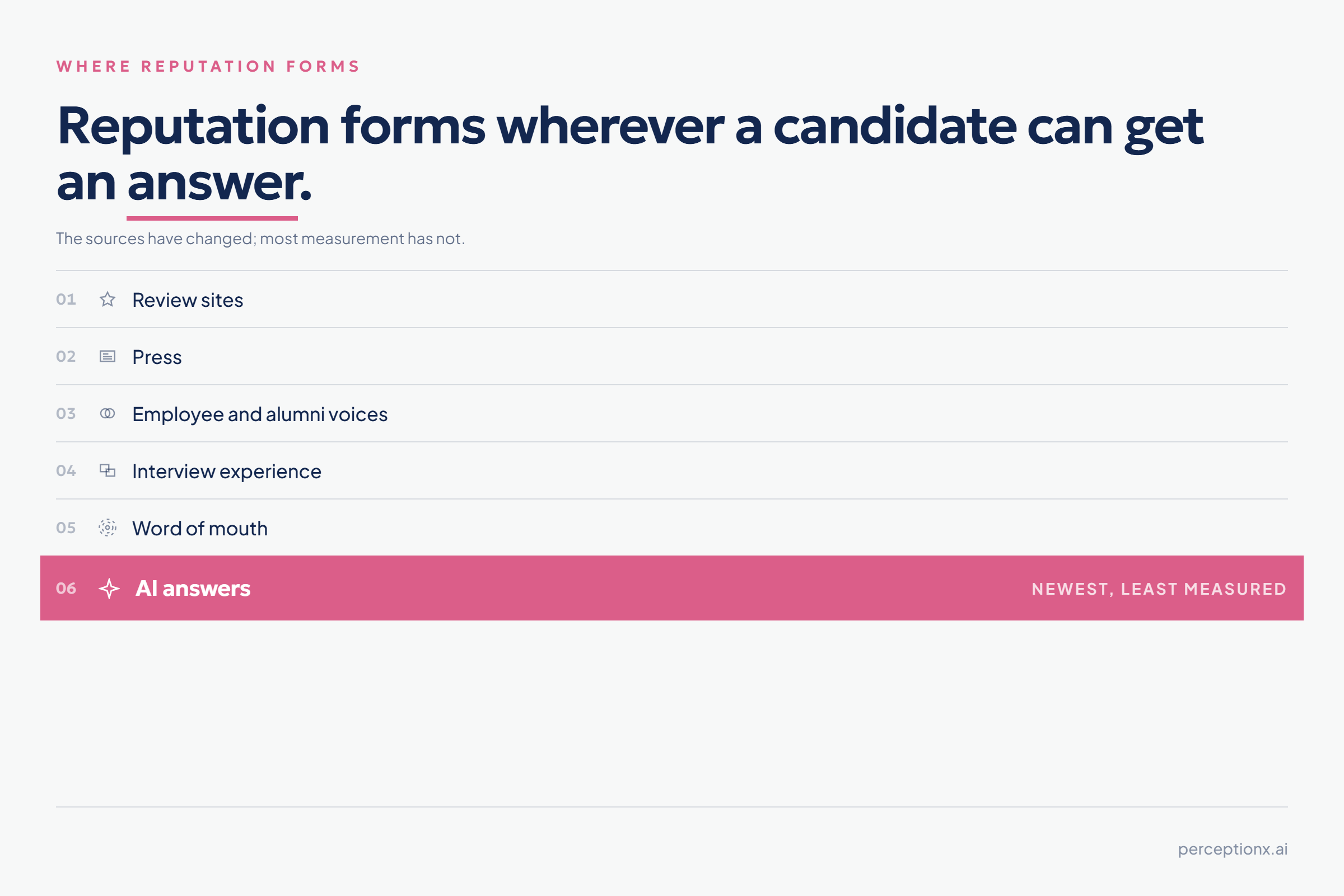
A company's reputation as an employer is built from many voices, most of them outside its control:
- Current and former employees, through employee reviews, word of mouth and social media. Employees who feel proud of where they work become credible ambassadors; employees who feel ignored leave reviews that last for years.
- Candidates, through the hiring process. How people are treated when they apply, interview and get rejected shapes what potential employees hear next.
- Alumni, whose recommendations and comments influence future candidates long after they leave.
- Your own channels, such as career pages, job postings, job descriptions and employee testimonials.
- The press and news sites, especially coverage of layoffs, leadership decisions and workplace culture.
- AI tools, which now summarise all of the above for job seekers in a single answer.
Employer reputation management vs employer branding
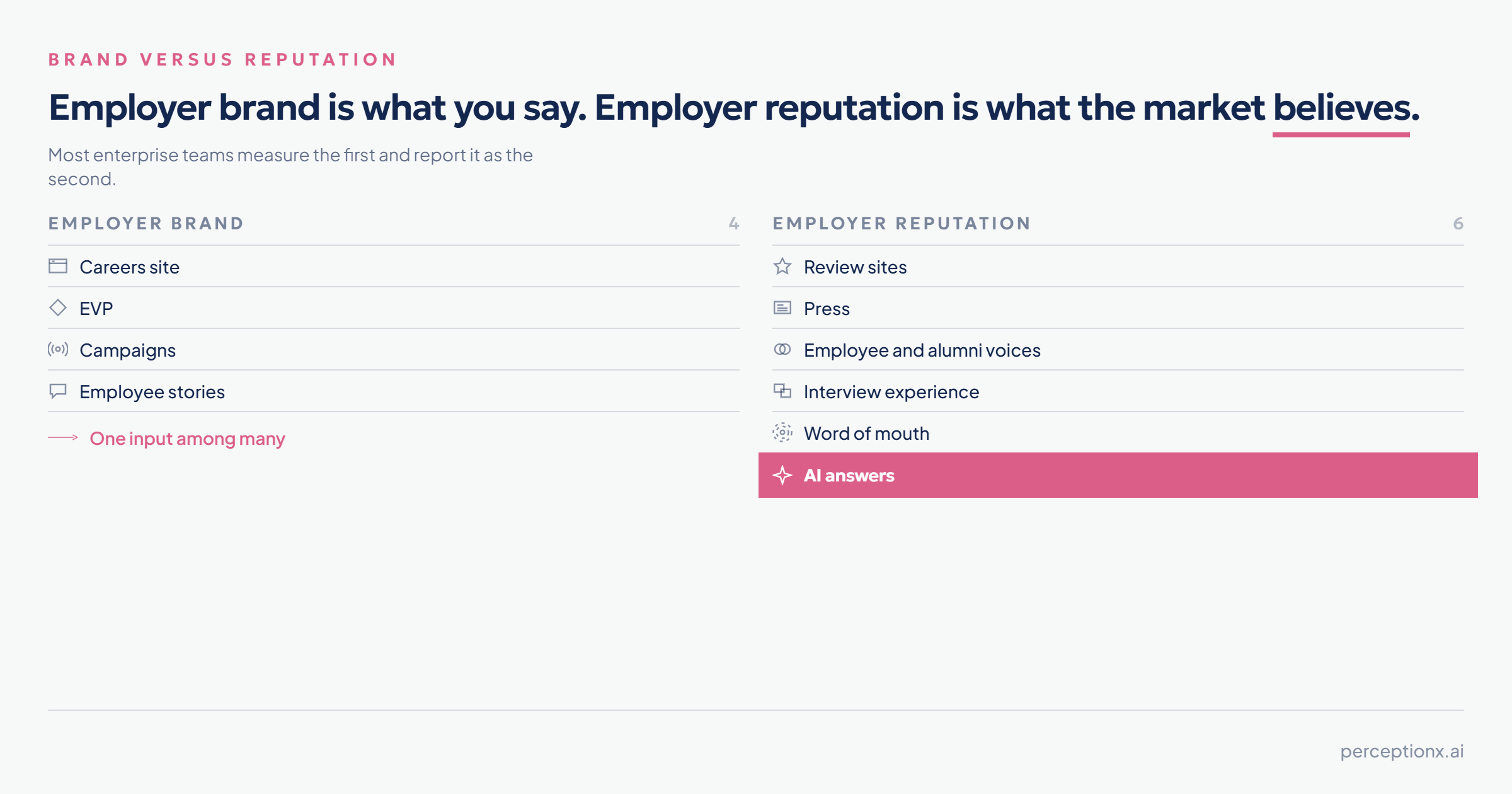
Employer branding is what a company says about itself as an employer: the employer value proposition, the careers site, campaigns and recruitment marketing. It is owned and intentional.
Employer reputation management deals with what everyone else concludes. The employer brand is one input, alongside employee reviews, word of mouth, news coverage, recruiter behaviour, the interview process and AI answers.
A strong employer brand with a weak reputation is a promise the market does not believe. Our guide to employer brand vs employer reputation covers the difference in depth.
Employer reputation management vs online reputation management
Online reputation management, sometimes called business reputation management, grew up around consumer reviews and search results, and much of it is about suppressing or outweighing negative content. That approach does not work for employer reputation, for three reasons:
- Candidates read across many sources. Review sites, forums, LinkedIn, news and AI answers all feed the same impression. Pushing one review down does not change the rest.
- AI assistants synthesise everything. They summarise what they find across sources, so a single positive page cannot hide a consistent pattern.
- Positive content is not enough. Publishing positive content to build a positive online reputation helps only when it matches what people experience; otherwise negative reviews simply continue.
- The cause is the experience. If employees and candidates keep describing the same problem, the only durable fix is to change it.
Why employer reputation management matters now
Candidates have always checked what it is like to work somewhere. What has changed is where they check.
In PerceptionX research across seven countries, 96% of AI-using job seekers had used AI to research an employer, learn about a role or prepare for an interview in the past year, and 82% said an AI answer had changed their mind about pursuing a role at a company.
AI assistants build those answers from sources the employer does not control.
In October 2026 PerceptionX data, for questions about what it is like to work somewhere, more than four in five AI answers drew on review sites, job platforms or employee forums, with Glassdoor in 63% of answers and Indeed in 44%.
An employer's own site appeared in more than half of all AI answers about employers, but almost never on its own. Managing employer reputation now means managing what those sources say, because that is what AI repeats.
The business case
A positive employer reputation is a competitive advantage in hiring.
It helps you attract top talent and top quality applicants without paying a premium, raises offer acceptance, and supports retention: organisations known for career development tend to keep their people longer.
A poor reputation does the opposite. Top candidates quietly rule you out, recruiting costs rise and current employees start looking for their next employer.
Because customers read the same review sites and news coverage as job seekers, employer reputation also affects the wider company's reputation and credibility.
How to manage your employer reputation: a 6-step process
1. Set the scope
Decide which markets, job functions and talent competitors matter most. A global employer does not have one reputation.
It has one per market and per function, and each is shaped by different sources. Start with the markets and roles where hiring is hardest.
2. Establish a baseline
Measure how you are perceived today, from outside your own channels.
Combine employee feedback and employee satisfaction data with candidate feedback, review site data (ratings, review volume and recurring themes), social listening and what AI assistants tell candidates when they ask which employers to consider and what it is like to work for you.
Our framework for measuring employer reputation sets out the signals and cuts to use.
3. Find the drivers
Paying attention to patterns, not single comments, gives the most useful insight. For each weak reading, identify the cause.
Is the problem that you are absent from answers, that the answers are negative on specific themes such as pay or career growth, or that the information is out of date?
Which sources are driving it? The fix for each is different.
4. Fix the experience first
Where employees and candidates consistently describe a real problem, change the underlying practice: management quality, pay transparency, the interview process, communication during change. Reputation follows experience, with a delay.
5. Close the information gaps and respond to reviews
Publish the specific, current facts candidates look for and AI can quote: pay ranges, the hiring process and timelines, career paths, flexibility policies and benefits.
Keep your company profile on review sites and job platforms complete in every market, including local platforms such as kununu in Germany or AmbitionBox in India.
Respond to online reviews, including negative employee reviews, with specifics rather than templates. Acknowledge what is fair, explain what has changed and invite people to continue the conversation.
Do not chase five star reviews or try to bury one star ratings: candidates notice, and online review sites penalise review manipulation. Encouraging current employees to leave honest reviews regularly is the healthier way to keep the picture current.
6. Re-measure every quarter
Repeat the same measurement, in the same markets, on the same surfaces. Reputation moves slowly and unevenly; quarterly re-measurement shows what worked and where to focus next.
Build trust through open communication
Much of employer reputation management is simply communication. The leadership team sets the tone: explaining decisions openly, especially difficult ones, builds trust inside the company, and employees carry that trust outside it.
Regular employee feedback channels, transparent updates during change and visible follow-through on what people raise all reduce the gap between what you say and what employees experience.
Employee advocacy works best on top of that foundation: when employees feel heard, their posts and testimonials are credible because they are true.
Employee advocacy and company culture
A strong reputation is easiest to sustain when your company culture gives employees something real to talk about. Employee advocacy tools can help people share stories, jobs and news, but they work only when employees choose to take part.
Potential candidates trust a colleague's post far more than a campaign, which is why advocacy built on a healthy culture does more for your employer reputation than any paid channel.
Who owns employer reputation management?
Usually employer brand or talent acquisition leads it, but it cannot be run by one team.
HR owns the employee experience, recruiters own the candidate experience, communications owns press and leadership messaging, and local HR teams own review site responses in their markets.
The best programmes have one owner for measurement and a shared agenda for action, reviewed by leadership every quarter.
Employer reputation management tools
Most teams combine several tools: employee survey platforms, review site dashboards, social listening and an AI reputation platform that shows what ChatGPT, Google and other assistants tell candidates.
Our guide to employer reputation management software compares the categories and what to look for.
Common mistakes
- Treating it as a campaign. A burst of content does not change a reputation built on years of experience.
- Using one global score. Averages hide the market or function where the problem really is.
- Only watching review ratings. Star ratings miss what AI and forums are saying, and why.
- Ignoring industry peers. Reputation is relative; benchmark against the employers you compete with for top talent.
- Responding defensively. Templated or argumentative review replies make things worse.
- Not re-measuring. Without a repeat reading, you are managing activity, not reputation.
How PerceptionX helps
PerceptionX is the only employer reputation platform built for how candidates now research employers.
It shows what ChatGPT, Google and other AI assistants tell job seekers about working for a company: whether they recommend it, what they say about it and which websites those answers come from, in every market and for every type of role.
Our scores are independent: they come from what AI actually says, not from what employers tell us.
Key takeaways
- Employer reputation management is measure, diagnose, act and re-measure, repeated every quarter.
- It differs from employer branding, which manages the message, and from online reputation management, which manages search results.
- AI assistants now summarise your reputation from review sites, forums and job platforms, so those sources need managing.
- Fix the experience first, then publish the facts candidates and AI look for.
Frequently asked questions
What is employer reputation management?
Employer reputation management is the ongoing process of measuring how an organisation is perceived as a place to work, finding what drives that perception, changing it and re-measuring. It covers employee reviews, social media, press, the candidate experience and what AI assistants tell job seekers.
How is employer reputation management different from employer branding?
Employer branding manages what a company says about itself as an employer. Employer reputation management deals with what employees, candidates and the market actually believe, which is shaped by many sources the company does not control.
How do you manage employer reputation?
Set the markets and roles that matter, measure a baseline, find the drivers of weak readings, fix the underlying experience, publish the facts candidates look for, keep review site profiles current and re-measure every quarter.
Who is responsible for employer reputation?
Employer brand or talent acquisition usually leads it, but HR, recruiters, communications, leadership and local HR teams all shape it. One team should own measurement, with a shared action plan reviewed by leadership.
Can you remove negative employer reviews?
Generally only if they break the platform's rules. The effective approach is to respond professionally, fix the underlying issue and make sure accurate, current information is available.

Find out how AI is shaping your employer brand — and what you can do about it.