How to Measure Employer Brand: A 7-Step Guide

To measure your employer brand, track how the talent market perceives you, how candidates behave because of that perception, and what it does to your hiring results, using the same metrics, in the same markets, every quarter. In practice that means combining perception metrics (what people believe about you as an employer), attraction metrics (what candidates do), experience metrics (what employees say) and efficiency metrics (what it costs to hire), and linking them so you can show cause and effect.
Most teams measure only what is easy: followers, careers site traffic, campaign clicks. Those numbers show activity, not whether your employer brand is getting stronger.
This guide sets out a practical, step-by-step way to measure employer brand properly, the metrics to use at each stage, a simple scorecard you can copy, and how to measure the part most teams now miss: what AI assistants tell candidates about you.
What is employer brand measurement?
Employer brand measurement is the process of tracking how your company's employer brand is perceived by your target audience, and what that perception does to talent attraction, hiring and retention.
It covers both external employer branding, meaning how candidates, former employees and the wider market see you, and internal employer branding, meaning how current employees experience and describe the company.
Done well, it turns employer branding efforts from a creative exercise into a strategic process.
It tells you whether your employer brand messaging is landing, which employer branding initiatives are worth more investment and where the employee experience does not match the promise.
Why measure your employer brand?
A strong employer brand is one of the most valuable assets in recruitment, but only if you can prove it. Measuring it brings four key benefits:
- More qualified candidates. You can see whether your employer brand is attracting the right people, not just more people, and whether passive candidates are noticing you.
- Lower hiring costs. When a strong employer branding strategy works, more hires come from direct applications and referrals, and fewer from expensive agencies.
- Better retention. High employee turnover can signal a gap between employer branding and the real employee experience. Measurement shows where it is.
- A credible business case. Hard numbers win budget from leadership, finance and hiring managers far more easily than impressions do.
Without measurement, it is impossible to say whether the employer brand matters to your hiring results or simply looks good.
Why measuring employer brand is hard
Your employer brand lives in other people's heads. You cannot read it directly, so you measure it through signals, and each signal only shows part of the picture.
- Brand and reputation differ. Your employer brand is what you say about yourself. Your employer reputation is what the market concludes. Good measurement covers both.
- Results lag. A change in perception can take months to show up in applications or offer acceptance.
- Many things affect hiring. Pay, the job market and the hiring process all move the same numbers as employer brand.
- One global number hides the truth. A brand can be strong with engineers in one country and weak with sales candidates in another.
The answer is not one perfect metric. It is a small, stable set of metrics, read by market and function, tracked over time.
Use a strategic framework, not a list of numbers
The four-stage model below is a strategic framework: it links what potential employees believe to what they do and what that costs. That link is what lets you explain how your employer brand affects the organization's reputation as a place to work, and the business outcomes leadership cares about.
Before you start: agree who owns what
Employer brand measurement touches many teams. Talent acquisition owns recruitment metrics and the talent pipeline.
HR owns employee engagement and employee satisfaction data. The marketing team often owns the careers page, social media platforms and content.
Hiring managers see the quality of candidates first-hand. Agree one owner for the measurement framework, a shared set of key metrics and a regular forum to review them.
It avoids the common problem of every team reporting different numbers for the same thing.
How to measure employer brand in 7 steps
1. Define what your employer brand should achieve
Start with the business problem, not the metric. Are you trying to attract more qualified applicants for hard-to-fill roles, raise offer acceptance, reduce early turnover, or enter a new market?
Write down two or three goals, the talent segments they apply to and the markets that matter most. Every metric you pick should connect to one of them.
2. Write down your employer value proposition
A well-defined employer value proposition aligns with company culture and values, and it is the yardstick for everything you measure.
You cannot measure whether people see you the way you intend unless you know what you intend.
List the three to five things your employee value proposition promises, such as career growth, flexibility or meaningful work. These become the attributes you track in perception measurement.
Check them against the company's mission and leadership perspectives, so the promise is one the organisation will actually keep.
Run a few focus groups with current employees to test whether the attributes feel true. If employees do not recognise the promise, candidates will not believe it either.
3. Choose metrics for each stage
Use a four-stage framework so you can see where the brand is working and where it breaks:
- Perception: how the talent market sees you. Brand awareness, consideration, review ratings and themes, social sentiment, and what AI assistants say about you.
- Attraction: what candidates do. Careers site visitors, applications per role, quality of applicants, source of hire and the share of direct and referral applications.
- Experience: what employees and candidates live through. Employee net promoter score (eNPS), engagement, candidate experience scores and first-year retention.
- Efficiency: what it costs. Cost per hire, time to hire, offer acceptance rate and quality of hire.
For the full list with definitions and formulas, see our guide to employer branding metrics.
4. Set a baseline
Measure every chosen metric before you change anything, for each market and talent segment that matters. Without a baseline, you cannot show that your employer branding work moved anything.
5. Benchmark against competitors
Employer brand is relative.
Pick the five to ten companies you lose candidates and offers to, and measure the perception metrics for them the same way: review ratings and themes, social share of voice, and how often AI assistants recommend them compared with you.
6. Measure on a fixed cadence
Track attraction and efficiency metrics monthly from your applicant tracking system. Track perception metrics monthly or quarterly. Run deeper perception surveys once or twice a year. Keep the method stable so changes are real.
7. Connect the metrics and report the story
The goal is a chain: perception improved in this market, so applications and offer acceptance rose, so cost per hire fell.
Report that chain to leadership every quarter, by market and function, with one or two actions for the next quarter.
Our guide on employer branding budgets shows how to turn it into a business case.
How to measure internal employer branding
Your employer brand starts inside the company. Engaged employees are the most credible proof of your employer brand, and disengaged ones are the fastest way to undermine it. Measure:
- Employee engagement and employee satisfaction through internal surveys, broken down by team, location and tenure.
- Employee net promoter score (eNPS): how likely employees are to recommend the company as a place to work.
- Alignment with your EVP: whether employees agree the company delivers what it promises, attribute by attribute.
- Employee expectations versus reality, using stay and exit interviews and new-hire surveys at 30 and 90 days.
- Internal communications reach and trust, especially during change, because internal culture shapes what employees later say in public.
Employee feedback collected this way is an early warning system. Problems usually appear in internal surveys months before they appear in reviews.
How to measure external employer branding
External measurement shows how your company's employer brand travels beyond your own channels:
- Careers page performance: visitors, time on page, application starts and the share of visitors who apply.
- Social media engagement: reach and engagement on employer brand content across social media platforms, and which social media posts drive careers site visits.
- Encouraging employees to share: the share of employees who take part when you invite them to post about their work, a useful signal of how engaged they really are.
- Employee advocacy: how many employees share company content and employee stories, and the engagement that employee generated content earns compared with corporate messaging.
- Employer review sites: ratings, themes and responses from current and former employees.
- AI answers: whether AI assistants recommend you and what they say, covered in detail below.
Compare external messaging with what employees and candidates actually say. Consistent messaging across all of these channels is one of the clearest signs of a compelling employer brand.
How to measure candidate experience
Every candidate who applies forms an opinion of your employer brand, and many share it. Track candidate experience at each stage of the application process and interview process:
- Application completion rate and drop-off by stage.
- Time between stages and response times.
- Candidate satisfaction or candidate NPS, from both hired and rejected candidates.
- Whether the role matched candidate expectations set by job descriptions and recruitment marketing.
Our guide to how to improve employer reputation covers how to act on what you find.
A simple employer brand measurement scorecard
| Stage | Core metrics | Data source | Cadence |
|---|---|---|---|
| Perception | AI recommendation rate and sentiment, review rating and themes, awareness and consideration | AI answer tracking, review sites, perception survey | Monthly; survey twice a year |
| Attraction | Applications per role, qualified applicant rate, direct and referral share | Applicant tracking system, web analytics | Monthly |
| Experience | eNPS, candidate experience score, first-year retention | Employee and candidate surveys, HR system | Quarterly |
| Efficiency | Offer acceptance, time to hire, cost per hire, quality of hire | Applicant tracking system, finance | Monthly |
How to measure employer brand perception
Perception is the hardest stage to measure and the most important, because it drives everything after it. Use three complementary methods:
Perception surveys
Ask your target talent audience, in each market, what they know and believe about you compared with competitors, by attribute.
Surveys give depth and the "why", but they are slow and expensive to run across many markets. Our guide to the employer reputation survey includes a question bank.
Reviews and social listening
Track ratings, review volume and recurring themes on Glassdoor, Indeed and the local review sites that matter in each country, plus social media and forum sentiment.
Read the themes, not just the stars: they tell you which part of your employee value proposition is landing and which is not.
AI answers
This is the newest and fastest-growing source of perception, and the one most measurement plans miss.
In PerceptionX research across seven countries, 96% of AI-using job seekers had used AI to research an employer, learn about a role or prepare for an interview in the past year, and 82% said an AI answer had changed their mind about pursuing a role at a company.
Yet 58% had caught AI giving inaccurate information about an employer.
To measure it, ask the questions candidates actually ask, in each market's language, across ChatGPT, Google AI Overviews, Google AI Mode and Perplexity, and track four things: how often you are recommended, how positively you are described, whether the facts are right and which sources the answers rely on.
Between July and September 2026, the median employer PerceptionX tracks was named in 17% of the AI answers where candidates asked which companies to consider.
For most employers, that is the biggest gap in their employer brand they have never measured.

Recruitment metrics that show employer brand impact
The strongest evidence that employer branding matters comes from recruitment metrics. Watch for these changes after employer branding initiatives:
- More qualified candidates per role, and a higher share of qualified candidates in the talent pipeline.
- More applications from passive candidates and from referrals.
- Higher offer acceptance rate, especially against named competitors.
- Shorter time to hire for hard-to-fill roles.
- Lower early employee turnover, which shows the employer brand set accurate expectations.
Track them for the specific talent segments your employer branding strategy targets, not just in total.
Measure by market and function
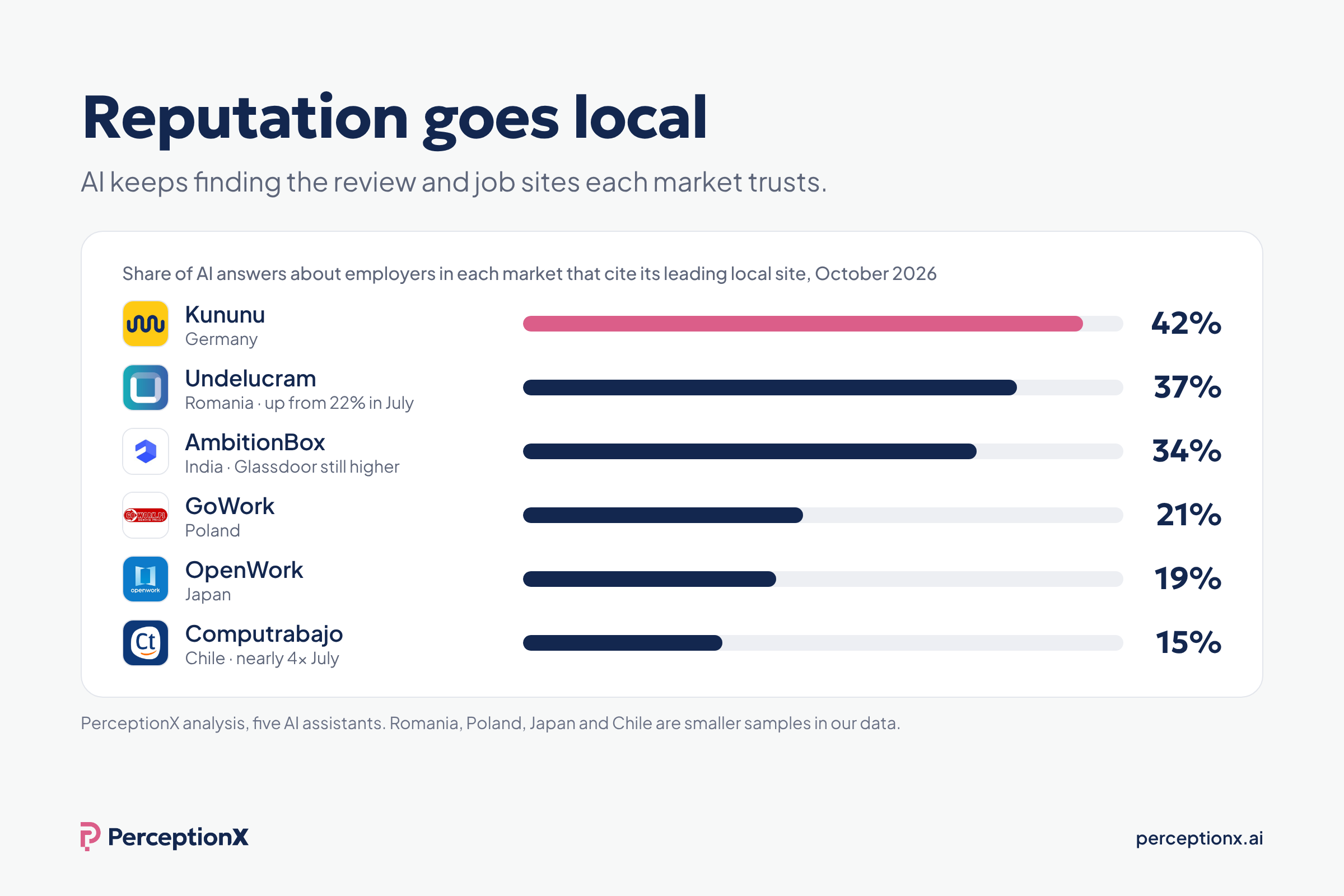
The sources that shape your employer brand change at every border.
In October 2026 PerceptionX data, Glassdoor appeared in 63% of AI answers about what it is like to work somewhere, while kununu appeared in 42% of AI answers about employers in Germany and AmbitionBox in 34% in India.
Candidates for different roles also ask different questions and hear different answers. Measure each priority market and job function separately, then roll up, never the other way round.
How to measure employer branding ROI
Leadership will eventually ask what the employer brand returns. Build the answer in three parts.
1. Add up the investment
Include employer branding initiatives, content and campaigns, careers page work, tools, and the time of the people involved.
2. Quantify the hiring gains
Compare your baseline with the current period for the talent segments you targeted: savings from fewer agency hires, lower job board spend, faster time to hire for critical roles, more offers accepted and lower early employee turnover. Put a cost on each, using your own finance data.
3. Compare and report
Employer branding ROI is the hiring gains minus the investment, divided by the investment. Be conservative: claim only the changes you can reasonably connect to employer branding, and show the perception metrics that moved first. A modest, credible number wins more trust than a large, fragile one.
Employer brand KPIs by goal
Pick key metrics according to what your employer branding strategy is trying to do:
- Goal: attract top talent for hard-to-fill roles. AI recommendation rate for those roles, qualified applicants per role, share of passive candidates.
- Goal: win more offers against competitors. Offer acceptance rate, reasons for declined offers, perception versus named competitors.
- Goal: retain talent. First-year retention, eNPS, gap between employee expectations and experience.
- Goal: enter a new market. Awareness and consideration in that market, local review site coverage, how AI describes you in the local language.
- Goal: improve diversity of hires. Applicant mix by segment, perception of inclusion among target groups, candidate experience scores by group.
Qualitative measurement matters too
Numbers show what changed; conversations explain why. Combine metrics with qualitative insight from focus groups, candidate interviews, exit interviews and the comments in reviews and surveys. Read what people actually write about your company's culture, managers and workplace culture.
The words candidates and employees use are often the best guide to which employer brand messaging works and which sounds like corporate messaging. They also give you the real employee stories that make an employer brand credible.
How often to report, and to whom
- Monthly: a short dashboard for talent acquisition and the employer brand team covering attraction and efficiency metrics.
- Quarterly: a one-page story for HR leadership and hiring managers: what moved, why, and what happens next, by market and function.
- Twice a year: a deeper review with perception surveys, competitor benchmarks and AI answer analysis for the leadership team.
A real world example of employer brand measurement
Consider a typical scenario, simplified for illustration. A global company struggles to hire software engineers in one European market. Its overall review rating looks fine, so the problem is invisible in global reporting.
When the team measures by market and function, three things appear. Engineering candidates in that market rarely see the company recommended in AI answers.
The answers they do see lean on old reviews about slow career growth. And internal surveys show engineers there rate career development lower than anywhere else.
The team fixes the underlying issue with a clear engineering career framework, publishes it on the careers page, encourages engineers to share employee testimonials and project stories, and updates its review site profiles.
A quarter later it re-measures the same metrics. The point of the example is the method: measure narrowly, find the cause, act, and measure the same way again.
Use an employer reputation index to benchmark
Once you have a stable set of metrics, an employer reputation index turns them into one score you can benchmark against competitors and track every quarter. Choose one that measures external perception by market and talent group, and that includes what AI assistants tell candidates.
Tools for measuring employer brand
- Applicant tracking system: attraction and efficiency metrics.
- Web analytics: careers site traffic, sources and conversion.
- Survey platforms: employee, candidate and talent market perception.
- Review site dashboards and social listening: ratings, themes and sentiment.
- An AI employer reputation platform: what AI assistants tell candidates, by market, function and model, and which sources drive it. Our guide to employer reputation management software compares the options.
Common mistakes when measuring employer brand
- Measuring output instead of outcome. Followers and impressions show reach, not perception or hiring impact.
- Using one global average. It hides the market or role where the brand is failing.
- Changing metrics every quarter. Without a stable method, trends are noise.
- Ignoring competitors. A rising score means little if competitors rose faster.
- Measuring only external signals. Internal employer branding and employee engagement predict what will appear externally next.
- Skipping AI answers. Candidates increasingly meet your employer brand in an AI answer before they reach your careers site.
Turn measurement into continuous improvement
Measurement only matters if it changes decisions. Treat employer brand measurement as a cycle of continuous improvement:
- Review the scorecard every quarter with talent acquisition, HR and the marketing team.
- Pick one or two priorities per market or talent segment where the gap is largest.
- Agree actions and owners, from fixing a step in the interview process to updating employer brand messaging.
- Re-measure the same metrics next quarter and keep what works.
Over time, this turns a strong employer brand from a claim into something you can show, with numbers, to leadership and to candidates.
How PerceptionX helps
PerceptionX is the only employer reputation platform built for how candidates now research employers.
It shows what ChatGPT, Google and other AI assistants tell job seekers about working for a company: whether they recommend it, what they say about it and which websites those answers come from, in every market and for every type of role.
Its Employer Reputation Index turns that into one score you can track and benchmark. Our scores are independent: they come from what AI actually says, not from what employers tell us.
Key takeaways
- Measure employer brand across four stages: perception, attraction, experience and efficiency.
- Tie every metric to a business goal, set a baseline, benchmark competitors and keep the method stable.
- Measure perception three ways: surveys, reviews and social listening, and AI answers.
- Read results by market and function, then report the chain from perception to hiring outcomes every quarter.
Frequently asked questions
How do you measure employer brand?
Define what the employer brand should achieve, write down your employee value proposition, choose metrics across perception, attraction, experience and efficiency, set a baseline, benchmark against competitors, measure on a fixed cadence and report how changes in perception affect hiring results.
What are the best metrics to measure employer brand?
Perception metrics such as review themes, survey ratings and how AI assistants describe you; attraction metrics such as applications per role and qualified applicant rate; experience metrics such as eNPS and first-year retention; and efficiency metrics such as offer acceptance, time to hire and cost per hire.
How do you measure employer brand perception?
Combine perception surveys of your target talent audience, review site and social media analysis, and tracking of what AI assistants tell candidates about you, by market and job function.
How often should you measure employer brand?
Track attraction and efficiency metrics monthly, perception metrics monthly or quarterly, and run deeper perception surveys once or twice a year. Report trends to leadership every quarter.
How do you measure employer brand ROI?
Link changes in perception to hiring outcomes such as more qualified applicants, higher offer acceptance, faster time to hire and lower cost per hire, then compare those savings with what the employer branding work cost.
What is the difference between internal and external employer branding measurement?
Internal measurement tracks how current employees experience and describe the company, through engagement, eNPS and internal surveys. External measurement tracks how candidates, former employees and the market see you, through reviews, social media, careers site data and AI answers.
Can you measure employer brand without a big budget?
Yes. Start with your applicant tracking system data, free review site analytics, a short candidate survey and a regular check of what AI assistants say about you in your key markets. Add tools as the programme grows.

Find out how AI is shaping your employer brand — and what you can do about it.