Employer Branding Budget: How to Set It, Allocate It and Justify It

An employer branding budget is the money a company sets aside to shape how candidates and employees see it as a place to work. It pays for the career site and its content, employer brand campaigns, job platform and review site profiles, employee advocacy, research and measurement, and the people and agencies who run them. Most employer brand teams set it once a year, during budget season, and most of them have to defend it against recruiting spend that is easier to count.
This guide covers what an employer branding budget should include, three ways to set it, how to allocate it for 2027 and how to build a business case that finance will accept. It is written for the planning cycle, when the decisions for next year get made.
What an employer branding budget covers
Employer branding budgets vary widely by company size, hiring volume and how many markets a company hires in. The line items are more consistent. Most budgets cover seven areas.
| Budget line | What it pays for | Metric it should move |
|---|---|---|
| Research and measurement | Employer brand audit, candidate and employee surveys, tracking what AI assistants tell candidates | A baseline for every other line; perception by market |
| Employer value proposition | EVP research, messaging, testing with employees and candidates | Consistency of what candidates hear across sources |
| Career site and content | Career pages, FAQs on pay and process, employee stories, photography and video | Career site conversion, qualified applicants per opening |
| Profiles and reviews | Job platform and review site profiles, review responses, local platforms in each market | Ratings, response rate, accuracy of AI answers |
| Employee advocacy | Programmes, training and tools that help employees share their experience | Referral rate, reach, employee net promoter score |
| Campaigns and paid media | Recruitment marketing campaigns, social ads, events, sponsorships | Awareness, applications from target talent pools |
| People and partners | Employer brand team, agency fees, freelancers, AI tools and other technology | Output and speed across all lines |
The useful test for every line is the third column. If you cannot name the metric a line should move, it will be the first thing cut when budgets tighten, and it probably should be.
How to set your employer branding budget
There is no standard benchmark that fits every employer, and most published figures are old, small-sample or come from vendors. Three methods give a defensible number for your own situation.
1. Top-down: a share of the talent acquisition budget
Many companies set the employer branding budget as a share of total talent acquisition spend, then adjust each year. It is simple and easy to approve, but it ties employer branding to last year's spend rather than next year's needs, and it tends to shrink in exactly the years when hiring is hardest.
2. Bottom-up: from the hiring plan
Start with the hiring plan: how many roles, in which markets and functions, and which are hardest to fill. Then cost what it takes to reach and convince those candidates in each market. This method produces the most credible number, because it connects every line of the budget to a hire the business has already agreed it needs.
3. Problem-led: from the gaps in your reputation
Start from what an employer brand audit or perception research shows: where candidates have the wrong picture of you, where you are invisible, where offers are declined. Budget against fixing those gaps in priority order. This method is the strongest in a business case, because it points to problems finance can already see in recruiting data.
Most mature teams combine the second and third methods: the hiring plan sets the scale, and the reputation gaps set the priorities.
How to allocate the budget for 2027
Where candidates form their view of an employer has changed, and most employer branding budgets have not caught up. Budgets are still weighted towards campaigns and social content. Candidates increasingly research employers through AI assistants, and those assistants build their answers from career sites, review sites and job platform profiles.
PerceptionX data shows the scale of the shift. In October 2026, an employer's own site appeared in more than half of AI answers about employers, and in 86% of answers to factual questions about pay, benefits or the hiring process. For questions about what it is like to work somewhere, more than four in five AI answers drew on review sites, job platforms or employee forums. Over the same period, YouTube's presence in AI answers about employers fell by 64% and Instagram's by 78%.

That points to four changes for 2027 budgets.
- Fund the evidence before the campaign. Career site content that answers real candidate questions, current profiles on job and review platforms and responses to reviews are the sources AI quotes. They are often underfunded because they look like maintenance.
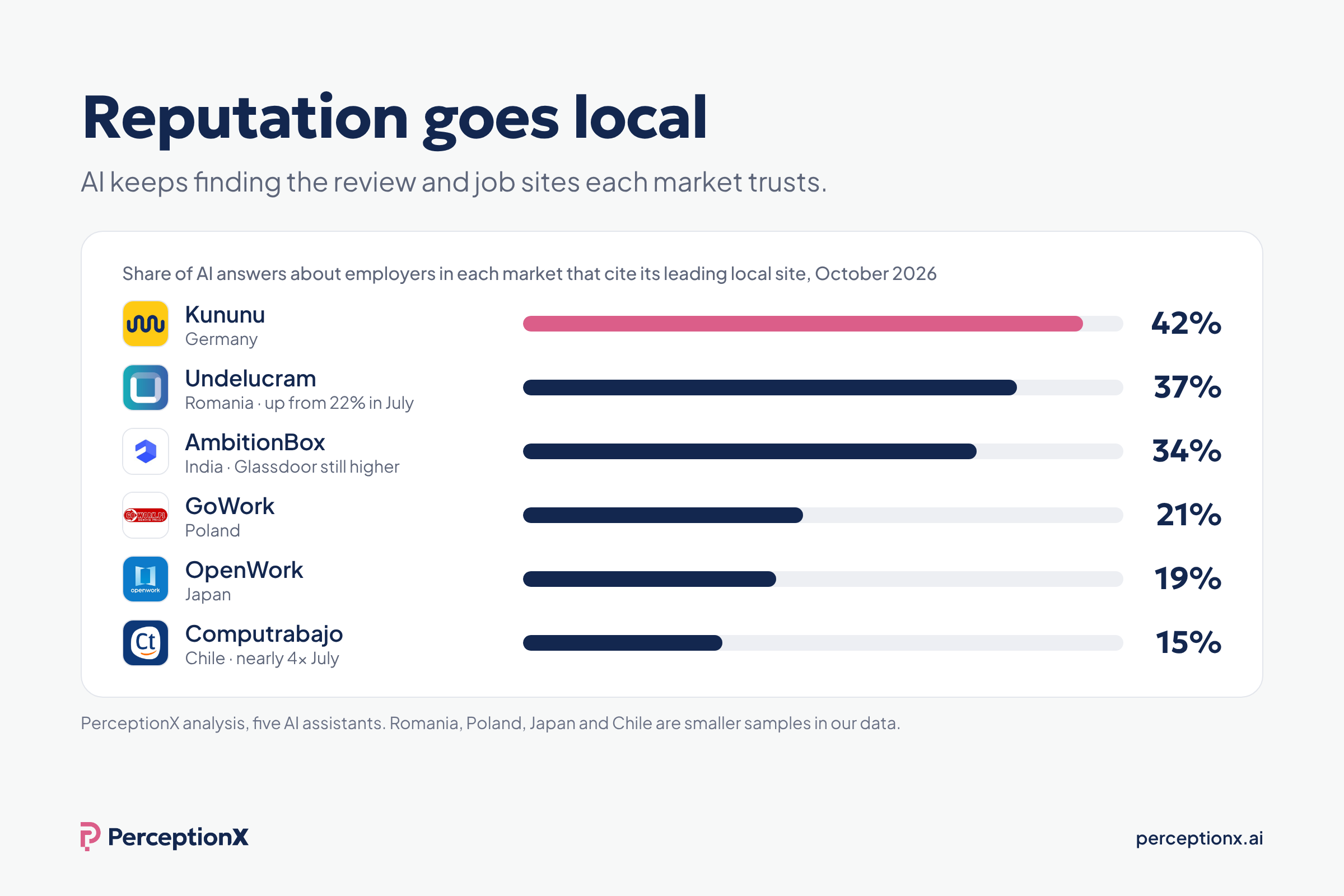
- Budget by market, not by region. In many countries, AI relies on local review and job platforms rather than global ones. A budget that only covers the global platforms leaves those markets to chance.
- Extend employee advocacy beyond social. Advocacy budgets should cover honest reviews and employee forums as well as social posts, because that is where AI reads the employee voice.
- Ring-fence measurement. Set aside a fixed share for research and measurement, including what AI tells candidates about you, so the rest of the budget can be judged on results.

Our employer reputation trends for 2027 explain each of these shifts in more detail.
How to build the business case
Finance teams approve budgets that are tied to costs they already track. The strongest employer branding business cases connect spend to four of them.
- Cost per hire. A stronger employer brand lowers the cost of attracting each hire, especially agency and paid advertising costs.
- Time to fill. Every day a role stays open has a cost to the business. Shorter time to fill is often the largest single saving.
- Offer acceptance. Each declined offer repeats part of the hiring cost. Candidates who arrive with an accurate picture of you are more likely to accept.
- Early attrition. New hires who leave in their first year cost the business their hiring and onboarding twice. Accurate expectations reduce early attrition.
A simple way to present it: take one of these costs, show its current level from your own recruiting data, and show what a realistic improvement would be worth. For example, as an illustration only: if a company makes 500 hires a year and each declined offer adds 5,000 in repeated hiring cost, lifting offer acceptance from 80% to 85% means around 35 fewer declined offers, worth roughly 180,000. Use your own numbers; the method is what matters.
Our guide to employer branding metrics covers how to calculate employer branding ROI in full, and which metrics to report to business leaders.
Common employer branding budget mistakes
- No baseline. Spending before measuring means you cannot show what changed. Start with an employer brand audit.
- Campaigns without evidence. A campaign that sends candidates to a thin career site, or to review pages nobody manages, pays for attention it then loses.
- One budget for every market. Candidates in different countries use different sources. Allocate by market priority.
- Tools before process. Technology helps only when someone owns the work it supports. Our guide to employer branding tools covers what to look for.
- Reporting activity instead of outcomes. Posts published and campaign reach do not win budget. Changes in cost per hire, offer acceptance and perception do.
How to run employer branding on a limited budget
Not every team has a massive budget, and a strong employer brand does not depend on one. Many of the most effective employer branding efforts cost little beyond time. If you are working with a limited budget, these practical ways to stretch it will do more than flashy campaigns.
Turn current employees into brand ambassadors
Your existing employees are the most credible voice you have. Employee testimonials, team stories and posts on social media from the existing team speak directly to potential candidates in a way company content cannot, and authentic content from real people feels authentic because it is. Give brand ambassadors topics and light training rather than scripts, and celebrate the ones who take part.
Fix the careers page before anything else
The careers page plays a critical role in every candidate journey, and it is one of the sources AI reads most. Answer the questions potential employees ask: pay, the application process, what the first months look like, and how people grow. A clear careers page improves candidate experience and candidate quality at almost no cost.
Repurpose existing content
Most companies already have more material than they use: annual reports, internal updates, leadership talks and recordings from industry events. Repurpose existing content into short videos, employee stories and social media posts. It supports consistent messaging and saves production budget for the pieces that matter.
Spend less on job boards, more on job postings
Job board spend and agency fees are often the largest line items in recruiting, and they buy reach rather than reputation. Better job descriptions and job postings, with real detail on pay, team and company culture, attract the right talent and give AI accurate information to quote. Every open seat filled through a referral or a well-written job posting reduces the need for paid reach.
Use low cost channels well
Low cost channels such as LinkedIn, short videos, employee referral programmes and responses to reviews often outperform paid media for employer brand work. AI tools can help a small team draft and adapt content quickly, as long as a person checks it for accuracy and keeps the tone consistent.
Who to bring into the budget conversation
Employer brand investment works best when it is planned with other teams, not just defended to them. Before the next budget conversation, involve:
- The HR team and HR managers, who own the employee experience that the employer brand describes, and the data on engagement and retention.
- The marketing team, who can share brand guidelines, creative assets and media buying, and help you stay consistent with the consumer brand.
- Finance, who will judge the business case. Agree the metrics with them before the budget conversation, not after.
- Hiring managers, who know which roles are hardest to fill and what top talent asks about.
Connecting the employer branding strategy to the wider business strategy across different departments of the organization turns it from a marketing cost into a competitive advantage. It also protects against a bad reputation building in one part of the business while another part tells a different story.
How to adjust the budget through the year
An employer branding budget should not be fixed for twelve months. The job market changes, hiring plans change, and what potential candidates hear about you changes with them. Review spend every quarter and adjust based on results: move money towards the channels and markets that improve candidate quality, offer acceptance and how you are described, and away from those that do not. Keep a small reserve for the moments that matter, such as a new hire surge, a new market or a reputation issue that needs a fast response. That way the budget keeps serving the target audience you need to reach, including future employees in the markets you have not entered yet.
How PerceptionX supports budget decisions
PerceptionX is the only employer reputation platform built for how candidates now research employers. It shows what ChatGPT, Google and other AI assistants tell job seekers about working for a company: whether they recommend it, what they say about it and which websites those answers come from, in every market and for every type of role. Our scores are independent: they come from what AI actually says, not from what employers tell us. For budget planning, that gives employer brand teams a baseline before they spend, a way to prioritise markets and sources, and a measure of whether the spend changed what candidates are told.
Putting it together
A strong employer branding budget for 2027 starts from the hiring plan, prioritises the gaps in how candidates see you, funds the sources AI and candidates actually read, and ring-fences measurement so every other line can be judged on results. Built that way, it stops looking like a marketing cost and starts looking like what it is: a way to hire the people the business needs, faster and at lower cost.
Frequently asked questions
What is an employer branding budget?
An employer branding budget is the money a company sets aside to shape how candidates and employees see it as a place to work. It typically covers research and measurement, the employer value proposition, the career site and content, job platform and review site profiles, employee advocacy, campaigns, and the people, agencies and tools that run them.
How much should a company spend on employer branding?
There is no single benchmark that fits every employer. The most defensible approach is to build the budget bottom-up from the hiring plan, then prioritise it against the gaps in how candidates see you. A share of the talent acquisition budget is a simpler starting point, but it ties spend to last year rather than next year's hiring needs.
How do I justify an employer branding budget?
Tie it to costs finance already tracks: cost per hire, time to fill, offer acceptance and early attrition. Show the current level from your own recruiting data and what a realistic improvement would be worth, and include a measurement baseline so results can be shown afterwards.
What should an employer branding budget prioritise in 2027?
The sources candidates and AI assistants actually read: career site content that answers candidate questions, current job platform and review site profiles, responses to reviews and local platforms in each market. Ring-fence a share for measurement, including what AI tells candidates about you.
Who owns the employer branding budget?
In most large companies, talent acquisition or HR owns the employer branding budget, with marketing and communications as close partners. What matters most is a single owner who can connect spend to hiring outcomes.

Find out how AI is shaping your employer brand — and what you can do about it.