Employer Brand vs Employer Reputation: What Enterprise Talent Leaders Need to Measure

Ask a global employer brand team how the employer brand is performing and you will usually get a good answer. Campaign reach is up, the careers site was rebuilt, the EVP refresh landed in eleven languages, the employee story programme produced more content than last year, the Glassdoor rating held.
Ask how the company's reputation as an employer has changed in Germany, for software engineers, in the last two quarters, and the room goes quiet.
That is not a failure of effort. It is a category error that most of the industry has made for a decade: measuring the brand and reporting it as the reputation.
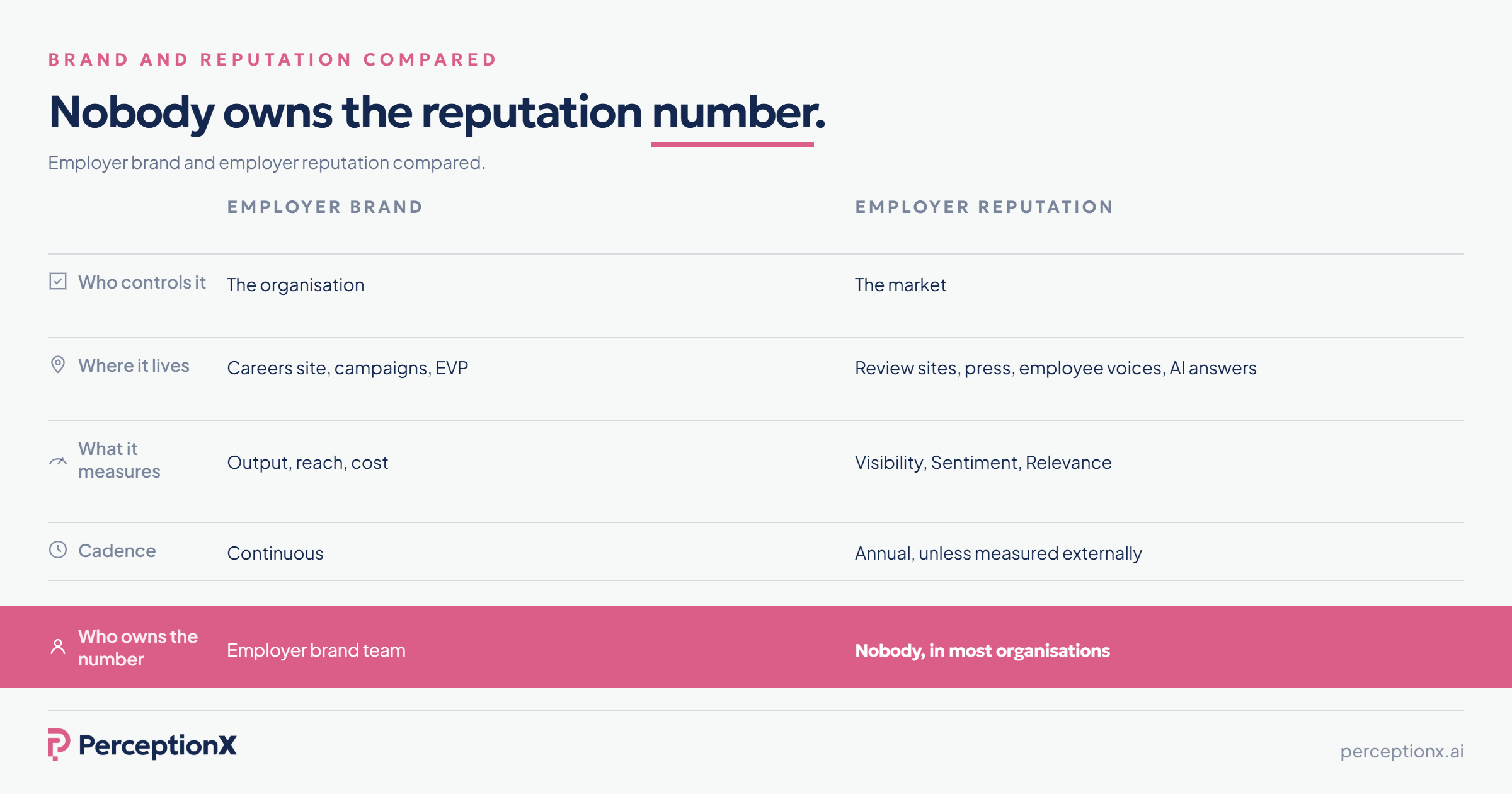
Two different things
An employer brand is chosen. Someone decided what the organisation would stand for as an employer, wrote it down, gave it a visual identity and pushed it through channels the organisation controls. It is a communication programme, and like any communication programme it can be measured by reach, engagement, consistency and cost.
An employer reputation is not chosen. It is the sum of what candidates, employees, former employees and the wider market believe about the organisation as a place to work. It is shaped by the brand, but also by every review, every article, every employee post, every interview a candidate walks out of, every recruiter who did or did not follow up, and every AI-generated summary a candidate reads before deciding whether to apply.
The brand is an input. The reputation is the outcome. Confusing the two produces a specific failure: the programme looks healthy on every metric the team owns, while the thing the programme exists to move is not being measured at all.
Why the confusion persists
Three reasons, none of them careless.
The brand is easy to measure and the reputation is hard. Every channel the team controls comes with a dashboard. Reputation lives in places the team does not control, and the traditional way to measure it, a panel survey, is expensive, annual and national. Faced with a choice between precise measurement of the wrong thing and rough measurement of the right thing, most teams reasonably chose precision.
Review sites became a proxy. For a decade, Glassdoor and Indeed ratings were the only continuously available external signal, so they became shorthand for reputation. They are a real signal. They are also one source among several, with coverage that varies sharply by country and by function, and they say nothing about whether the employer is visible or relevant to the candidates it wants.
The organisation rewards output. Regional teams are set content targets and campaign targets. They hit them. Nobody is set a reputation target, because nobody has been measuring reputation in a way that could support one.
What AI changed
Until recently the gap between brand and reputation was survivable. The brand went out, the reputation formed slowly through reviews and word of mouth, and the annual survey caught up eventually.
AI assistants have compressed that. When a candidate asks "is Company X a good place to work as a product manager", the answer is a synthesis of whatever sources the model has learned to trust about employers, weighted in ways the employer cannot see. The careers site is one input. It is not the dominant one.
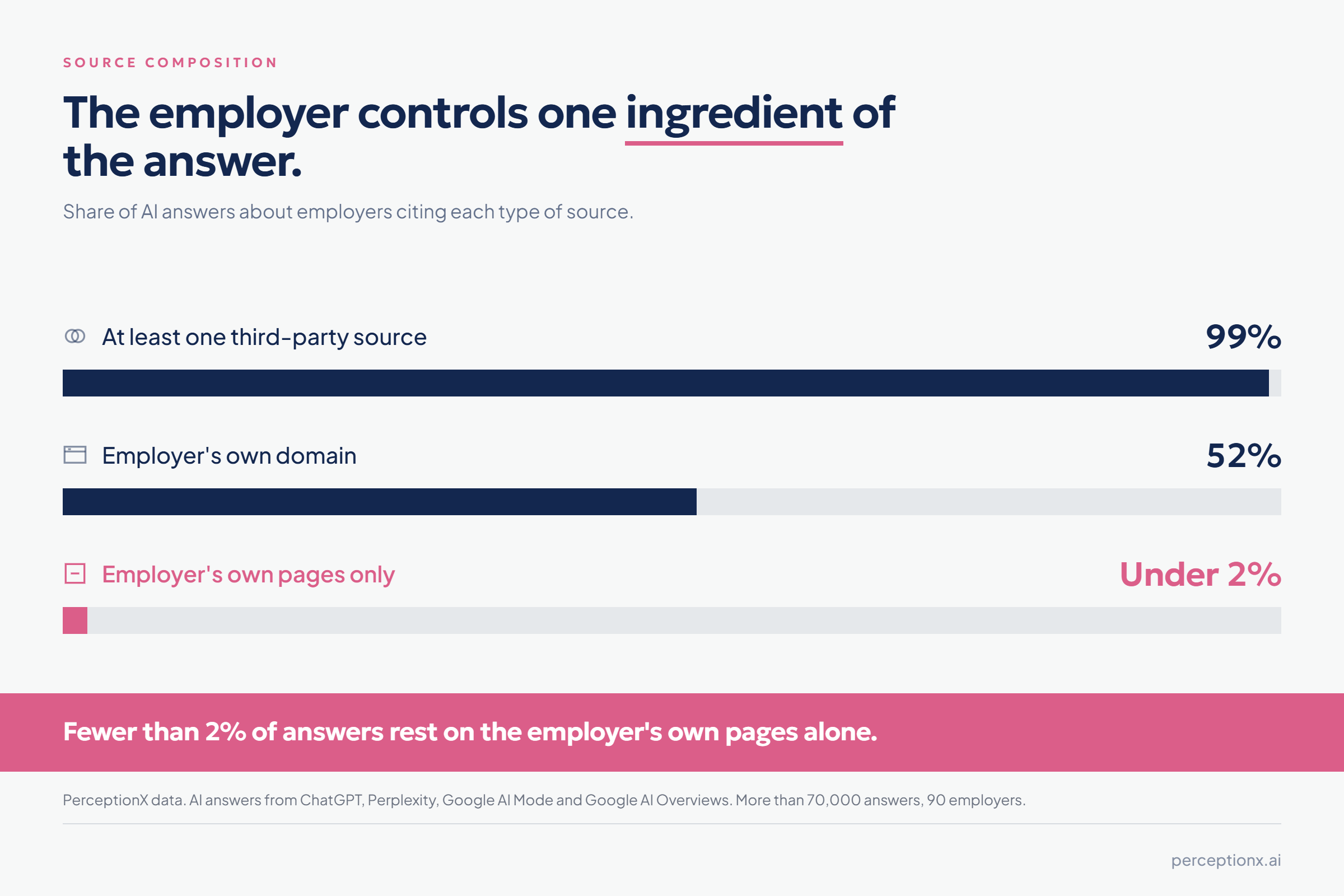
PerceptionX's data puts a number on it. Across more than 70,000 AI answers about 90 employers, 99% drew on at least one third-party source and fewer than 2% relied on the employer's own pages alone. The careers site is usually in the mix. It is almost never the whole answer.
In PerceptionX's May 2026 survey of 306 job seekers who use AI tools, 82% said an AI answer had changed their mind about pursuing a role at a company, and 58% had caught an AI tool being wrong about an employer. Both figures matter. The first says reputation is being formed on this surface. The second says the surface is not a faithful mirror of the brand, and the employer will not know what it is saying unless someone looks.
An AI answer is, in effect, a reputation reading generated on demand, delivered to the candidate with no employer involvement. It makes the brand-versus-reputation distinction concrete in a way that a panel survey never did. The brand is what the team wrote. The reputation is what the assistant said.
A working comparison
The last row is the one to fix.
What to measure instead
Reputation measurement does not replace brand measurement. Brand metrics still tell the team whether the programme is running. What changes is that reputation gets its own signals, its own cuts and its own trend line.
The signals are Visibility (is the employer present when candidates ask), Sentiment (what share of what is said is positive, expressed as a percentage) and Relevance (how current the sources behind the answer are). Each is read by market, by function, by reputation attribute, by surface, by source and against named competitors. The full framework is set out in How to Measure Employer Reputation.
Two consequences follow for enterprise teams.
Regional teams get a shared reading. Today, a global employer brand lead typically has eleven regional narratives and no common instrument. A reputation reading per market, on the same signals, gives the global lead something to compare and the regional lead something to own.
Brand investment can be tested. If the EVP refresh claimed three attributes, the attribute cut shows whether the market now associates the employer with those three attributes, per market, a quarter later. That is a test the brand's own metrics cannot run.
The uncomfortable implication
If reputation is measured independently, the brand programme will sometimes be shown not to be working. A campaign that performed well on reach will have left sentiment in its target market untouched. An EVP that tested well internally will turn out to describe attributes the market does not associate with the employer at all.
That is not an argument against measuring reputation. It is the argument for it. A programme whose success can only be shown by its own output cannot be defended in a budget conversation, and cannot be improved, because there is no feedback. The distinction between employer brand and employer reputation is, in the end, the distinction between effort and effect.
Where to go from here
The category is set out in full in Employer Reputation for Global Employers. How AI surfaces form reputation, and how to see what they currently say about you, is covered in What AI Says About You as an Employer.

Find out how AI is shaping your employer brand — and what you can do about it.