How to Improve Your Employer Brand in ChatGPT and Other AI Assistants

Most large employers are not in the answer.
When candidates ask an AI assistant which companies are worth working for in their field and market, PerceptionX, an employer reputation partner, found that the employers it tracks were mentioned in 17% of those answers at the median between July and September 2026. Four in ten were mentioned in fewer than one answer in ten. These are well-known companies with funded employer brand programmes and careers sites that took eighteen months to build.
So the question is a fair one, and it gets asked in roughly these words: how do we improve our employer brand in ChatGPT, or make our recruitment brand show up in AI at all? TA teams ask it; so do CEOs who typed the company name into ChatGPT and did not like what came back.
What follows is what the answers are actually built from, why the usual playbook does not move them, and what does.
Your employer brand in ChatGPT is now part of the applicant journey whether you manage it or not. Job seekers ask AI platforms like ChatGPT, Google Gemini, Perplexity and Google AI Overviews which companies to work for, what the company culture is like, how the hiring process works and whether there is real career development. They get a single answer, written in confident prose, before they ever reach your careers page. This guide covers what ChatGPT says about your company, how to check it, and how to improve your employer brand in ChatGPT and the other AI tools candidates use.
One caution before the method. Nobody can guarantee placement in an AI answer. Any agency promising it is selling something they cannot deliver. What you can do is change the evidence the answer is assembled from, and measure whether the answer changed.
Why AI is reshaping employer branding in the AI era
Candidate behavior changed faster than most talent teams noticed. An Adzuna study of 1,200 job seekers found that 59% had used AI in their job search. PerceptionX's own survey of active job seekers across seven countries found that 96% had used AI to research an employer or prepare for an interview, and 58% had caught AI giving inaccurate information about an employer. They use it to build a shortlist, compare employers, check employee reviews and prepare for the interview process. Even candidates who never open an AI assistant meet AI search, because Google AI Overviews now sit above the search results for many employer questions.
That is what is reshaping employer branding. For twenty years the employer controlled the first impression through its careers site, job descriptions and social media. Now artificial intelligence writes the first impression, drawing on multiple sources the employer does not own: review sites, Reddit, LinkedIn posts, media coverage and third party platforms. A strong employer brand on your own site does not guarantee a strong AI employer brand. The two have to be managed together.
How AI search changes the candidate experience
The candidate journey used to start on your career sites or a job board. It now often starts with direct questions to an AI assistant, and the answer sets how candidates perceive you before they read a word you wrote.
That matters most for top candidates, who have options and shortlist quickly. If the answer leaves you out, or describes your company's reputation from an outdated source, those candidate perceptions are formed without you. In a competitive talent market, that is where top talent is won or lost.
It also means your company's employer brand is now assembled across different channels at once: your own pages, review platforms, LinkedIn, communities and the press. The candidate experience begins inside that answer, not on your careers page.
How to see what ChatGPT says about your company as an employer
Before you change anything, find out what candidates hear. What does ChatGPT say about your company? Checking your employer brand in ChatGPT takes an afternoon if you do it properly.
- Ask the questions candidates ask. Not just "what is it like to work at [company]", but discovery prompts that do not name you: which companies in [industry] in [country] are best for a software engineer, who has the best work life balance, who invests in career development. Our guide to prompting AI to audit your employer reputation lists the prompts by type.
- Ask what candidates evaluate employers on. Include the prompts candidates use about remote policy, growth opportunities, professional growth and the interview process. Then ask directly: how does ChatGPT describe your company as an employer? Compare the answer with what you know to be true.
- Ask on multiple platforms. ChatGPT, Gemini and Perplexity draw on different sources and give different answers to the same question, and Google AI Overviews differ again. One assistant is one data point.
- Record what ChatGPT responses say, not just whether you appear. Note how the AI responses describe your company culture, workplace culture, pay, hiring process and leadership, and whether the detail is accurate.
- Log the sources. Where the assistant shows them, note the third party domains it cites. That list tells you which review data, directories and communities are shaping the answer.
- Note who else is named. The employers AI recommends alongside or instead of you are your real competitors for top talent in that market.
Repeat the same prompts more than once. These models do not give the same answer twice, so a single answer is an anecdote, not a measurement.
The mistake: treating it like SEO
The reflex is to reach for the SEO playbook: optimise the careers site, add schema markup, publish more content, and wait to be indexed.
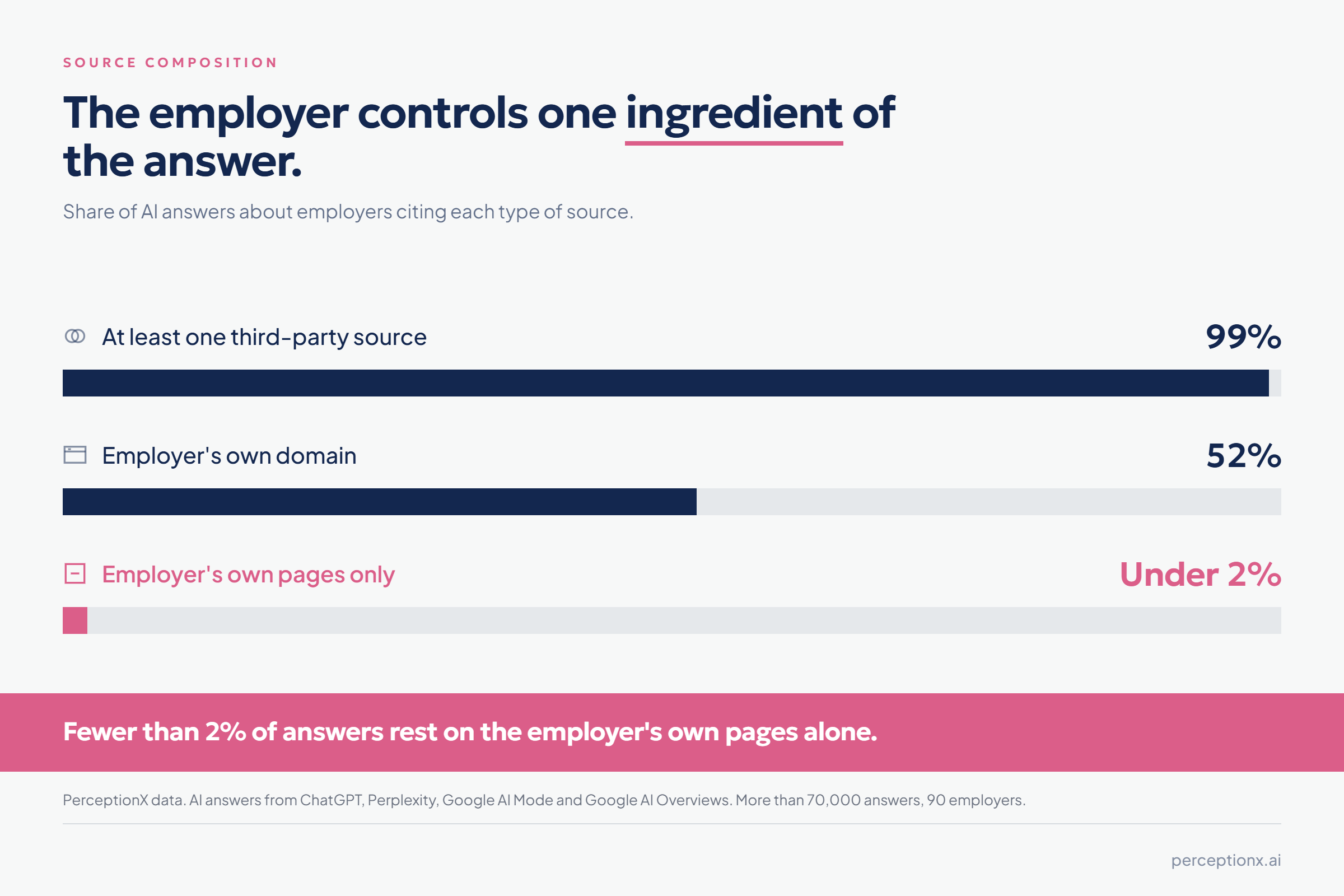
That is aimed at the wrong target. An AI answer about employers is not a ranked list of pages. It is a synthesis of third-party sources, and the employer's own site is a minor ingredient. Across the AI answers about employers that PerceptionX analysed, 99% drew on at least one third-party source, and fewer than 2% relied on the employer's own pages alone.
Structured data on job postings is still worth having, because it helps search engines read a role correctly. It just does not decide whether assistants like ChatGPT name you when a candidate asks which employers to consider. Keep the structured data accurate, then focus on the sources that do shape the answer.
The careers site still matters. It is just not the lever most teams think it is. You do not write your way into the answer from your own domain.
Candidates ask two different kinds of question, and the sources differ
This is the finding that should change what your team does next.
PerceptionX puts four kinds of question to the AI surfaces candidates use. Two of them matter here. Discovery questions are how a candidate finds employers they had not considered: which companies are good to work for in this field, who is hiring for this role in this market. Experience questions are how a candidate judges an employer they already have in mind: what is it like to work at Company X.
The sources behind those two kinds of answer are not the same. The table below shows the share of AI answers in which each source appeared, between July and September 2026.
| Source | Discovery answers | Experience answers |
|---|---|---|
| Directories and curated lists | 38% | 13% |
| 31% | 27% | |
| Glassdoor | 24% | 62% |
| 21% | 17% | |
| Indeed | 20% | 50% |
| YouTube | 18% | 24% |
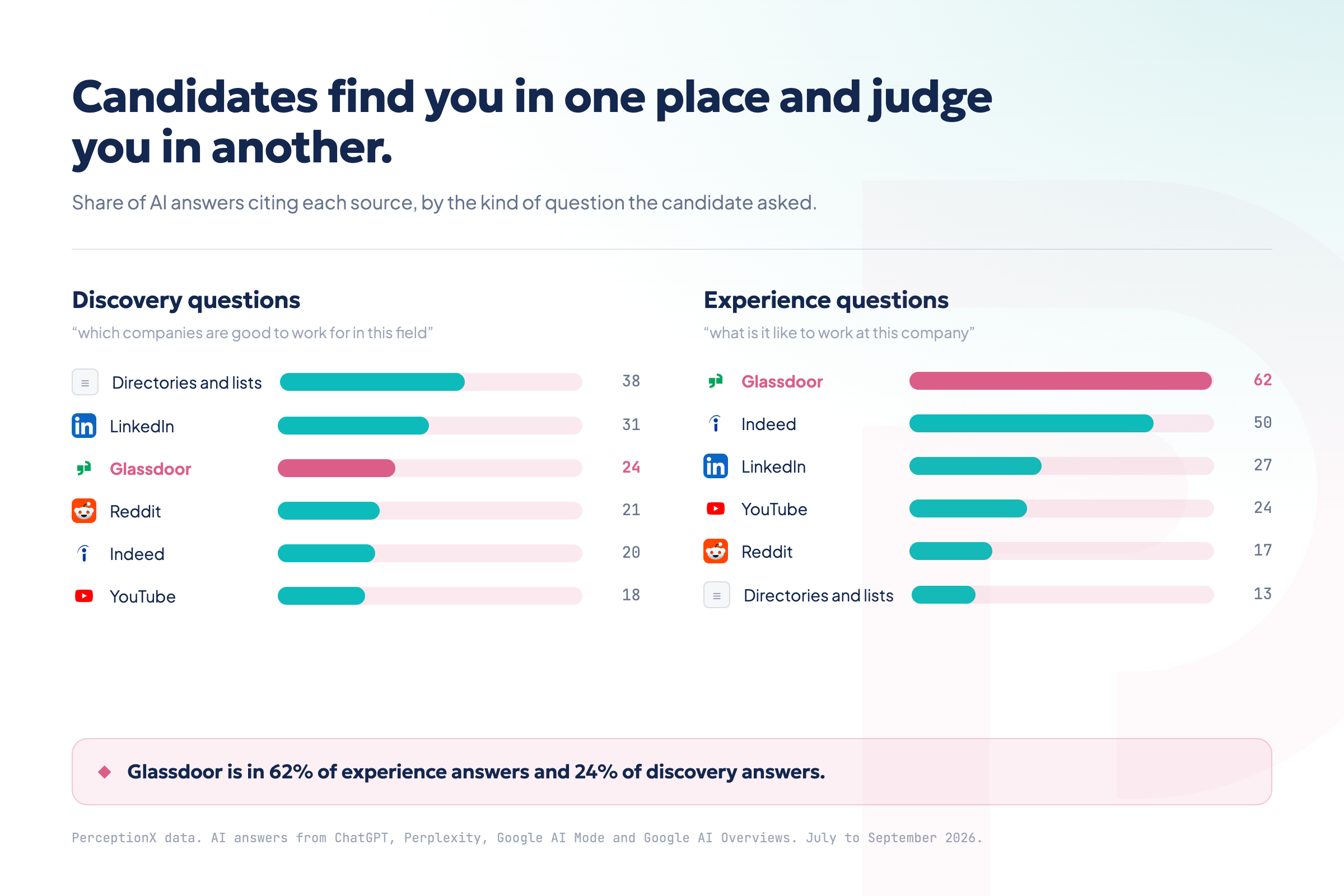
Read that table one row at a time and the problem is obvious. Glassdoor is in 62% of experience answers and 24% of discovery answers. Directories run the other way: 38% and 13%. Most employer brand programmes are built around review sites, which means the work is aimed almost entirely at the second column, where candidates who already know you decide whether you are any good. It does very little for the first column, where candidates find out you exist at all.
If nobody is discovering you, your Glassdoor rating is a question that never gets asked.
How to improve your employer brand in ChatGPT and other AI platforms
So what puts an employer into a discovery answer?
Honest answer: no single thing, and anyone who tells you otherwise is guessing.
We checked. Across the tracked set, an employer's visibility in discovery answers shows no reliable relationship with its sentiment, with the freshness of its sources, or with how heavily review sites feature in its answers. The employers that appear most are not the ones with the best ratings or the most content. There is no one number to push.
What the source mix does tell you is where the model looks when it is building a shortlist, and that is actionable enough. Four places, in the order the data puts them.
1. Third-party lists and directories. The single largest category in discovery answers at 38%. These are industry lists, "best places to work" compilations, sector directories, curated roundups, ecosystem databases. Most employers have no idea which ones cover their sector and market, and no process for being included in them. This is unglamorous, largely free, and the highest-leverage gap we see.
2. LinkedIn. 31% of discovery answers. Not the company page follower count, which no model reads and no candidate asks about. What gets picked up is public, substantive and attributed to a person: engineers describing what they are building, leaders writing about decisions they made, posts that name the team, the city and the problem rather than restating the values. A company page publishing campaign assets adds very little here. Fifty employees writing plainly about the work, in the markets you hire in, adds a great deal.
3. Reddit. 21% of discovery answers overall, and far higher in some markets: about a third of answers in the Philippines against 2% in Switzerland. You cannot manufacture a Reddit presence and should not try, but you should know what is there and whether it is accurate.
4. YouTube. 18% of discovery answers, and heavily weighted to particular markets, appearing in roughly three in ten answers in Brazil, Mexico and South Korea. Employers with no video presence are simply absent from a source that carries real weight in those places.
A fifth point that is not a source: the model has to have a reason to name you for a specific role in a specific country. Employers described only in general corporate terms tend to be absent from role-specific and market-specific questions, because there is nothing to connect them to the query.
Where employees and company culture fit
Employees are often the most credible source on culture that a model can find. When employees describe the culture in their own words, on LinkedIn, in communities and on review sites, AI tools like ChatGPT have something specific to repeat. When the only account of the culture is the employer's own, the model tends to fall back on review data.
That is why a strong employer brand in AI depends less on what the employer brand team publishes and more on what employees say in public. Focus on making it easy for employees to talk about the work: the team, the problems, how decisions get made and what the culture is like day to day. Do not script it. Scripted posts read as campaign material and add little.
The same applies to employer reputation more broadly. The employer brand is what you say about yourself; employer reputation is what employees, former employees and candidates say about you. AI answers are built mostly from the second.
What to fix on your careers page and company profile
Your own site is a minor ingredient in AI answers, but it is the one you fully control, and it is where the model checks practical detail. Make your employer content easy to quote.
- Careers page: state specifics. Where teams are based, what the hiring process and interview process look like step by step, how long they take, and what career development looks like in practice.
- Job descriptions: include the role, the team, the location, the pay range and what success looks like. Vague job descriptions give AI tools nothing to connect you to a role-specific question.
- Company profile pages: keep your LinkedIn, Glassdoor, Indeed and local review site profiles complete and current. Outdated profiles are a common source of wrong answers.
- Consistent content: the same facts and brand messaging on your careers sites, job postings, company profile pages and social channels. When sources disagree, AI answers either hedge or pick the wrong one.
- Remote policy and growth: say plainly, on the careers page and in job postings, where people can work from, how promotion works and what growth opportunities exist. Candidates ask about these often, and an answer with nothing to quote tends to fill the gap from review sites.
- Current employees: give them reasons and room to write about the work. Posts by people carry more weight in AI answers than posts by the company.
None of this replaces the discovery work above. It makes sure that once a candidate asks about you, the answer is accurate.
How to fix inaccurate AI information about your company
You cannot ask an AI assistant to correct what it says about you as an employer. The fix happens at the source the answer was built from.
- Find the source first. Use the sources you logged when checking the answers. Wrong pay, old locations or a retired benefit usually trace back to an outdated page, an expired job posting or a stale profile.
- Careers site: correct the page that states the wrong fact, and remove or redirect pages for closed offices, past programmes and old policies so they stop being read.
- Job descriptions: close expired job postings and make sure live ones state the current location, remote policy and pay range in the same words as the careers page.
- Review site profiles: claim your company profile on each review site that appears in answers in your markets, update the benefits, locations and company description, and reply to reviews that repeat a factual error with the correct detail.
Then re-run the same prompts. AI answers update as the sources are re-read, so expect a lag, and check each assistant separately.
The market problem
Everything above shifts at the border, which is why a global plan does not work. The table below shows the share of AI answers about employers in which each review site appeared, by country.
| Country | Glassdoor | Indeed | Local site |
|---|---|---|---|
| United States | 44% | 33% | n/a |
| United Kingdom | 49% | 31% | n/a |
| Germany | 36% | 15% | kununu 37% |
| Switzerland | 29% | 24% | kununu 50% |
| India | 46% | 20% | AmbitionBox 32% |
| Japan | 16% | 5% | n/a |
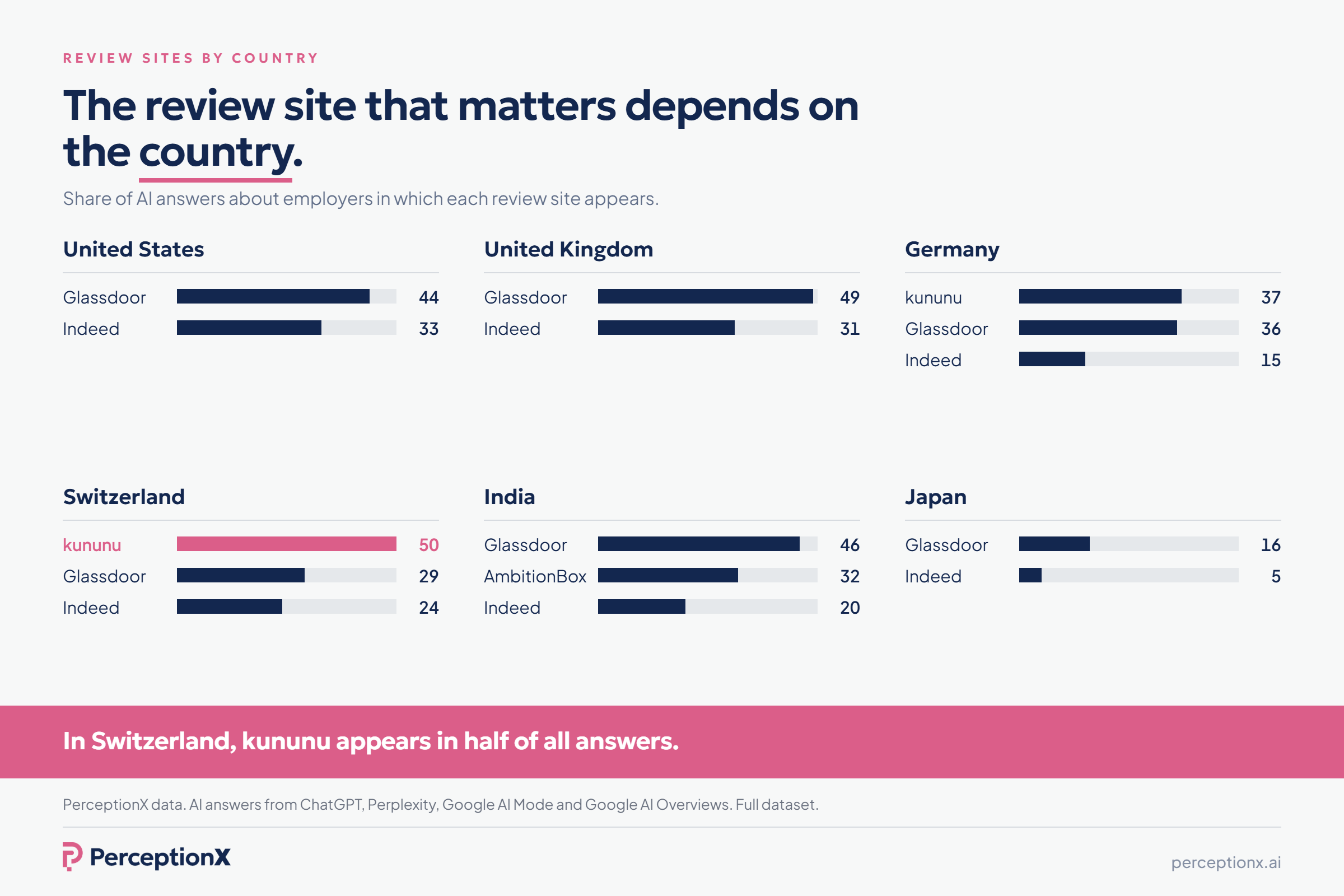
A team running one global source strategy is running the right strategy for two markets and the wrong one everywhere else. Every country needs its own source map, which is a smaller job than it sounds: identify the sources that actually appear in answers in that country, and work on those.
The surfaces disagree too
There is no single "AI". For the same discovery questions in the same period, the share of answers naming the tracked employer differed by surface.
| AI surface | Employer mentioned |
|---|---|
| Google AI Mode | 24% |
| Google AI Overviews | 18% |
| ChatGPT | 14% |
| Perplexity | 13% |
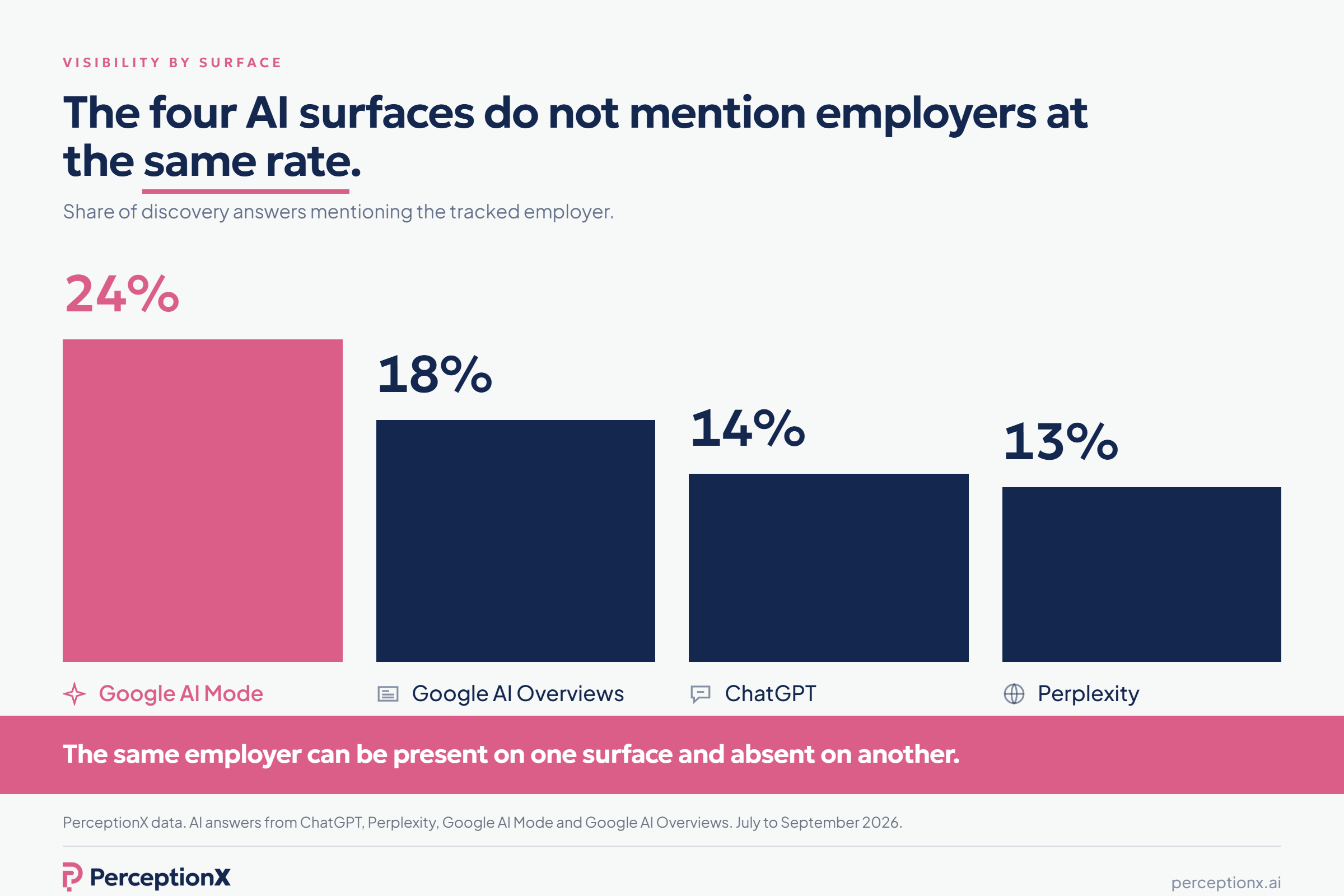
Worth knowing before anyone declares the problem solved on the basis of a few prompts typed into one assistant.
How to track employer brand visibility and sentiment in AI responses
Employer brand tracking in AI needs three measures, read per country, per function and per surface.
- Brand visibility: the share of discovery answers that name you. This is your employer brand visibility, and it is the measure most teams have never seen.
- Brand sentiment: of the points AI makes about you, the share that are positive. Track sentiment by attribute, because you can be described well on pay and badly on work life balance in the same answer.
- Accuracy and sources: whether the detail is correct, and which sources carried it.
Manual checks are a good start and a poor system. Continuous tracking, with the same prompts run repeatedly across multiple platforms, is what tells you whether anything changed. It lets you track changes in employer brand mentions, sentiment and sources quarter by quarter, so you know where to focus next. That is what PerceptionX does for talent acquisition teams, and the method is set out in employer branding metrics.
Tools to track how AI describes your employer brand
There are a few ways to do this, and they differ mainly in how much they can repeat and break down.
- Manual checks: run the prompts yourself across assistants and markets. Good for a first read, but answers vary between runs, location and language change the result, and it does not scale beyond a handful of questions.
- Spreadsheets: log each prompt, answer, mention and source in a shared sheet. That gives you a record over time, but someone has to run every prompt by hand and code sentiment consistently.
- General marketing AI-visibility tools: built for product and brand marketing. They track whether a brand appears in buying questions, not the questions candidates ask about employers, and rarely split results by job function or hiring market.
- Employer reputation platforms: PerceptionX is an employer reputation partner built for this, combining measurement, specific recommendations and advice from practitioners who have measured employer brand for years. It runs the questions candidates ask across ChatGPT, Google AI Overviews, Google AI Mode and Perplexity, by market, job function and language. It scores Visibility, Sentiment and Relevance in the Employer Perception Score, and traces each answer to its sources, so you can see which review sites, directories and LinkedIn posts carry your employer brand in each market.
Our scores are independent: they come from what AI actually says, not from what employers tell us.
A sequence that works
1. Measure first, at the level the answer is given. Not "are we in ChatGPT" but: in this country, for this function, on this surface, are we named, and if not, which sources did the answer use instead? Absence is the finding; the source list is the brief.
2. Read the answer for who else is in it. Your own absence is only half the information. The same answer names the employers the model considered worth recommending for that role in that market, and those are your real talent competitors, which are frequently not the companies on your competitor slide. Three things are worth recording each time. Which employers appear, and how often, per market. How that set changes between countries, because the companies you lose engineers to in Poland are rarely the ones you lose them to in Texas. And which sources are carrying them, since a competitor appearing through three sector directories you have never heard of is a specific, copyable instruction rather than a mystery. Done consistently, this turns a visibility check into a reading of the talent market: who owns the shortlist, where, for which roles, and on the strength of what evidence.
3. Fix the discovery layer before the experience layer. Find the lists and directories that appear in discovery answers for your sector and markets, and get into the ones you legitimately qualify for. Then look at whether there is enough public, role-specific, market-specific substance about your company for a model to connect you to the question.
4. Do the review-site work anyway, but know what it buys. It shapes what is said about you once you are found. It does not get you found.
5. Re-measure a quarter later. These answers are rebuilt continuously from sources that change. One reading tells you where you stand; two tell you whether anything you did worked, and whether the competitor set around you moved while you were working.
The uncomfortable part
You cannot buy your way in, and you cannot write your way in from your own domain. What sits behind these answers is other people's accounts of you: lists you qualified for, employees who posted something worth reading, communities that discussed you, press that covered the work.
Which is the old definition of reputation, arriving through a new door. The difference is that it is now measurable, per country, per function, per surface, per quarter. To dive deeper, the full measurement framework is set out in How to Measure Employer Reputation, and the distinction between the brand you publish and the reputation you hold is covered in Employer Brand vs Employer Reputation.
Frequently asked questions
How do I improve my employer brand in ChatGPT?
Measure first: run the questions candidates ask, in each country and for each role, and record whether you are named and which sources the answer used. Then work on those sources. For discovery answers that means third-party lists and directories, LinkedIn posts by employees, Reddit and YouTube. For experience answers it means review sites. Your careers page and job descriptions should give specific, consistent facts.
How can I track my employer brand in ChatGPT?
Run the same set of discovery, experience, competitive and informational prompts repeatedly on ChatGPT and the other AI platforms candidates use, and record visibility, sentiment, accuracy and sources each time. A single check is an anecdote; tracking only works when the same prompts are repeated over time.
What does ChatGPT say about my company?
It depends on the question, the country, the role and the surface. ChatGPT builds each answer from third-party sources such as review sites, LinkedIn, Reddit and directories, so the description can differ sharply between markets and can be out of date. The only way to know is to ask the questions candidates ask.
Can I pay to appear in ChatGPT answers about employers?
No. Nobody can guarantee placement in an AI answer. You can change the evidence the answer is built from and measure whether the answer changed.
Is AI reshaping employer branding?
Yes. Candidates now form a first impression from AI answers before they visit the careers site, and those answers are written from sources the employer does not control. Employer branding now includes managing those sources and measuring the answers.
What is an AI employer brand?
It is how AI tools describe you as an employer when candidates ask: whether you are named, what is said about your company culture, pay, work life balance and growth, and which sources the description comes from. It is built mostly from third-party sources, so it can differ from the employer brand you publish.
Why do ChatGPT responses differ from Google AI Overviews?
Each AI surface draws on its own mix of sources and builds its own answer. The same question can name different employers on ChatGPT, Perplexity, Google AI Mode and Google AI Overviews, which is why tracking one assistant is not enough.
Which AI tools should I check?
Check the assistants candidates actually use: ChatGPT, Perplexity, Gemini, Google AI Mode and Google AI Overviews. Ask the same questions on each, because each draws on different sources.
Does company culture content help in AI search?
Only when it is specific and repeated by others. General statements about values give a model little to quote. Concrete detail about teams, locations, hiring steps and how people progress, echoed in LinkedIn posts by employees and on review sites, gives AI search something to connect to the question.

Find out how AI is shaping your employer brand — and what you can do about it.