Employer Branding Examples: 5 Companies Doing It Well and What to Borrow

Employer branding examples are real cases of companies shaping how candidates and employees see them as a place to work, through what they offer, what they publish and how openly they share it. The best examples have one thing in common: they are specific. Instead of claiming a great culture, they show it with evidence anyone can check.
This guide looks at five well-known employer branding examples, what each one does differently, and the patterns any employer can borrow, whatever its size or budget. It also covers what makes an employer brand hold up now that candidates research companies through AI assistants as well as careers pages.
What is an employer brand?
An employer brand is the reputation an organisation has as a place to work. It is what current and prospective employees believe about pay, the work environment, career development, leadership and company culture, whether or not the company has ever written any of it down.
Every employer has one. The only choice is whether it is shaped by evidence the company publishes or left to rumour, old reviews and whatever an AI assistant pieces together.
At the centre of most employer brands sits an employer value proposition (EVP), sometimes called an employee value proposition. It is the honest answer to one question: why would a good person choose to work here, and stay?
A useful EVP links company values and core values to concrete things employees get: pay, flexibility, professional growth, the people they work with and the purpose behind the work. If the internal culture does not match the EVP, the gap shows quickly in reviews and in what employees tell friends.
Why is employer branding important?
Employer branding is important because candidates check before they apply. Job seekers read careers pages, review sites and social media, and increasingly they ask AI assistants what a company is like to work for.
A strong employer brand helps in three practical ways. It makes attracting candidates easier, because people already know what the company stands for. It improves the quality of applicants, because potential candidates who do not fit can rule themselves out early.
It also supports retention. When the job matches what was promised, people stay longer, and employee retention rates are one of the clearest signs that an employer brand is true.
For talent acquisition teams, that is a real competitive advantage in a tight talent market. Top talent and ambitious talent have choices, and they choose employers whose story they can verify.
The effects add up. A strong employer brand tends to lower cost per hire and time-to-fill, because fewer roles need repeated advertising. After people join, it supports higher employee engagement and loyalty, because the experience matches the promise.
Candidates also increasingly look for alignment between their personal values and their work. Purpose-driven employers tend to attract people who are committed to the mission, and those people are often the most loyal.
What makes a good employer branding example
The employer brands that stand out share four qualities:
- Specific: they describe concrete policies, numbers and practices, not adjectives.
- Public: they publish the detail where candidates can find it, not only in recruiting conversations.
- True: current employees recognise what is described, so reviews and word of mouth back it up.
- Consistent: the same story appears on the careers site, in job postings, on review sites and in what employees say.
These qualities matter more than ever because AI assistants now summarise employers for candidates. AI repeats what it can find and verify.
Specific, public, consistent evidence gets quoted; vague claims get ignored. An authentic employer brand is simply one where the published story and the lived experience are the same thing.
5 employer branding examples to learn from
The five employer brand examples below are well documented and easy to check. None of them relies on a big advertising campaign. Each one is built on a policy or practice the company made public.
1. GitLab: a public handbook as the employer brand
GitLab publishes its company handbook openly at handbook.gitlab.com, covering how the company works, its values, how decisions are made and how its all-remote model operates. Candidates can read how the company actually runs before they apply, rather than relying on a careers page summary.
Why it works: the handbook turns workplace practices into public evidence. Candidates and remote employees alike can see how meetings run, how work is documented and how the company's values apply to everyday decisions.
What to borrow: publish how work really happens. Even a few pages on how teams work, how performance is reviewed and how decisions are made gives candidates and AI assistants specific, credible material.
2. Buffer: transparent salaries
Buffer has published its salary formula and the salaries of its team for years, and offers a public salary calculator. Pay transparency is the employer brand: candidates know what they will earn and how pay is decided before they apply.
Why it works: pay is the question prospective candidates care about most and companies answer least. Answering it openly removes a source of doubt from the whole recruitment process and signals trust before anyone has met. This kind of radical transparency also reduces bad-fit hires, because people who disagree with the approach simply do not apply.
What to borrow: most employers will not publish every salary, but publishing pay ranges in every job posting and explaining how pay decisions are made answers the question candidates ask most, and gives AI an accurate answer to repeat.
3. Patagonia: purpose and benefits that match
Patagonia's employer brand is tied closely to its environmental mission, and its benefits back that up. The company has long offered on-site child care at its headquarters, and has written publicly about the business case for family support. The policy is the proof behind the brand.
Why it works: the company's mission, its sustainability efforts and its support for work-life balance point in the same direction. Candidates do not have to take the purpose on faith, because the benefits show it.
What to borrow: link your employer value proposition to one or two benefits or practices that clearly prove it, and explain why you offer them.
4. Atlassian: a clear flexible work policy
Atlassian introduced Team Anywhere, a distributed work policy that lets most employees choose where they work, and has shared research and practices on distributed work. The clarity of the policy is what makes it an employer brand asset: candidates do not have to guess how flexible the company really is.
Why it works: flexibility is easy to promise and hard to define. A named policy with clear rules tells candidates exactly what kind of work environment they are joining.
What to borrow: state your working model plainly, including office expectations, time zones and how often teams meet in person. Ambiguity about flexibility is one of the fastest ways to lose candidates late in the process.
5. Airbnb: one announcement, many questions answered
In 2022 Airbnb announced that employees could live and work anywhere in the country they work in without a pay change, with the option to spend time working from other countries. The announcement answered the questions candidates care about, such as location, pay and travel, in one clear statement that was widely reported.
Why it works: one policy change became an employer branding moment because it was explained fully and in public. Senior management made the decision visible, and the detail travelled further than any advert.
What to borrow: when you change a policy that affects candidates, explain it in plain terms, answer the obvious follow-up questions upfront and publish it where candidates and AI will find it.
Employer branding examples by approach
Great employer branding is not only for famous companies. These approaches work for employers of any size.
Careers pages that answer real questions
The strongest careers pages answer what candidates ask: pay, the hiring process, team structure, career growth and the first months in the job. A dedicated FAQ page, written in plain language and kept current, often does more than a brand video.
Job descriptions that describe the real job
Job descriptions are often the first and only thing a candidate reads. The best ones describe the actual work, the team, the pay range, the working pattern and what success looks like after the first few months.
Generic lists of requirements and claims about a fast-paced environment tell candidates nothing. Specific job descriptions also give AI assistants accurate material to repeat when someone asks about a role.
Employee-led content
Day-in-the-life posts, team blogs and employee testimonials written by employees, in their own words, carry more weight than corporate copy. The best employee advocacy programmes give people topics and support, not scripts.
Showcase employee testimonials with context
The most useful way to showcase employee testimonials is to attach them to something concrete: a project, a promotion, a move between teams or a policy the person used. Authentic stories with real detail are far more convincing than quotes about a great team.
To share employee stories well, encourage employees to write or record them themselves, and edit lightly. Employee generated content works because it sounds like a person, not a brochure.
Employee development you can see
Career development is one of the main reasons people join and leave. Employers that publish how promotion works, what training is available and how internal moves happen give candidates a clear picture of professional growth.
Mentoring, internal job boards and visible examples of people who moved up all count as evidence. Employee development only works as an employer brand message when people inside the company can point to it.
Employee resource groups and recognition
Employee resource groups give employees a voice and show candidates who they will find inside the company. When groups publish what they do, the work becomes part of the employer brand.
Employee recognition works the same way. Regular, specific recognition for real work, shared internally and sometimes externally, tells candidates what the company values in practice. Company events can do this too, as long as they reflect daily life rather than a one-off show.
A strong sense of community inside the company also tends to go with higher employee satisfaction, which in turn shows up in reviews and referrals.
Diversity and inclusion that shows up in hiring
Inclusive hiring practices, such as structured interviews, diverse interview panels and job descriptions written without unnecessary requirements, help employers attract talent from a wider range of backgrounds.
Employers that publish their diversity, equity and inclusion commitments, and report honestly on progress, also strengthen their wider reputation. Claims without follow-through do the opposite.
Benefits that support well-being
Competitive benefits and real support for employee well-being are part of the employer brand, not just the reward package. Candidates look for the detail: parental leave, mental health support, flexible hours and how easy these are to use in practice.
Publishing that detail, and showing employees who use it, turns a benefits list into evidence.
Corporate social responsibility that employees can see
Corporate social responsibility supports an employer brand when employees take part in it and can describe it. Volunteering time, community projects and environmental commitments with clear owners are more credible than a page of pledges.
The test is simple: would a current employee mention it unprompted? If not, it is not yet part of the employer brand.
Honest review responses
Employers that respond to reviews on Glassdoor, Indeed and local review sites, especially negative ones, show candidates that feedback is heard. A thoughtful response to a critical review can do more for credibility than ten positive ones.
Social media, job boards and recruitment marketing
Social media gives employers a place to show daily life: team moments, real projects and the people behind the work. Job boards reach active candidates who are already comparing offers. Both work best when they repeat the same message as the careers site.
Authentic employee stories shared on social media also reach people that company accounts never will, which is why employee advocacy and employer branding work so well together.
Recruitment marketing is how an employer promotes open roles and its employer brand to the right people. Employer branding is what makes that promotion believable.
Interactive recruitment experiences, such as realistic job previews, open days or online challenges, can lift application rates when they show the real job rather than a polished version of it.
Local-market employer brands
Global employers that do well adapt their employer brand by market: local review sites, local languages and the benefits that matter in each country, while keeping one core value proposition.
Employer branding vs recruitment marketing
The two are often confused. Employer branding is the long-term reputation of the company as a place to work. Recruitment marketing is the set of employer branding campaigns, adverts, emails and events used to fill specific roles.
A recruitment marketing campaign can bring people to a careers page. Only the employer brand tells them whether to stay and apply. When the employer brand is weak, recruitment marketing gets more expensive, because each campaign has to work harder to convince people.
The four Ps of employer branding
A common framework for employer branding initiatives is the four Ps. It is a simple way to check that an employer brand covers what candidates care about.
- People: who candidates will work with, how they are managed and how the team treats each other.
- Purpose: what the organisation is for and why the work matters, linked to the company's mission.
- Place: where and how work happens, including location, flexibility and the work environment.
- Product: what the company makes or does, and why someone would be proud to work on it.
Most of the examples above lean on one P more than the others. GitLab leads with place, Atlassian with place and flexibility, and Patagonia with purpose. A complete employer branding strategy covers all four.
How to build an authentic employer brand
The best employer branding examples did not start with a campaign. They started with a working environment worth describing, and then described it plainly. Here is how to do the same.
Start with employee feedback
Gather employee feedback before writing a word. Employee surveys, exit interviews, stay interviews and review sites show what employees actually value and where the experience falls short.
Look at the whole employee journey, from application to onboarding, promotion and leaving. Employee engagement and employee satisfaction results tell you where the story is strong enough to publish and where the workplace culture needs work first.
Write a clear employer value proposition (EVP)
Turn what you learn into a short employer value proposition. Keep it specific: name the benefits, the working model and the growth paths that make the company different.
Test it with current employees. If they do not recognise it, rewrite it. A compelling employer brand is one employees would describe the same way without being asked.
Agree who owns it: senior management, talent acquisition and the marketing team
Employer branding works best as a shared job. Senior management sets the policies that become the proof points. Talent acquisition knows what candidates ask. The marketing team knows how to publish and keep the message consistent.
Without clear ownership, the careers site, job postings and social media drift apart, and candidates notice.
Engage employees as the main voice
Engage employees by asking them to share what they do and why, not by handing them scripts. People trust other employees far more than corporate copy.
A meaningful employee experience produces the stories, and employee advocacy carries them further. A powerful employer brand is usually just many employees saying similar, specific things.
Lessons from the best employer branding examples
- Show, do not tell. Policies, numbers and documents beat adjectives.
- Publish the detail. If the answer is not public, candidates and AI will look for it somewhere else.
- Make it true first. The best examples start with an employee experience worth describing.
- Stay consistent. The careers site, job postings, review responses and employee voices should tell the same story.
- Measure what candidates actually hear. An employer brand is what people believe, not what you publish. Check it regularly.
How to check your own employer brand
A useful test is to ask an AI assistant what it is like to work at your company, in each market where you hire, and compare the answer with your employer value proposition. In PerceptionX research, 58% of job seekers had caught AI giving inaccurate information about an employer, so the answer may not match what you publish.
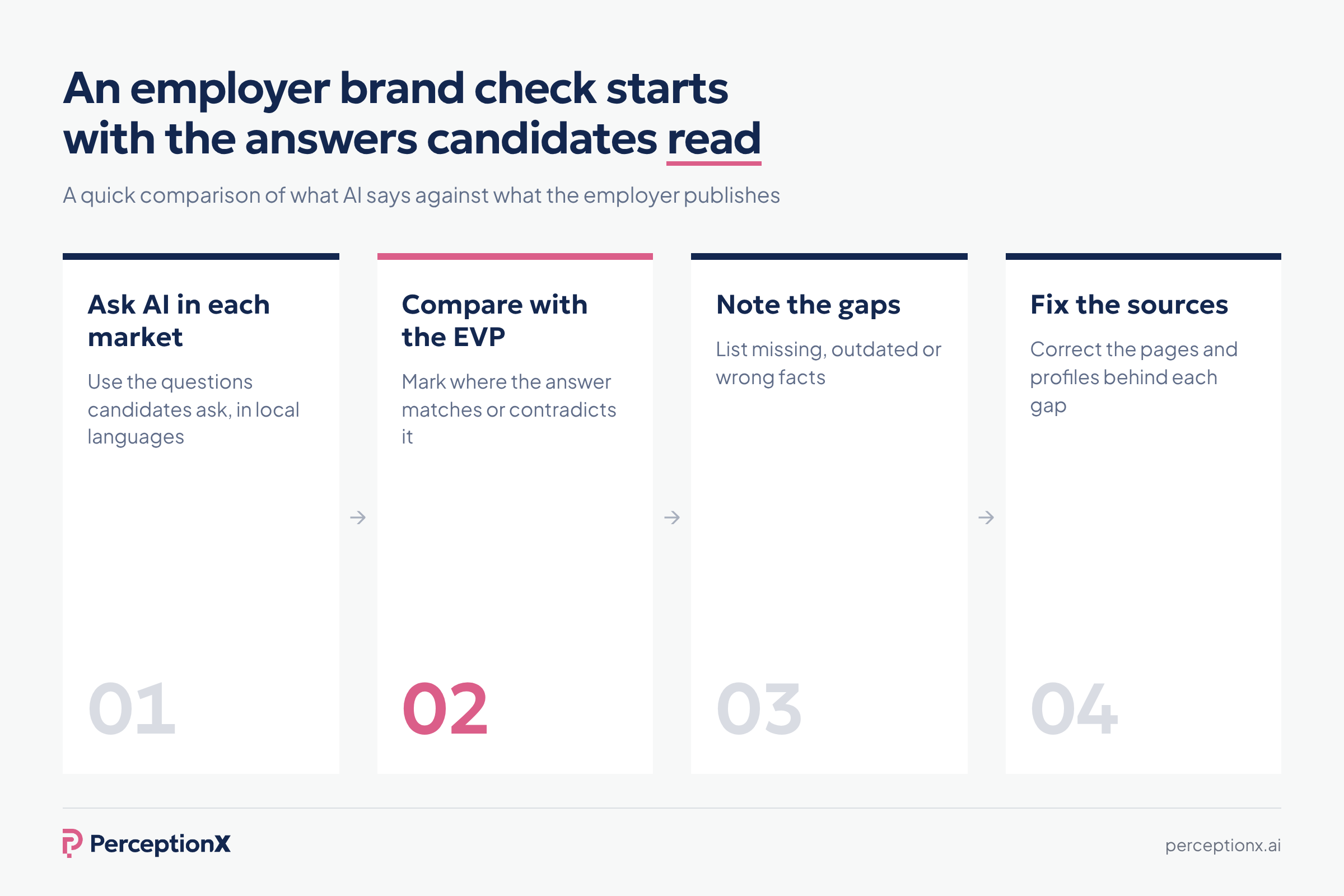
Where it does not, trace the answer back to its sources and fix them. PerceptionX measures this systematically across markets, job functions and AI models.
Measurement is only the start: every finding comes with recommendations on what to change, and practitioners who have measured employer brand for years help your team act on them.
Alongside AI answers, track the signals that show whether the employer brand is working: the quality of applicants, time-to-fill, offer acceptance, employee retention rates and what reviews say over time. Employee retention rates in particular show whether employer branding initiatives are working, because they reflect whether the promise held. Brand reputation as an employer moves slowly, so look for steady direction rather than single spikes.
Done well, employer branding contributes directly to the company's success, because the right people find you, join and stay.
For the steps to build your own approach, read our guide to employer brand strategy, and for the fundamentals see what is employer branding.
Frequently asked questions
What are some good employer branding examples?
Well-known examples include GitLab's public company handbook, Buffer's transparent salaries, Patagonia's purpose-led benefits such as on-site child care, Atlassian's clear distributed work policy and Airbnb's live and work anywhere announcement. Each makes the employer brand specific and public.
What makes an employer brand strong?
A strong employer brand is specific, public, true and consistent. It describes real policies and practices, publishes them where candidates can find them, matches what current employees experience and tells the same story across every channel.
Can small companies have a strong employer brand?
Yes. Small companies can stand out with clear careers pages that answer real questions, published pay ranges, employee-led content and honest responses to reviews. None of these needs a large budget.
How do I improve my employer brand?
Start by finding out how candidates, employees and AI assistants describe you today. Then close the gap with specific evidence: clearer careers pages, pay ranges in job postings, active review responses and employee stories, and measure the change over time.
What is an employer brand?
An employer brand is an organisation's reputation as a place to work: what candidates and employees believe about its pay, culture, flexibility, leadership and career prospects. It exists whether or not the company manages it.
What are the four Ps of employer branding?
The four Ps are people, purpose, place and product. Together they cover who you work with, why the work matters, where and how work happens, and what the company makes or does.

Find out how AI is shaping your employer brand — and what you can do about it.