Employer Brand Strategy: How to Build One for 2027, Step by Step

An employer brand strategy is the plan for how a company will shape what candidates, employees and the wider market believe about it as a place to work, and how it will measure whether that belief is changing. It sets out the employer value proposition, the audiences that matter, the channels and sources that reach them, the people who own the work and the metrics that show progress. A good employer branding strategy turns a vague goal, "be seen as a great place to work", into decisions about where to spend time and money.
Done well, it gives a company a real competitive advantage in the market for top talent. A strong employer brand helps you attract and retain the people the business needs, makes every hire easier and supports employee retention.
A well defined employer brand also gives recruiters, hiring managers and current employees one story to tell, so candidates and employees hear the same thing wherever they look.
This guide covers how to build an employer brand strategy for 2027, step by step, and what has changed. The biggest change is that more of a company's employer brand is now written by sources it does not control, and read back to candidates by AI assistants.
Why does employer branding matter?
Employer branding focuses on one question: why would a good candidate choose to work here rather than somewhere else? Every company has an employer brand, whether it manages it or not.
It is the sum of what candidates and employees say, read and hear about the organisation as a place to work.
A positive employer brand makes hiring easier. Qualified candidates are more likely to apply, more likely to accept an offer and more likely to stay.
A weak or unclear one does the opposite. Recruiters spend more time persuading, offers are turned down and new hires leave when the reality does not match what they were told.
The employer brand also shapes the wider brand reputation. Customers, investors and future employees read the same reviews and the same news stories, so how a company treats its people, and how former employees talk about it, feeds into overall brand perception, not just recruitment.
Employer brand versus employee branding
The two terms are often confused. The employer brand is the company's reputation as a place to work. Employee branding is the work of helping employees understand and reflect the company's values in how they work and how they talk about the company.
A strong employer branding strategy needs both: a clear promise, and employees who recognise it and can speak to it in their own words.
Why employer brand strategy looks different in 2027
For years, employer branding strategy focused on what companies published: careers pages, campaigns, social media and recruitment marketing. That still matters, but it is no longer where most candidates form their first impression.
Job seekers now research employers through AI assistants. In PerceptionX research across seven countries, 96% of job seekers had used AI to research an employer, learn about a role or prepare for an interview, and 82% said an AI answer had changed their mind about a company as a place to work.
Those answers are built from review sites, job platforms, forums and the employer's own pages.
PerceptionX data shows which sources matter most. In October 2026, an employer's own site appeared in more than half of AI answers about employers, and in 86% of answers to factual questions about pay, benefits or the hiring process. For questions about what it is like to work somewhere, more than four in five answers drew on review sites, job platforms or employee forums.
A modern employer brand strategy has to manage all of those sources, not just the ones the brand team publishes.

How to build an employer brand strategy in 10 steps
1. Start with business goals and hiring plans
An employer branding strategy exists to help the business hire and keep the people it needs. Start with the hiring plan: which roles, in which markets, how many and how hard to fill. Add retention goals and any changes coming, such as new locations, acquisitions or restructuring.
Link the strategy to the company's mission as well. Candidates want to know what the business is trying to achieve and how their role contributes to it. Every later decision should trace back to these goals.
2. Audit your current employer brand
Before deciding what to say, find out what people already believe. An employer brand audit covers employee surveys, candidate feedback, review sites, social media, exit interviews and, increasingly, what AI assistants tell candidates in each market.
Use more than one method. Employee surveys show scale, focus groups show the reasons behind the scores, and interviews with recent hires and former employees show where the promise and the reality part ways.
Look at employee satisfaction and employee engagement by team and location, not just the company average. Read employer review sites the way candidates do, starting with the most recent reviews and the themes that repeat.
The gap between what you want to be known for and what people actually hear is where the strategy starts.
3. Define your target talent audiences
Not every candidate cares about the same things. Define the talent segments that matter most, such as engineers, graduates, frontline workers or senior leaders, and what each group values, where they research employers and which competitors they compare you with.
Candidate personas are useful if they are built from real research, not assumptions.
This is also the point to look at the recruitment process from the candidate's side: how long it takes, how often candidates hear back and how each stage feels. Candidate experience is part of the employer brand, and candidates talk about it.
4. Build a compelling employer value proposition
The employer value proposition (EVP) is the core of the strategy: what the company offers in return for people's work, across pay and benefits, career growth, culture, flexibility, purpose and the work itself. A strong EVP is specific, true for current employees and different from competitors.
A compelling employer value proposition covers the areas candidates weigh most: rewards and employee benefits, career growth, company culture and workplace culture, work-life balance and flexibility, and the purpose of the work. Culture claims need the same evidence as pay: how teams work, how decisions get made and what employee resource groups exist and actually do.
The EVP should sit alongside the corporate brand identity without copying it. The tone and visuals can match, but the promise is about work, not products.
Test it with employees before you publish it. If people inside do not recognise it, candidates will not believe it.
5. Turn the EVP into proof, not slogans
Candidates and AI assistants both look for evidence. Replace claims such as "we invest in our people" with specifics: how many people moved internally, how long parental leave is, how the promotion process works, what hybrid working looks like in practice.
Specific, checkable detail is what AI quotes and what candidates trust.
Employee stories and employee testimonials are the strongest proof, as long as they describe actual employee experiences rather than polished quotes. A short account of how someone moved teams, returned from parental leave or earned a promotion does more than any slogan. This is how an authentic employer brand is built.
6. Fix the career site first
The career site is the one source you fully control and one of the sources AI cites most. Build it around the questions candidates ask: pay ranges, the hiring process, team structures, career development and what the first months look like.
One clear answer per page, dated and written in plain language, beats any campaign.

7. Manage the sources you do not control
Claim and update your profiles on job platforms and review sites in every market where you hire, including local review sites, which matter more than global ones in many countries.
Respond to reviews, positive and negative. A short, specific reply that explains what has changed shows candidates that the company listens. Our guide to employer reputation management software covers the tools that help.
8. Activate employees as your most credible voice
Employee advocacy works when people share real experiences in their own words. Give employees topics, training and recognition rather than scripts, and extend advocacy beyond social media to honest reviews and employee forums, which is where AI reads the employee voice.
Encourage employees to post when they have something real to say, such as a project they are proud of or what they learned in a new role. Brand ambassadors work best as volunteers with time set aside for it, not as a quota. Employee resource groups are often a natural starting point, because their members already talk about the company in public.
9. Choose channels by audience and market
Pick channels based on where each talent segment researches employers, not on habit. That usually means the career site, LinkedIn, the main review and job platforms, and local platforms in priority markets, with campaigns and events layered on top.
Choose social media platforms by audience too: graduates and engineers rarely research employers in the same places. Budget by market rather than by region. Our guide to setting an employer branding budget covers how to allocate it.
10. Measure your employer branding efforts and adjust
Decide upfront how you will know the strategy is working. Track perception (how candidates and AI describe you), attraction (qualified applicants, career site conversion), experience (employee engagement and retention) and efficiency (time to fill, cost per hire, offer acceptance).
Keep the list of key performance indicators short enough that leadership will read it, and report employer brand performance alongside hiring results so the link is visible. Review quarterly and move effort to what works. Successful employer branding is continuous improvement, not a one-off campaign. Our guide to employer branding metrics sets out how to calculate each one.
What makes a strong employer brand
Building a strong employer brand is less about creative campaigns and more about the match between what a company says and what employees experience. The most effective employer branding strategies share a few traits.
- It is true. A compelling employer brand describes the job and the company the way current employees would. An attractive employer brand that overpromises loses people in their first months.
- It is specific. A robust employer brand rests on details candidates can check: pay ranges, career paths, flexibility rules and how the hiring process works.
- It is consistent. A consistent employer brand tells the same story on the career site, in job postings, on review sites and in interviews, and adapts the detail by audience and market.
- It is owned. Someone is accountable for the result, with a budget and the authority to fix gaps.
A strong employer brand requires the employee experience to back it up. If the brand and the reality diverge, reviews and forums will expose the gap, and AI assistants will repeat it to candidates. That is why the best branding efforts start inside the company.
Employer brand messaging and recruitment marketing
Once the EVP and proof points are agreed, the employer brand messaging has to reach every place candidates look. Four areas need the most attention.
Job descriptions and job postings
Job descriptions are often the first thing a candidate reads, and the most neglected. Rewrite them around the work, the team and what success looks like, and include pay ranges where you can.
Job postings on external platforms should carry the same detail as the career site, because AI assistants read both.
Social media presence
A steady social media presence built on employee stories and company news, such as a new office, a team milestone or how the business handled a change, does more than occasional campaign bursts.
Post where each audience already spends time, and let employees speak rather than the corporate account alone.
Internal communications
Internal communications are part of the employer brand. Employees should hear about the EVP, changes to benefits and company news from the company first, not from a review site or a news story.
Employees who understand the strategy are more likely to support it, and more likely to describe the company accurately when candidates ask.
Brand consistency
Brand consistency matters across every touchpoint. Agree a short set of messages, a tone of voice and proof points, then check that recruiters, hiring managers and agencies use them.
Recruitment marketing platforms and recruitment marketing tools can help distribute content and show where applicants come from, but they only amplify the messages you give them.
Employer brand strategy template
A one-page employer brand strategy keeps everyone aligned. Use this structure as a template and fill in each row for your company.
| Component | Question it answers | Typical owner |
|---|---|---|
| Business goals | Which hires and retention outcomes does the business need? | Talent acquisition with leadership |
| Current perception | What do employees, candidates and AI assistants say about us today? | Employer brand team |
| Target audiences | Which talent segments matter most, and what do they value? | Talent acquisition |
| Employer value proposition | What do we offer that is true, specific and different? | HR with employer brand |
| Proof points | What evidence backs each part of the EVP? | Employer brand team |
| Sources and channels | Where does each audience research us, by market? | Employer brand with marketing |
| Metrics | How will we know perception and hiring are improving? | Talent acquisition with finance |
Who owns the employer brand strategy
In most large companies, talent acquisition or HR owns the employer brand strategy, with marketing and communications as close partners. The arrangement matters less than clarity: one owner who can connect the strategy to hiring outcomes, with agreed roles for HR, marketing, communications, hiring managers and leadership.
Employer branding fails most often when it sits between teams and nobody is accountable for the result. Whoever owns employer branding needs a seat in talent acquisition planning and a direct line to leadership.
Leadership support matters too. The employer brand is shaped by decisions far outside the brand team, from pay and promotion to how restructuring is handled. A strategy that leadership has signed up to is far more likely to survive contact with reality.
Common employer brand strategy mistakes
- Starting with the message. Writing the EVP before auditing perception produces claims nobody believes.
- Generic claims. "Great culture" and "growth opportunities" say nothing. Specific evidence wins.
- Ignoring the sources AI reads. A strategy that only covers owned channels leaves reviews, job platforms and forums to chance.
- One strategy for every market. Candidates in different countries use different sources and value different things.
- Measuring activity, not outcomes. Posts published and campaign reach do not show whether perception changed.
- Treating it as a campaign. Employer branding initiatives that stop when the campaign ends leave nothing behind. The strategy needs owners and a quarterly rhythm.
- Promising what the employee experience does not deliver. The fastest way to damage an employer brand is to overstate it.
Employer brand strategy for global employers
Global employers face an extra challenge: they hold a different reputation in every market.
The sources AI relies on differ by country. In October 2026, kununu appeared in 42% of AI answers about employers in Germany and AmbitionBox in 34% in India, so a strategy built around one global review site will miss the platforms candidates actually read in those markets.
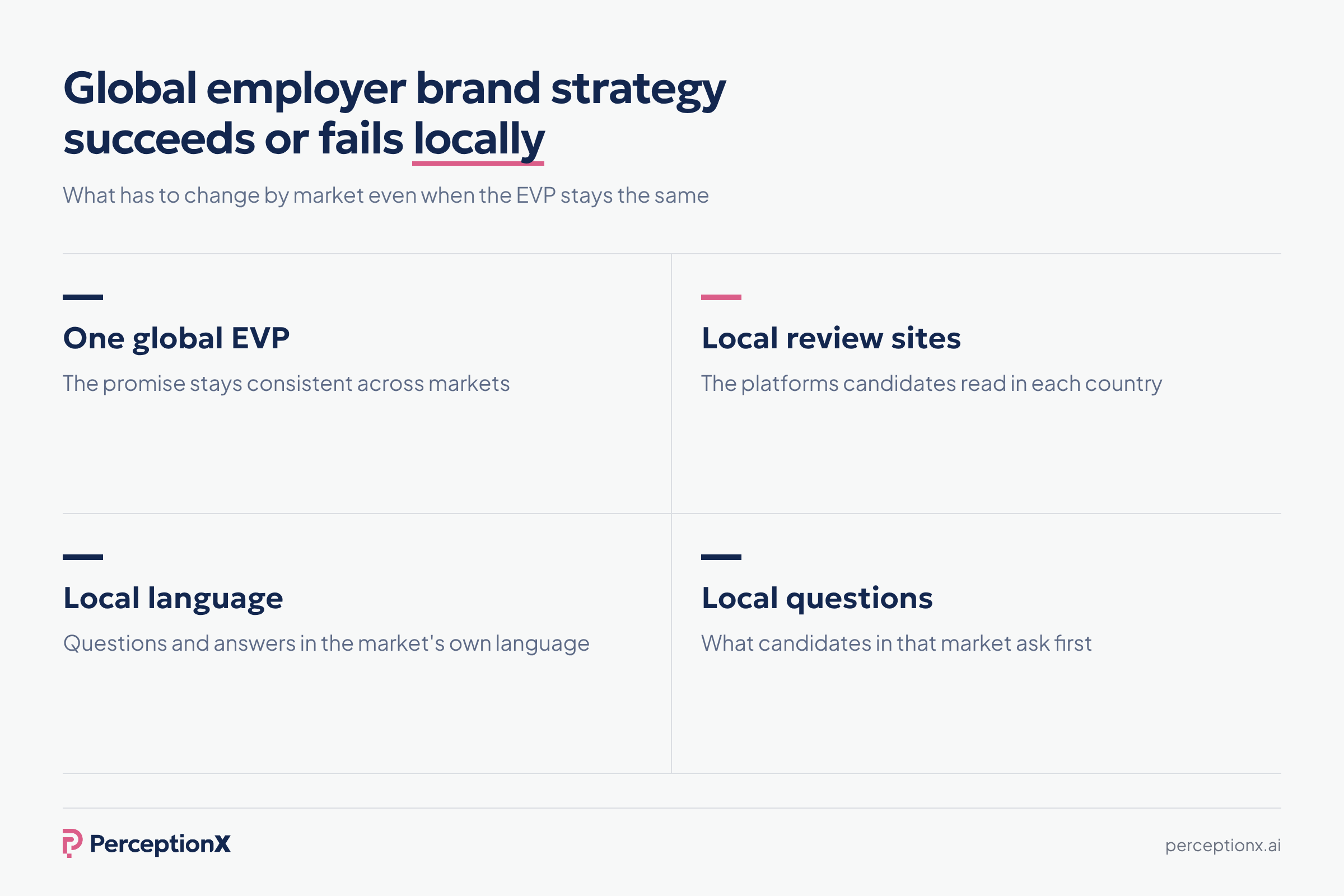
A global employer brand strategy keeps one EVP at the core and adapts the proof, channels and priorities by market. It measures every country separately, because a global average hides the market that is dragging the number, and it gives local teams the tools to manage local sources.
Your first 90 days
An employer brand strategy does not need a year of planning before anything changes. A practical first 90 days looks like this.
- Days 1 to 30: agree the business goals, run the audit, including what AI assistants tell candidates in your priority markets, and interview employees and recent hires.
- Days 31 to 60: draft and test the employer value proposition, collect proof points, and fix the most visible gaps on the career site and your main review and job platform profiles.
- Days 61 to 90: launch employee advocacy with a small group, set the metrics and baseline, and agree the budget and owners for the year.
By the end of the quarter you have a strategy grounded in evidence, early fixes in place and a baseline to measure against. For inspiration on what good looks like, see our roundup of employer branding examples.
How PerceptionX supports employer brand strategy
PerceptionX is the only employer reputation partner built for how candidates now research employers. It brings together three things: technology that measures what AI tells candidates about you, specific recommendations on what to change, and advice from practitioners who have measured employer brand for years. It shows what ChatGPT, Google and other AI assistants tell job seekers about working for a company: whether they recommend it, what they say about it and which websites those answers come from, in every market and for every type of role. Our scores are independent: they come from what AI actually says, not from what employers tell us. For employer brand strategy, that gives teams an objective baseline before they plan, a way to prioritise markets and sources, and a measure of whether the strategy changed what candidates hear. For what is changing next year, see our employer reputation trends for 2027.
Key takeaways
- An employer brand strategy is the plan for shaping and measuring what people believe about you as a place to work.
- Start with business goals and an honest audit, then build a specific, tested employer value proposition.
- Prove the EVP with checkable detail on the career site, profiles and review sites, because that is what candidates and AI read.
- Use employees as your most credible voice, choose channels by audience and market, and measure outcomes every quarter.
Frequently asked questions
What is an employer brand strategy?
An employer brand strategy is the plan for how a company shapes what candidates, employees and the market believe about it as a place to work, and how it measures whether that belief is changing. It covers the employer value proposition, target audiences, channels and sources, ownership and metrics.
What are the steps to build an employer branding strategy?
Start with business goals and hiring plans, audit your current employer brand, define your target talent audiences, build or refresh the employer value proposition, turn it into specific proof, fix the career site, manage the review sites and job platforms you do not control, activate employees, choose channels by audience and market, and measure and adjust every quarter.
What is the difference between employer brand and employer branding strategy?
The employer brand is what people believe about you as an employer. The employer branding strategy is the plan to shape and measure that belief, including what you say, where you say it and how you prove it.
Who should own the employer brand strategy?
In most large companies, talent acquisition or HR owns it, with marketing and communications as partners. What matters most is a single accountable owner who can connect the strategy to hiring outcomes.
How do you measure an employer brand strategy?
Track perception, including how candidates and AI assistants describe you, alongside attraction metrics such as qualified applicants, experience metrics such as engagement and retention, and efficiency metrics such as time to fill, cost per hire and offer acceptance. Compare each against a baseline every quarter.
How is AI changing employer brand strategy?
Candidates increasingly research employers through AI assistants, which build their answers from career sites, review sites, job platforms and forums. Employer brand strategy now has to manage those sources and measure what AI tells candidates, not just what the company publishes.
What should an employer brand strategy template include?
A one-page template should cover business goals, current perception, target audiences, the employer value proposition, proof points, sources and channels by market, and metrics, with a named owner for each row.
What makes a strong employer brand?
A strong employer brand is true, specific, consistent and owned. It describes the company the way current employees would, backs every claim with detail candidates can check and tells the same story on the career site, in job postings and on review sites.
How long does it take to build an employer brand strategy?
A first version can be in place within a quarter: audit and interviews first, then the EVP and the most visible fixes, then advocacy, metrics and a baseline. After that, the strategy is reviewed and adjusted every quarter.

Find out how AI is shaping your employer brand — and what you can do about it.