Employer Brand Intelligence: What It Is and How to Build It

Employer brand intelligence is the evidence an organisation gathers about how it is perceived as an employer, compared with the employers it competes with for talent, and turned into decisions about what to fix first. It combines employer branding data from reviews, surveys, hiring outcomes, social channels and, increasingly, AI answers into one view of where you stand and why.
This guide explains what employer brand intelligence is, how it differs from employer branding analytics and talent intelligence, which data sources it draws on, and how to build a programme that changes decisions rather than filling dashboards.
What is employer brand intelligence?
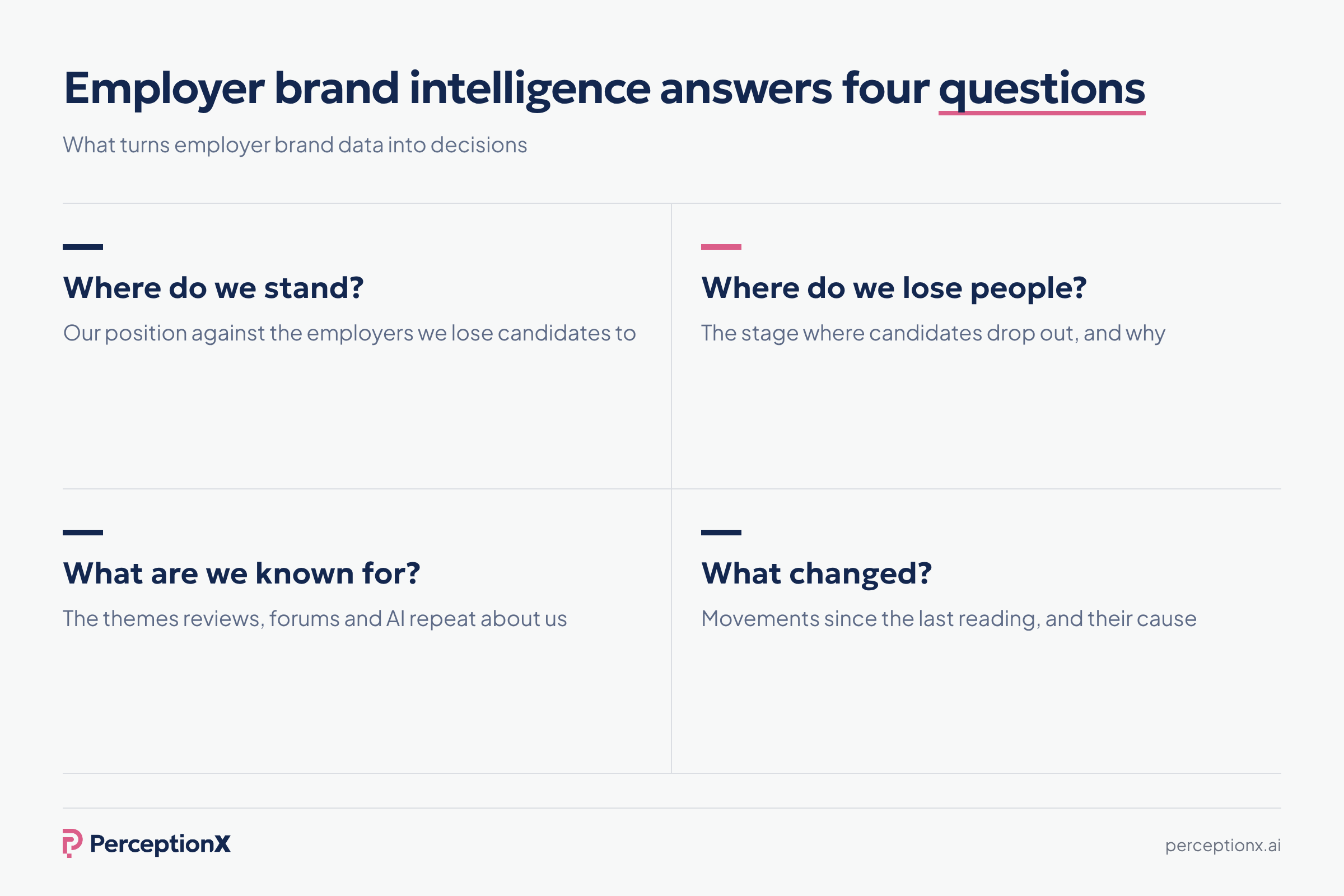
Most employer brand teams have plenty of data: careers site traffic, campaign reach, review ratings, survey scores. Employer brand intelligence is what you get when that data is organised around a few questions that matter to the business:
- How are we perceived as a place to work, by the people we want to hire?
- How does that compare with the employers we lose candidates to?
- Where in the hiring journey does perception cost us candidates?
- What changed since the last reading, and what caused it?
The word intelligence matters. Data describes; intelligence explains and points to an action. An average review rating is data. Knowing that engineering candidates in one market rate you lower on career growth than your two closest competitors, and that the theme traces back to a set of old forum threads, is intelligence.
Employer brand intelligence vs analytics vs talent intelligence
The three terms overlap, and vendors use them loosely. A practical way to separate them:
| Discipline | Main question | Typical data |
|---|---|---|
| Employer branding analytics | Are our employer brand activities performing? | Careers site visits, campaign reach, applications by source, cost per hire |
| Talent intelligence | Where is the talent we need, and what does it cost? | Labour market supply, salaries, skills, competitor hiring |
| Employer brand intelligence | How are we perceived as an employer against our talent competitors, and why? | Reviews, surveys, candidate feedback, offer declines, social and forum discussion, AI answers |
Analytics looks inward at your own activity. Talent intelligence looks at the labour market. Employer brand intelligence looks at perception: what the market believes about you, and how that belief affects who applies, accepts and stays. For the activity side, see our guide to employer branding analytics.
The data behind employer brand intelligence
No single source gives the full picture. A useful programme combines internal and external employer brand data:
- Hiring funnel data. Applications, drop-off by stage, offer acceptance and the reasons candidates give when they decline. Offer declines are among the most honest signals you have.
- Candidate and employee feedback. Candidate experience surveys, onboarding surveys and exit interviews, read for recurring themes rather than averages.
- Review sites. Ratings and, more usefully, the themes in reviews on Glassdoor, Indeed and local review sites in each market.
- Social and forum discussion. What employees and candidates say on LinkedIn, Reddit and industry forums, where opinions are less filtered.
- Perception research. Surveys of target talent who have never applied, to understand awareness and consideration.
- AI answers. What ChatGPT, Gemini, Google AI Overviews and Perplexity tell candidates who ask about you, and which sources those answers rely on.
- Competitor signals. The same sources read for the employers you compete with, so every number has a comparison.
The last two are where most programmes are weakest. Without competitor data, you cannot tell whether a score is good. Without AI answers, you miss the summary that a growing share of candidates read first.
How to build an employer brand intelligence programme
- Name your talent competitors. List the employers you actually lose candidates and offers to, by market and job function. This is your comparison set, and it is often different from your commercial competitors.
- Choose a small set of questions. Start with the four above. Every data source you add should help answer one of them.
- Map sources to the hiring journey. Awareness, consideration, application, offer, first year. Each stage has its own signals, and gaps between stages show where perception costs you people.
- Set a baseline. Record where each measure stands today, for you and for your competitors, using a method you can repeat.
- Read themes, not just scores. Classify what reviews, surveys and AI answers say into themes such as pay, career growth, culture, leadership and flexibility, so you can see which ones help and which ones hurt.
- Trace each theme to its source. A weak theme is only actionable when you know where it comes from: an outdated careers page, a cluster of reviews, a news story or a forum thread.
- Report on a fixed rhythm. Monthly or quarterly, with the same measures each time, so changes are real. Our guide to employer brand tracking covers the cadence.
For the measures themselves, see employer branding metrics and our step by step guide on how to measure employer brand.
Turning intelligence into decisions
Intelligence only earns its place when it changes what the team does. A simple example, with illustrative findings rather than research:
For example, an employer sees offer acceptance for software engineers fall in one market while it holds elsewhere. Exit and decline reasons mention career progression. Reviews in that market repeat the same theme, and AI assistants, asked which employers to consider for engineering careers there, recommend two competitors ahead of it and describe its progression as limited, citing an old forum discussion.
The decision follows directly: publish current, specific information about engineering career paths in that market, encourage recent promotions to share their stories on the channels candidates read, and track whether the theme and the AI answers change over the next two quarters.
Without the combined view, the same team might have raised salaries or run a broad awareness campaign, neither of which addressed the cause.
AI answers are now part of employer brand intelligence
Candidates increasingly ask AI assistants what a company is like to work for before they visit a careers site. In PerceptionX research across seven countries, 72% of AI-using job seekers used AI before deciding whether to apply, 82% said an AI answer had changed their mind about a company as a place to work, and 58% had caught AI giving inaccurate information about an employer.
That makes the AI answer a source of employer brand intelligence in its own right, and often the first one a candidate meets. It summarises reviews, forums, news and your own content into a few sentences, and it can be out of date or wrong.
PerceptionX measures what AI assistants tell candidates about employers across ChatGPT, Google AI Overviews, Google AI Mode and Perplexity, by market, job function and language. The results come together in the Employer Perception Score, which shows how often AI recommends you, how positively it describes you and how current its sources are, benchmarked against your talent competitors and traced back to the sources behind each answer.
Measurement is only the start: every finding comes with recommendations on what to change, and practitioners who have measured employer brand for years help your team act on them.
Our scores are independent: they come from what AI actually says, not from what employers tell us.
Common mistakes
- Collecting without a question. Dashboards that track everything rarely change a decision. Start with what you need to know.
- No comparison set. A score in isolation cannot tell you whether you are winning.
- Global averages only. Perception differs by market and job function; averages hide the problem.
- Counting activity as perception. Reach and traffic measure what you did, not what the market believes.
- Ignoring AI answers. They now sit between candidates and every other source you track.
Who owns employer brand intelligence?
Ownership usually sits with the head of employer brand or talent marketing, working with talent acquisition for funnel data, HR for employee feedback and communications for news and social signals. Leadership needs a short summary each quarter; recruiters and hiring managers need the market and function detail that explains their own results.
To compare yourself directly with other employers, read our guide to employer brand benchmarking.
Key takeaways
- Employer brand intelligence turns employer branding data into answers about how you are perceived against your talent competitors, and why.
- It differs from analytics, which tracks your own activity, and talent intelligence, which tracks the labour market.
- The best programmes combine funnel data, feedback, reviews, social discussion, perception research, competitor signals and AI answers.
- Intelligence is only useful when each weak theme is traced to a source you can change.
- AI answers are now one of the first things candidates read, so they belong in every employer brand intelligence programme.
Frequently asked questions
What is employer brand intelligence?
Employer brand intelligence is the evidence an organisation gathers about how it is perceived as an employer, compared with its talent competitors, organised to explain why and to show what to fix first.
How is employer brand intelligence different from talent intelligence?
Talent intelligence studies the labour market: where skills are, what they cost and who is hiring them. Employer brand intelligence studies perception: what candidates and employees believe about you as an employer, and how that compares with competitors.
What data is used in employer brand intelligence?
Hiring funnel data and offer declines, candidate and employee feedback, review sites, social and forum discussion, perception surveys, competitor signals and what AI assistants tell candidates about the employer.
Why do AI answers matter for employer brand intelligence?
Many candidates now ask AI assistants about an employer before they visit its careers site. The answer summarises reviews, forums and news into a few sentences, so it shapes perception early and needs to be tracked like any other source.
How often should employer brand intelligence be updated?
Monthly or quarterly, using the same measures and comparison set each time, so changes reflect real movements rather than changes in method.
Who should own employer brand intelligence?
Usually the head of employer brand or talent marketing, with input from talent acquisition, HR and communications, and a short quarterly summary for leadership.

Find out how AI is shaping your employer brand — and what you can do about it.