Employer Brand Tracking: How to Track Your Employer Brand Over Time

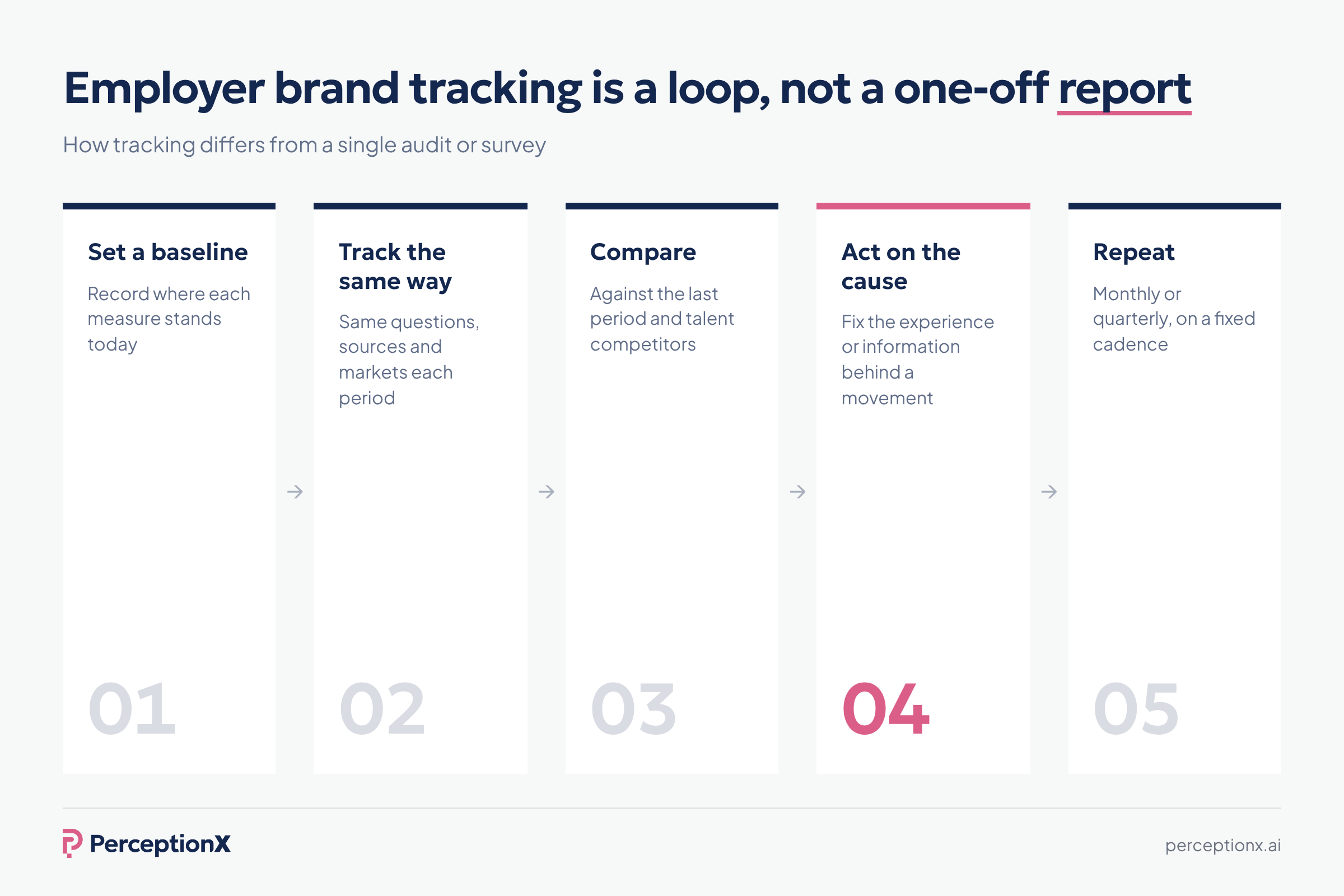
Employer brand tracking is the practice of measuring the same employer brand metrics, in the same way, at regular intervals, so you can see how your standing as an employer changes over time and against the employers you compete with for talent. One measurement tells you where you are. Tracking tells you whether you are getting better or worse, where, and why.
Most teams already hold the raw material: a survey from last year, a review rating, a hiring report. What is usually missing is the discipline that turns those numbers into a trend: fixed definitions, a baseline, a benchmark and a rhythm.
This guide is for heads of employer brand and talent acquisition at large employers. It covers what to track, how to set a baseline, how to build an employer brand benchmark, how often to measure, a simple tracker layout and how to act when a number moves.
What is employer brand tracking?
Employer brand tracking is repeated measurement. You choose a small set of metrics, fix how each one is calculated, record a starting point and then measure again on a set schedule. The output is a line over time, not a single score.
A good employer brand tracker answers four questions:
- Where do we stand? How job seekers and current employees see the company as a place to work today.
- Which way are we moving? Whether each metric is rising, falling or flat since the baseline.
- How do we compare? Whether talent competitors are moving faster or slower than you.
- What caused it? Which campaign, event, policy or source sits behind the change.
Tracking sits inside the wider discipline of employer brand measurement. Our guide on how to measure employer brand explains the full method, and the guide to employer branding metrics explains how to calculate each number. This article is about the part that comes after: measuring the same things again and again, and reading the movement.
Employer brand tracking vs a one-off audit or survey
An audit, a survey and a tracker are often confused because they use some of the same data. They answer different questions.
| Approach | Question it answers | How often | What you get |
|---|---|---|---|
| Employer brand audit | Where do we stand today, and what is broken? | Once, or before a big change | A snapshot and a list of fixes |
| Employer brand survey | What do people think of us right now? | Usually once a year | A reading of opinion at one moment |
| Employer brand tracking | Are we getting better or worse, where, and against whom? | Monthly and quarterly | A trend, a benchmark and early warning |
An employer brand audit is a deep look at one moment. It is the right tool before a new employer brand strategy or after a merger. A survey captures opinion, but a yearly reading cannot tell you whether a drop happened in spring or autumn, or what triggered it.
Tracking is lighter and more frequent. It measures fewer things, more often, with identical definitions each time. The audit often becomes the baseline, and the tracker shows whether the fixes the audit recommended are working.
Tracking is also different from employer reputation monitoring. Monitoring listens for events as they happen, such as a wave of company reviews or a news story. Tracking compares fixed metrics from period to period. Large employers need both.
Why track employer brand over time?
- To prove that the work is working. Senior leadership funds what it can see. A trend line that moves after a campaign is the strongest case for continued investment in employer branding efforts.
- To catch problems early. A slow decline in how candidates describe your work environment is invisible in a single reading and obvious in a trend.
- To separate signal from noise. One bad month can be chance. Three in a row is a pattern.
- To see whether your employer brand resonates with the people you need. A company can be a desirable employer for graduates and unknown to experienced engineers. Tracking by audience shows the difference.
- To lower hiring costs. Tracking employer brand shows which activity improves operational efficiency and cost per hire, so budget moves to what works.
- To calculate ROI. You cannot show a return without a before and an after. Tracking supplies both.
What to track: four areas of employer brand metrics
A tracker that tries to follow everything follows nothing. Group your employer brand metrics into four areas and pick two or three numbers in each.
| Area | What it shows | Example metrics | Where the data comes from |
|---|---|---|---|
| Perception | How candidates perceive you as a place to work | Awareness and consideration among priority talent groups, review themes, overall sentiment | Surveys, review sites, social media, news coverage |
| Attraction | Whether perception turns into applications and hires | Careers site visits and apply rate, qualified applicants, offer acceptance rate | Careers site analytics, applicant tracking system |
| Experience | Whether the reality matches the promise | Candidate NPS, employee referral rate, early turnover among new hires | Candidate and employee surveys, HR data |
| AI answers | What AI tells candidates when they ask about you | How often you are named, how you are described, accuracy, sources cited | Repeated candidate questions put to AI assistants |
Perception: how candidates perceive you
Perception is what people believe about working for you before they have any direct contact. Track awareness and consideration among your priority talent groups, the themes in employee reviews on Glassdoor and Indeed, review volume and overall sentiment on social media and in news coverage.
Track themes as well as ratings. Company culture, pay, work life balance, career growth and leadership each move separately, and a flat rating can hide a falling theme. Track employee advocacy too: how often current employees share and comment on what it is like to work at the company, because candidates trust employees more than they trust corporate channels. Employee advocacy lifts employer brand perception, and companies with strong employee advocacy tend to see higher referral rates.
Employer brand perception is the slowest area to move and the one that drives the rest.
Attraction: careers page, applications and offer acceptance rate
Attraction metrics show whether perception turns into action. Track visits to your careers page and the share of visitors who start an application, the share of qualified applicants per role, response to recruiter outreach, and the offer acceptance rate.
Offer acceptance is the clearest attraction signal. When accepted offers fall while pay stays competitive, the cause is often something candidates hear about you late in the hiring process, from review platforms, from people they know or from AI tools.
Job boards and recruitment marketing reports will give you volume. Volume alone is a weak signal, so pair it with quality: hiring managers can tell you whether the people applying are the people they want.
Experience: candidate NPS, employee experience and employee referral rate
Experience metrics show whether the promise holds. Track candidate NPS after interviews as your core candidate experience measure, early turnover among new hires, engagement results and the employee referral rate. Candidate NPS scores range from minus one hundred to plus one hundred, which makes them easy to compare from period to period.
The employee referral rate is a useful honesty check. People refer friends only when the workplace experience matches what the company says about itself. If your company values read well on the careers site but referrals are falling, the candidate and employee experience needs attention before the messaging does.
AI answers: what AI tells candidates
The fourth area is new. Candidates now research employers by asking AI assistants which companies to consider and what it is like to work there. Those answers draw on your careers site, job descriptions, review sites, forums such as Reddit, LinkedIn and news coverage, and they compress all of it into a few sentences.
Track four things: whether your company appears when candidates ask for the best employers in your field, how you are described, whether the facts are right, and which sources the answer relies on. The next section explains how.
What AI tells candidates is now part of employer brand measurement
For years, employer brand tracking meant surveys, review ratings and hiring data. That picture is now incomplete, because a growing share of candidates discover and research employers through AI before they ever visit a careers site.
In PerceptionX research with job seekers, 72% of AI-using job seekers used AI before deciding whether to apply, and 82% said an AI answer changed their mind about a company as a place to work. The answers are not always right: 58% caught AI giving inaccurate information about an employer.
That makes AI responses a measurable part of your employer brand, and one that changes faster than a survey can follow. To include AI answers in your tracker:
- Write the questions candidates ask. Cover both kinds: shortlist questions, such as which leading employers to consider for a role in a market, and questions about you, such as what the culture, pay and interviews are like.
- Ask every assistant. ChatGPT, Google AI Overviews, Google AI Mode and Perplexity often give different answers to the same question.
- Repeat the same prompts each period. Trends only mean something when the question set stays fixed. If you add questions, report them separately until they have their own baseline.
- Split by market, job function and language. AI visibility for software engineers in Germany says little about nurses in the United States.
- Record the sources. When a description changes, the cited sources usually explain why.
Doing this by hand works for a first look and becomes unmanageable at scale, because a global employer needs many questions, markets and assistants measured on a schedule.
This is what PerceptionX measures. It tracks what AI tells candidates across ChatGPT, Google AI Overviews, Google AI Mode and Perplexity, by market, job function and language, in the Employer Perception Score, and traces answers to their sources. Our scores are independent: they come from what AI actually says, not from what employers tell us.
Measurement is only the start: every finding comes with recommendations on what to change, and practitioners who have measured employer brand for years help your team act on them.
Employer brand visibility in AI does not replace the other three areas. It adds the layer that most trackers are missing, and it gives you something survey data cannot: a comparable reading for every talent competitor, taken on the same day with the same questions.
How to set a baseline
A baseline is the first full reading of every metric in your tracker, taken before you change anything. Every later number is read against it.
- Fix the scope. Choose the markets, job functions and priority talent groups that matter most for hiring. Start narrow and add later.
- Fix the definitions. Write down exactly how each metric is calculated, what counts and what does not. An offer acceptance rate that includes verbal offers one quarter and excludes them the next is not a trend.
- Fix the sources. Name the system, survey or question set behind each number.
- Take the reading in a normal period. A baseline taken in the week of a layoff announcement or a major campaign will distort every comparison that follows.
- Record the context. Note what was live at the time: campaigns, hiring volumes, news. You will need it when you explain movements later.
If you have run an audit or a round of employer brand research recently, use it as the baseline for the metrics it covers, as long as you can repeat the method exactly.
How to build an employer brand benchmark
A number on its own is hard to judge. An employer brand benchmark gives it meaning by comparing you with the employers you actually compete with for talent.
To benchmark employer branding well, choose the comparison set with care:
- Use talent competitors, not business competitors. The companies that win your candidates are often in other industries. Ask recruiters and hiring managers where declined offers went, and check which employers AI names alongside you.
- Set the list by market and function. Your rivals for data scientists in London are not your rivals for plant engineers in Texas.
- Keep it short. Five to eight employers per segment is enough to form a median and small enough to read.
- Use the same method for everyone. A benchmark is only fair when every employer is measured with the same questions, sources and dates.
Not every metric can be benchmarked. You will not see a rival's offer acceptance rate or candidate NPS. Public signals can be compared: review ratings and themes, social media presence and, most completely, AI answers, where every employer can be measured in the same way. Mark each row of your tracker as benchmarked or internal only, so nobody expects a comparison that does not exist.
How to read a movement: a worked method
Three simple calculations turn a tracker into a judgement.
- Movement = current value minus baseline value.
- Gap to benchmark = your value minus the median of your talent competitors.
- Relative movement = your movement minus the movement of the benchmark median.
For example, say AI named your company in 30% of answers to shortlist questions at baseline and in 36% this quarter. Your movement is plus 6 points. If the median for your talent competitors moved from 40% to 41% in the same period, their movement is plus 1 point, your relative movement is plus 5 points and your gap has narrowed from 10 points to 5. These figures are illustrative only.
Relative movement matters most. If you rise by a little while the whole market rises by more, you have lost ground, and the tracker should say so.
Agree a noise band before you start. For example, a team might treat any change smaller than 2 points as noise unless it holds for two periods in a row. The right band depends on how much data sits behind each metric, so set it per metric and write it down.
How often to track: cadence
Different metrics move at different speeds, so one cadence does not fit all.
- Monthly: AI answers, review themes and attraction metrics such as careers site apply rate and offer acceptance. These move quickly and reward early action.
- Quarterly: the full tracker, with benchmark comparison and commentary, shared with senior leadership.
- Twice a year or yearly: survey measures such as awareness, consideration and engagement, which are costly to collect and slow to change.
Take readings at the same point in each period. Hold the question set, the sources and the definitions constant for at least a year. When something has to change, run old and new methods side by side for one period so the trend line does not break.
A simple employer brand tracker layout
A tracker does not need special software to start. One table per market and job function is enough, with a row for each metric and the same columns every period. The values below are an example for illustration only.
| Metric | Baseline | This quarter | Change | Talent competitor median | Gap | Owner |
|---|---|---|---|---|---|---|
| Share of AI answers that name you | 30% | 36% | Up 6 points | 41% | Behind by 5 points | Employer brand |
| Share of AI descriptions that are positive | 62% | 61% | Down 1 point | 64% | Behind by 3 points | Employer brand |
| Careers site apply rate | 8% | 9% | Up 1 point | Not available | Not available | Recruitment marketing |
| Offer acceptance rate | 74% | 79% | Up 5 points | Not available | Not available | Talent acquisition |
| Employee referral rate | 18% | 17% | Down 1 point | Not available | Not available | HR |
Add two things beneath the table each quarter: a short note on what changed in the period, such as campaigns, policy changes or news, and a list of the actions agreed with owners and dates. Without the note, nobody will remember in a year why a line moved.
Keep one row per metric and resist adding more. A tracker with a dozen clear rows gets read. One with dozens of rows gets filed.
How to act on movements
Tracking earns its place only when a movement leads to a decision. Use the same routine each time a number crosses your noise band.
- Confirm it. Check the definition and the data, then check whether the change appears in more than one market, function or AI assistant.
- Locate it. Break the number down. A fall in overall sentiment is usually concentrated in one theme, one location or one audience.
- Find the cause. Look at what changed: a wave of employee reviews, a news story, a policy, a stale careers page, or a source that AI has started to cite more often.
- Decide the type of fix. It is either an experience problem to solve, an information gap to close or a source to update. Each has a different owner.
- Assign and date it. Record the owner and the date in the tracker.
- Measure again. The next reading shows whether the action worked.
For example, if AI answers start to describe your interview process as slow, the cited sources will often point to recent candidate reviews. The fix is to shorten the process and encourage recent candidates to share their experience, not to rewrite the careers site.
Act on good news too. When a metric rises, find out why and do more of it. Positive movements are valuable insights into what makes a strong employer brand in your market, and they are the evidence that helps you attract top talent and keep funding.
Common employer brand tracking mistakes
- Changing the method mid year. New questions, new sources or new definitions break the trend.
- Tracking only what is easy. Follower counts and application volume are simple to collect and say little about how candidates perceive you.
- Reporting one global number. An average across markets hides the places where you are winning and losing.
- Benchmarking against the wrong employers. Business rivals are not always talent competitors.
- Leaving out AI. When candidates research company reviews and employers through AI assistants, a tracker without AI answers misses the first impression.
- Tracking without owners. A number nobody owns never changes.
Key takeaways
- Employer brand tracking measures the same metrics in the same way at regular intervals, so you see direction as well as position.
- An audit or survey is a snapshot. Tracking is the trend that follows it.
- Track four areas: perception, attraction, experience and AI answers.
- Set a baseline with fixed scope, definitions and sources, then benchmark against the talent competitors you lose candidates to.
- Read movement, gap to benchmark and relative movement together, with an agreed noise band.
- Review fast-moving metrics monthly and the full tracker quarterly, and attach an owner and a date to every action.
Frequently asked questions
What is employer brand tracking?
Employer brand tracking is the practice of measuring the same employer brand metrics, in the same way, at regular intervals, so you can see how your standing as an employer changes over time and against the employers you compete with for talent.
What does an employer brand tracker do?
An employer brand tracker records a baseline for each metric, repeats the measurement on a set schedule and shows the change, the gap to a benchmark of talent competitors and the owner of each action. It turns separate readings into a trend.
How is employer brand tracking different from an employer brand audit?
An audit is a deep look at one moment and produces a list of fixes. Tracking is lighter and repeated, and shows whether those fixes are working. The audit often becomes the baseline for the tracker.
How do you track employer brand?
Choose a small set of metrics across perception, attraction, experience and AI answers, fix the definitions and sources, take a baseline, pick the talent competitors to benchmark against, then measure again monthly and quarterly and act on any movement outside your noise band.
How often should you track your employer brand?
Review fast-moving metrics such as AI answers, review themes and offer acceptance monthly, the full tracker with its benchmark quarterly, and survey measures such as awareness and consideration once or twice a year.
How do you benchmark employer branding against other employers?
Pick five to eight talent competitors for each market and job function, measure every employer with the same questions, sources and dates, and compare your value and your movement with the median of the group.
Why include AI answers in employer brand tracking?
Many candidates now ask AI assistants about employers before they apply. In PerceptionX research, 72% of AI-using job seekers used AI before deciding whether to apply and 82% said an AI answer changed their mind about a company as a place to work.

Find out how AI is shaping your employer brand — and what you can do about it.