Employee Value Proposition Examples: 6 EVPs That Work

An employee value proposition (EVP) is the deal an employer offers its people: what they get in return for their skills, time and commitment, from pay and benefits to career growth, working conditions and culture. The best EVP examples are specific, honest and backed by something employees can point to.
Below are six employee value proposition examples from well-known employers, what each one does well, the pillars most EVPs are built on, and how to check whether candidates actually believe yours. For the basics, start with our guide to the employee value proposition.
What makes a strong EVP?
Every company has an EVP, written down or not. The question is whether it is clear, distinctive and true. Strong examples share four traits:
- Specific. They name what people actually get, not generic claims about being a great place to work.
- Distinctive. They describe something a talent competitor could not copy word for word.
- Backed by proof. A policy, a programme or a practice shows the promise is real.
- Honest about trade-offs. The most credible EVPs say who the company is not right for, as well as who it is.
6 employee value proposition examples
1. HubSpot: culture written down as a product
HubSpot publishes its Culture Code and treats it like a product it keeps improving. Its current culture commitments cover putting the customer first, being bold and continuing to learn, moving fast together, and treating each other well, with a set of people values behind the last one.
What it gets right: the culture is public, versioned and specific, so candidates can judge the fit before they apply, and employees can hold leaders to it.
2. Patagonia: purpose with a programme behind it
Patagonia's EVP is built on its environmental mission. Through its environmental internship programme, employees can spend up to two months working for an environmental group of their choice while keeping their pay and benefits.
What it gets right: the purpose claim comes with a concrete, costly commitment, which is what makes it believable.
3. Pret A Manger: a clear path up from the shop floor
Pret's EVP for front-line roles leans on learning and progression. Its apprenticeship programme has included funding an undergraduate degree in business management for apprentices.
What it gets right: for hourly roles, where candidates often expect no development, a degree path is a specific and rare promise.
4. Whereby: more than one way to grow
Whereby, a remote-first company, describes three progression tracks: an expert track for deep specialists, an entrepreneur track for people who improve how the company works, and a people leader track for those who want to manage.
What it gets right: it removes the common frustration that managing people is the only route to promotion, and it explains each path clearly.
5. Zoom: one value, applied everywhere
Zoom's culture is organised around care: for customers, for the wider community and for colleagues. Employees describe the idea in their own words on the company's careers pages.
What it gets right: one memorable value is easier to remember and to test than a long list, and hearing it from employees adds credibility.
6. Spotify: shared values and flexible work
Spotify presents its values on its careers site, including working as one team by breaking down silos, sharing context openly and working towards shared goals, alongside flexible arrangements for working in and out of the office.
What it gets right: it ties how people collaborate to how and where they work, two things candidates increasingly weigh together.
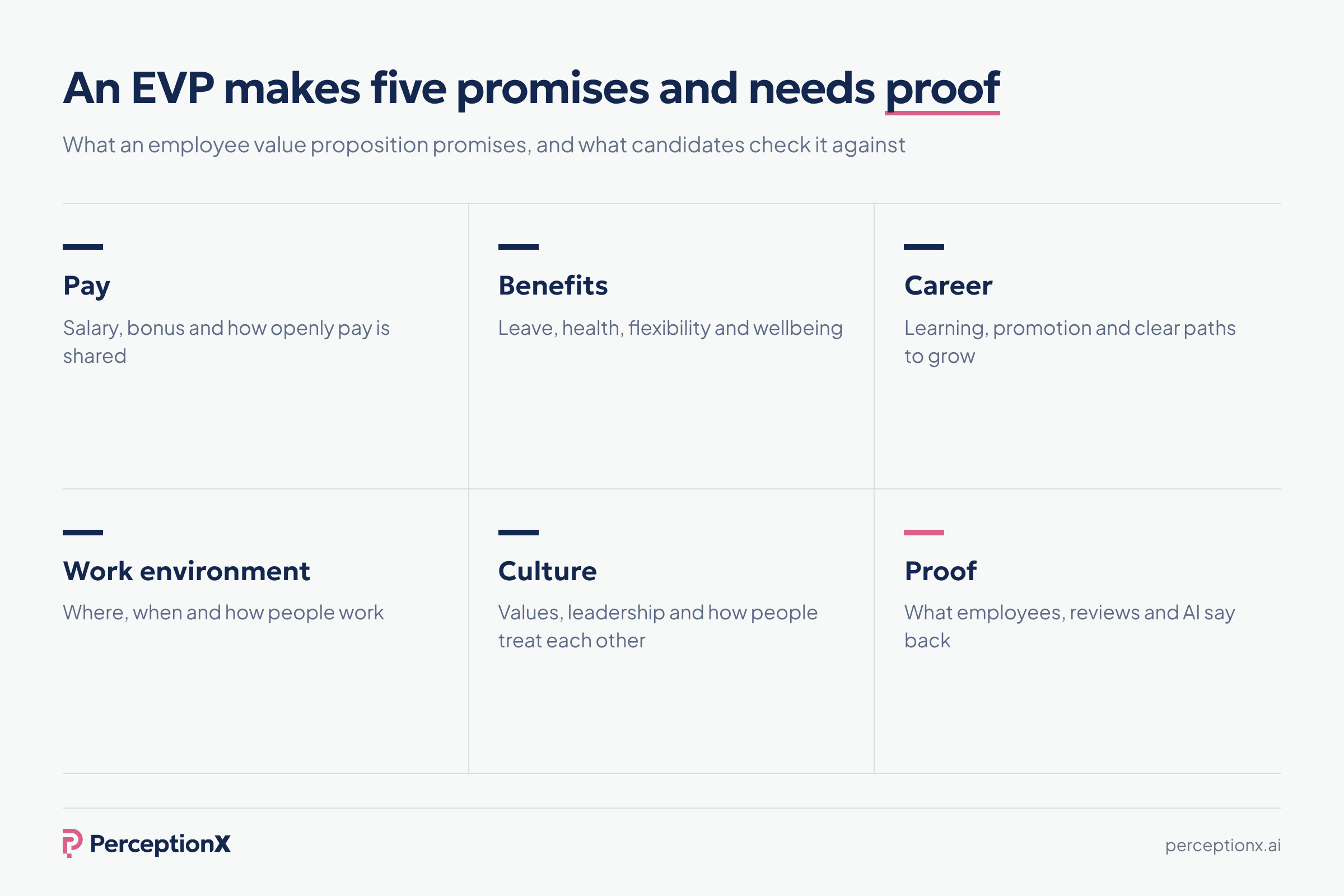
The five pillars of an EVP
Most EVP frameworks group the offer into five pillars. Each example above leads with one or two of them:
| Pillar | What it covers | Example above |
|---|---|---|
| Pay | Salary, bonus, equity and how openly pay is shared | Rarely the lead message, but candidates always check it |
| Benefits | Leave, health, wellbeing and flexibility | Patagonia's paid environmental internships |
| Career | Learning, promotion and paths to grow | Pret's degree apprenticeships; Whereby's three tracks |
| Work environment | Where, when and how people work | Spotify's flexible work |
| Culture | Values, leadership and how people treat each other | HubSpot's Culture Code; Zoom's focus on care |
A strong EVP does not need to win on all five. It needs to be clear about the one or two where it is genuinely different, and honest about the rest.
How to write your own EVP
- Start with what is true. Interview and survey employees, new hires and leavers about why they joined, why they stay and why they go. Our guide to the employer brand survey covers who to ask.
- Find what is distinctive. Compare the themes with what your talent competitors offer. Keep only what candidates could not get elsewhere in the same form.
- Attach proof to every claim. For each promise, name the policy, programme or story that shows it is real.
- Write it plainly. One short statement, three to five supporting pillars, and the proof points beneath them.
- Adapt it by audience. Engineers, store staff and graduates care about different things. Keep the core and change the emphasis.
- Test it outside the company. Check whether candidates and the sources they read say the same thing back.
Check whether candidates believe your EVP
An EVP is only as strong as what the market repeats. Candidates rarely read it in isolation: they compare it with reviews, forums, news and, more and more, AI answers.
In PerceptionX research across seven countries, 72% of AI-using job seekers used AI before deciding whether to apply, and 82% said an AI answer had changed their mind about a company as a place to work. If AI describes your culture, pay or progression differently from your EVP, that is the version many candidates will believe.
PerceptionX measures what AI assistants tell candidates about employers across ChatGPT, Google AI Overviews, Google AI Mode and Perplexity, by market, job function and language, in the Employer Perception Score. It shows which EVP themes AI repeats, which it contradicts and which sources shape each answer, so you can see where the promise and the perception part ways. Our scores are independent: they come from what AI actually says, not from what employers tell us.
Measurement is only the start: every finding comes with recommendations on what to change, and practitioners who have measured employer brand for years help your team act on them.
For a step by step method, read how to measure your EVP with AI, and for the wider set of measures, our guide to employer branding metrics.
Common EVP mistakes
- Generic claims. Innovation, collaboration and growth appear in almost every EVP and distinguish no one.
- No proof. A promise without a programme or policy behind it reads as marketing.
- One message for everyone. Different roles and markets need different emphasis.
- Ignoring the gap. If reviews and AI answers contradict the EVP, rewriting the EVP will not fix it. The experience, or the information about it, needs to change.
- Set and forget. An EVP needs checking against perception every year, and more often after major change. Our guide on how to measure employer brand sets out how.
Key takeaways
- The best employee value proposition examples are specific, distinctive, backed by proof and honest about trade-offs.
- Most EVPs are built on five pillars: pay, benefits, career, work environment and culture.
- A strong EVP leads with the one or two pillars where the employer is genuinely different.
- An EVP only works if candidates believe it, so test it against what reviews, forums and AI assistants say.
Frequently asked questions
What is an employee value proposition?
An employee value proposition is what an employer offers its people in return for their skills, time and commitment, covering pay, benefits, career growth, work environment and culture.
What is a good example of an employee value proposition?
Good examples are specific and backed by proof, such as HubSpot's public Culture Code, Patagonia's paid environmental internships or Whereby's three progression tracks.
What are the five pillars of an EVP?
Pay, benefits, career, work environment and culture. Most strong EVPs lead with one or two of these where the employer is genuinely different.
What is the difference between an EVP and employer brand?
The EVP is the offer itself. The employer brand is how that offer is perceived by candidates, employees and the market, including what reviews, forums and AI assistants say about it.
How do you write an EVP statement?
Start from what employees say is true, keep what is distinctive against talent competitors, attach proof to each claim, write one short statement with three to five supporting pillars, and adapt the emphasis by audience.
How do you know if your EVP is working?
Check whether candidates and the sources they read repeat it. Compare your EVP with reviews, survey results and what AI assistants tell candidates about you, by market and role.

Find out how AI is shaping your employer brand — and what you can do about it.