Employer Brand Benchmarking: How to Compare Against Talent Competitors

Employer brand benchmarking is the practice of comparing how your organisation is seen as a place to work with the employers you compete with for talent, using the same metrics, sources and dates for everyone. It turns a number that means little on its own into a position: ahead, level or behind, and by how much.
Most employer brand leaders can quote their own review rating or offer acceptance rate. Far fewer can say how those numbers compare with the three or four employers that keep winning their candidates. This guide explains how to choose the comparison set, what to benchmark, where the data comes from, how to lay out the benchmark and how to turn gaps into action.
What is employer brand benchmarking?
Employer brand benchmarking is a structured comparison. You pick a set of employers, measure them and yourself in the same way, and read the difference. The output is an employer brand benchmark: a table that shows where you lead, where you trail and which gaps matter for hiring.
It is a form of employer brand competitor analysis, with one important difference from a marketing competitor review. The subject is how job seekers and employees see each company as an employer, so the comparison is about talent and has little to do with products or market share.
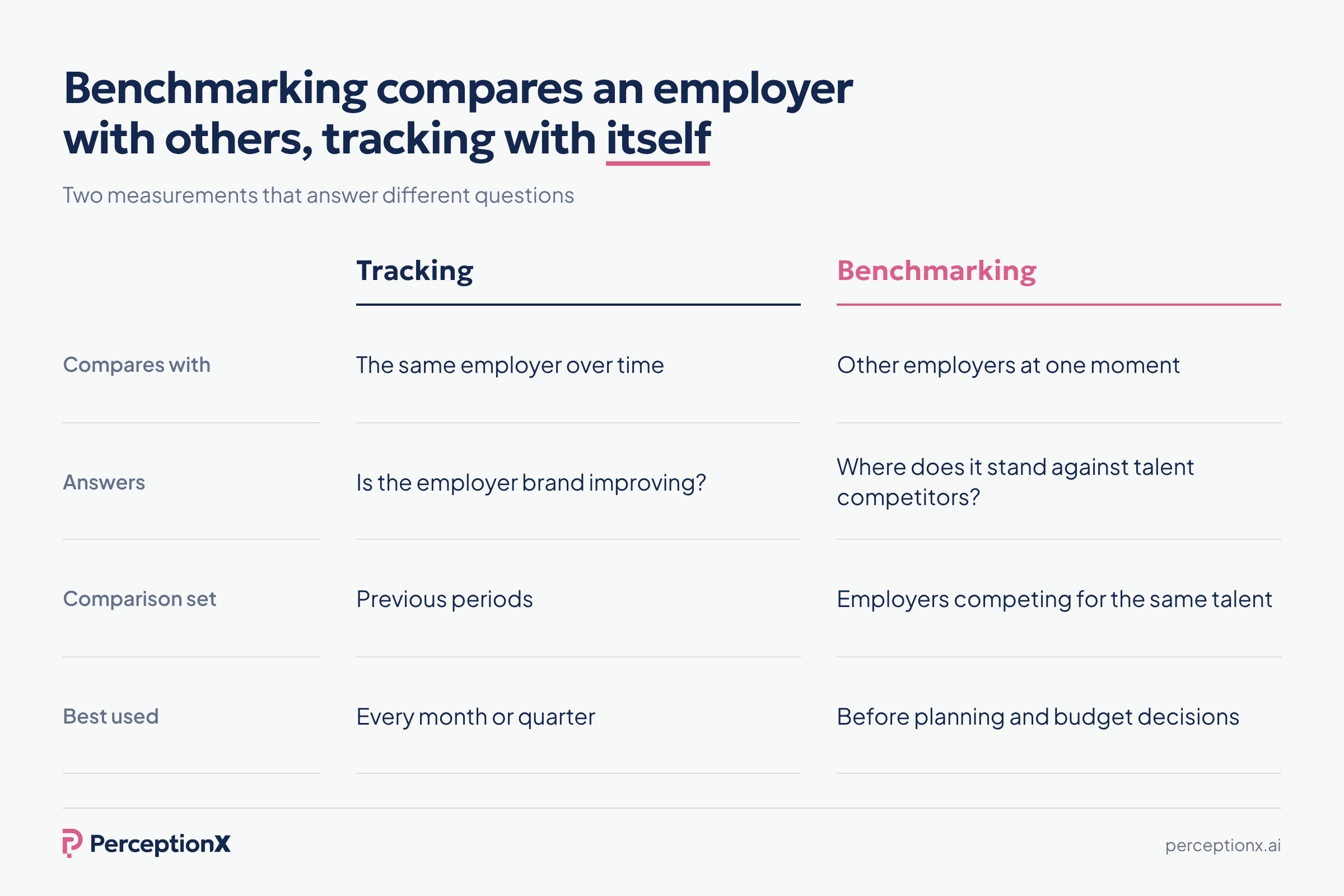
Benchmarking is also different from tracking. Employer brand tracking compares you with yourself over time. Benchmarking compares you with other employers at one moment. Tracking tells you whether you are improving. Benchmarking tells you whether that is enough. This article covers the comparison; the tracking guide covers the trend.
Both sit inside the wider discipline of measurement. Our guide on how to measure employer brand sets out the full method, and the guide to employer branding metrics shows how to calculate each number.
Why benchmark your employer brand?
- A number needs context. A share of positive company reviews sounds healthy until you learn that every rival scores higher. Without a comparison, a strong employer brand and a weak brand can look the same on a dashboard.
- Candidates compare, so you should too. Potential candidates rarely judge one employer alone. They read employee reviews, scan job boards and ask AI tools which companies to consider, forming opinions about several employers at once.
- It shows where to spend. Employer branding efforts are easier to fund when senior leadership can see a specific gap against a named rival for a named talent group.
- It protects what works. A benchmark also shows the themes where you already lead, which are the claims your employer brand content can make with confidence.
- It links brand to results. A strong employer attracts more qualified applicants, fills roles faster and can reduce hiring costs. Strong employer brands also tend to see lower employee turnover, while a company with a poor employer reputation often has to offer higher salaries to win the same people. Benchmarking shows whether your employer brand reflects that strength or leaves it to competitors.
- It keeps you competitive. High-performing companies run regular employer brand audits and benchmarks to stay competitive as employers, because the company's reputation as a place to work shifts whenever a rival improves.
Choosing the right comparison set: talent competitors, not product competitors
The most common mistake when teams benchmark employer brand is to copy the competitor list from the sales deck. The companies that sell against you are not always the companies that hire against you.
A bank competes for software engineers with technology firms. A manufacturer competes for data analysts with retailers and consultancies. A hospital competes for nurses with every other hospital within commuting distance, whatever its size. A well known consumer brand can be a minor player in the job market for the roles you need, and a company with no public profile can be the one top talent chooses over you.
To build the list of talent competitors:
- Ask where declined offers went. Recruiters and hiring managers usually know which employer a candidate chose instead. Record it for every declined offer.
- Ask where leavers go. Exit interviews and the public profiles of past employees show which employers take your people.
- Ask where new hires came from. The employers you recruit from are part of the same talent pool.
- Check who appears beside you. Look at which employers job boards show next to your job postings, and which companies AI assistants name when a candidate asks who to consider for the role.
- Add one aspirational employer. Include the employer your hiring teams most often hear named as the place people want to work, even if you rarely meet it in offers today.
Keep the set short enough to read and fix it for the year, so the comparison stays stable. Set a separate list for each market and job function, because the list changes as soon as the role or the country changes.
What to benchmark: four areas of comparison
A useful benchmark covers four areas. Some can be compared directly with other employers. Others can only be compared with industry averages, because rivals do not publish the data.
Brand perception: how candidates see each employer
Brand perception is what the people you want to hire believe about each employer: whether they know the company name, whether they would consider it and what they associate it with. Measure it with survey data from your target talent groups, asking the same questions about you and each talent competitor.
Compare awareness, consideration and the attributes people link to each employer, such as company culture, company values, pay, career development and work-life balance. The aim is to see whether your brand promise is the one candidates actually hear, and whether a rival owns a theme you thought was yours.
Review themes: employee experience and candidate experience
Review sites such as Glassdoor and Indeed publish what current employees and past employees say about every employer, which makes them one of the few sources where your rivals are as visible as you are. Many job seekers research company reviews before applying, and candidates tend to trust what employees say more than what the company says about itself.
Compare themes, not only star ratings. For each employer, read what reviews say about management, pay, professional development, career progression, well-being, the work environment and work-life balance. Note what employees love and where negative reviews cluster. Interview reviews do the same for candidate experience and the hiring process.
A theme comparison answers a sharper question than a rating: on the topics your target candidates care about most, who is described best? It also shows whether each employer's message and the lived employee experience match reality.
Attraction and hiring metrics: careers site, acceptance rate and cost per hire
These are the numbers talent acquisition already holds: careers site traffic and apply rate, how many candidates each role attracts, the share who are qualified, time to hire, cost per hire, offer acceptance rate, employee referral rate and first year retention. Candidate satisfaction scores, candidate net promoter score and candidate feedback from your own surveys belong here too, as does application abandonment: the share of applications that are started on the careers site and never submitted.
Employee referral rate deserves a note. A high referral rate indicates employee satisfaction and culture fit, because people only recommend an employer they would vouch for, and referred candidates tend to accept offers more often.
You will not see a rival's own metrics, so these are benchmarked against industry averages and against your own data across business units, markets and job functions. Treat published averages with care: check how each one is defined before you compare, because a figure for time to hire can start at job approval in one source and at first application in another.
Internal comparison is often more useful than an external average. If one country fills the same role faster and with a higher acceptance rate than another, the gap points to something you can learn from inside your own recruiting process.
Visible activity: careers page, social media presence and employee advocacy
Some of what rivals do is public. You can compare each careers page for clarity on pay, benefits and career paths, read their job descriptions, and review their social media presence and employer brand content. Look at how much employee content each employer has, such as employee spotlights and posts from staff, as a sign of employee advocacy. Employee-shared content usually reaches a far wider audience than corporate posts, so an employer with active advocates is seen by more of the people you both want to hire.
Free tools add simple signals. Google Trends shows relative search interest in each company name alongside words such as careers or jobs. Google Search Console shows which searches bring people to your own careers site, and SEO tools can estimate the same for rivals.
Treat this area as context. Activity is easy to count and easy to overvalue. A rival that posts every day has not necessarily left a positive impression on the people you both want to hire.
What AI tells candidates is now part of the benchmark
For a growing share of job seekers, candidate research now starts with a question to an AI assistant. That answer is already a benchmark, written for the candidate: when someone asks which employers to consider for a role, the assistant names a handful of companies, describes each one and leaves the rest out.
In PerceptionX research with job seekers, 72% of AI-using job seekers used AI before deciding whether to apply, and 82% said an AI answer changed their mind about a company as a place to work. The answers are not always right: 58% caught AI giving inaccurate information about an employer.
AI answers are also the most complete source for comparison, because every employer can be measured with identical questions on the same day. To include them in your benchmark:
- Write the questions candidates ask. Include shortlist questions, such as which employers to consider for a role in a market, and direct comparisons between you and a talent competitor.
- Ask every assistant. ChatGPT, Google AI Overviews, Google AI Mode and Perplexity often name different employers for the same question.
- Record four things for each employer. Whether it is named, how positively it is described, which themes it is praised or criticised for, and which sources the answer cites.
- Split by market, job function and language. The employers AI recommends for engineers in Germany are not the ones it recommends for sales roles in the United States.
- Compare the sources. When a rival is described more favourably, the cited sources usually show why. Our analysis of the sources AI cites about employers explains which ones carry most weight.
Doing this by hand works for a first look at one role in one country. It becomes unmanageable for a global employer with many roles, markets and competitors.
This is what PerceptionX measures. It tracks what AI tells candidates across ChatGPT, Google AI Overviews, Google AI Mode and Perplexity, by market, job function and language, in the Employer Perception Score, and traces answers to their sources. Our scores are independent: they come from what AI actually says, not from what employers tell us. Because every employer is scored with one method, the result is a like for like comparison with each talent competitor.
Measurement is only the start: every finding comes with recommendations on what to change, and practitioners who have measured employer brand for years help your team act on them.
Where employer brand benchmarking data comes from
Each source covers part of the picture. The table shows what each one tells you and whether it lets you compare directly with other employers.
| Source | What it tells you | Comparable with other employers? |
|---|---|---|
| Perception surveys of target talent | Awareness, consideration and the attributes linked to each employer | Yes, when the same questions are asked about every employer |
| Review sites such as Glassdoor and Indeed | What current and past employees say about culture, pay, management and careers, and how candidates describe interviews | Yes, by rating and by theme |
| Social media and forums such as LinkedIn and Reddit | What employees and candidates say in public, and how visible each employer is | Partly: volume is easy to compare, meaning takes reading |
| AI assistants such as ChatGPT, Gemini and Perplexity | Which employers are named, how they are described and which sources are cited | Yes, with identical questions for every employer |
| Careers sites and job postings | How clearly each employer states pay, benefits and career paths | Yes, by review against a fixed checklist |
| Your applicant tracking system and recruitment marketing platform | Apply rate, time to hire, cost per hire, offer acceptance rate and employee referral rate | No: compare across your own segments and with industry averages |
| Candidate and new hire surveys | Candidate satisfaction and why offers were accepted or declined | Indirectly: declined offer reasons name the rival |
Two rules keep the data fair. First, use one method for every employer in the set: the same survey questions, the same review period, the same AI prompts. Second, record the date. A benchmark that mixes this month's AI answers with last year's survey compares two different moments.
An employer brand benchmark table layout
One table per market and job function is enough. Put metrics in rows and employers in columns, then add the median of the talent competitors, your gap to that median and your rank. The values below are an example for illustration only and do not describe any real employer.
| Metric | You | Employer A | Employer B | Employer C | Median of competitors | Gap to median | Rank |
|---|---|---|---|---|---|---|---|
| Share of AI shortlist answers that name the employer | 34% | 52% | 41% | 28% | 41% | Behind by 7 points | Third of four |
| Share of AI descriptions that are positive | 66% | 61% | 70% | 58% | 61% | Ahead by 5 points | Second of four |
| Share of review comments on career development that are positive | 48% | 63% | 57% | 51% | 57% | Behind by 9 points | Fourth of four |
| Share of review comments on work-life balance that are positive | 72% | 55% | 64% | 60% | 60% | Ahead by 12 points | First of four |
| Offer acceptance rate | 78% | Not available | Not available | Not available | Not available | Internal only | Internal only |
Three simple calculations turn the table into a judgement:
- Gap to median = your value minus the median of your talent competitors.
- Gap to leader = your value minus the highest value in the set.
- Rank = your position when every employer in the set is ordered from best to worst.
For example, in the first row of the table, AI names your company in 34% of shortlist answers and the median for the three talent competitors is 41%, so your gap to median is minus 7 points. The leader is at 52%, so your gap to leader is minus 18 points, and you rank third of four. These figures are illustrative only.
Use the median, not the average, so that one unusually strong or weak employer does not distort the benchmark. Mark each row as benchmarked or internal only, so nobody expects a comparison that the data cannot support.
Benchmarking by market and job function
A single company-wide benchmark hides more than it shows. Large employers are rarely strong or weak everywhere. They are well known for one job function in one country and almost invisible for another.
Build the benchmark in segments:
- By market. Talent competitors, review sites and languages all change by country. An employer that leads at home can sit at the bottom of the set in a newer market.
- By job function. Engineers, sales teams, nurses and plant operators weigh different things and compare you with different employers. Career development may decide one comparison and shift patterns another.
- By career stage where it matters. Graduates and experienced hires often hold very different views of the same employer.
Start with the segments that matter most to the hiring plan: the roles with the largest volume, the longest time to hire or the highest cost of a vacancy. A few well chosen segments, each with its own comparison set, are more useful than one global average. The same structure appears in an employer brand audit, which is often the first time a company sees these differences.
How often to benchmark
Benchmarking is an ongoing practice, but not every source needs the same rhythm.
- AI answers and review themes: every quarter. Both change quickly and both cover every employer in the set.
- Attraction and hiring metrics: every quarter against your own segments, and once a year against industry averages, which are usually published annually.
- Perception surveys: once a year, or after a major change such as a merger, a restructuring or a new employer brand.
- The comparison set itself: once a year. Check declined offers and leaver data again, and replace any employer that no longer competes for your candidates.
Run an extra benchmark when something large happens to you or to a rival, such as layoffs, a return to office decision or a major hiring campaign. Those are the moments when positions change.
How to turn gaps into action
A benchmark earns its place only when a gap leads to a decision. Work through each gap in the same order.
- Rank the gaps by hiring impact. A gap on a theme that decides offers for a priority role matters more than a larger gap on a theme few candidates raise.
- Decide whether the gap is real or told. If employees of a rival describe better career progression because it is better, the fix is in the employee experience, and belongs with HR and the business. If your reality is strong and the story is missing, the fix is in content and sources.
- Find the source of the gap. Check which review themes, pages or AI citations drive the difference. A rival may lead because its careers site states pay ranges and career paths clearly and yours does not.
- Assign an owner and a date. Employer brand owns content, talent acquisition owns the hiring process, HR owns policy and employee satisfaction, and communications owns news. Collect feedback from each owner on what is feasible.
- Protect your leads. Where you are ahead, make sure job descriptions, the careers page and employee advocacy carry that proof, so the lead holds.
- Measure the same gap again. Repeat the benchmark next quarter with the same set and the same questions to see whether the gap has narrowed.
Report the benchmark to senior leadership as a short list: where you lead, where you trail, what you are doing about the gaps that affect hiring outcomes, and who owns each action.
Common employer brand benchmarking mistakes
- Using product competitors. The sales competitor list is rarely the talent competitor list.
- Comparing one company-wide number. A global average hides the markets and job functions where you are losing.
- Benchmarking activity instead of perception. Post counts and follower numbers show effort, not what candidates believe.
- Mixing methods. A benchmark is only fair when every employer is measured with the same questions, sources and dates.
- Treating industry averages as targets. An average tells you what is typical. Your talent competitors tell you what you need to beat.
- Leaving out AI answers. They are where many candidates now meet the comparison first, and they are a core part of the wider talent experience.
- Stopping at the table. A benchmark with no owners and no actions is a report, not a tool.
Key takeaways
- Employer brand benchmarking compares you with the employers you compete with for talent, using one method for everyone.
- Choose talent competitors from declined offers, leavers, new hires and the employers AI names beside you.
- Benchmark perception, review themes, attraction and hiring metrics, and what AI assistants tell candidates.
- Read each metric as a gap to the median, a gap to the leader and a rank.
- Build the benchmark by market and job function, repeat it every quarter and give every gap that matters an owner.
Frequently asked questions
What is employer brand benchmarking?
Employer brand benchmarking is the practice of comparing how your organisation is seen as a place to work with the employers you compete with for talent, using the same metrics, sources and dates for every employer in the comparison.
What is an employer brand competitor analysis?
An employer brand competitor analysis is a review of how rival employers are seen by candidates and employees. It compares perception, review themes, careers site content and what AI assistants say about each employer, so you can see where you lead and where you trail.
Who should you benchmark your employer brand against?
Benchmark against talent competitors: the employers that win your declined offers, hire your leavers and appear beside you in job boards and AI answers. They are often in other industries, so the list is rarely the same as your product competitors.
What should an employer brand benchmark include?
An employer brand benchmark should include brand perception among target talent, review themes for employee experience and candidate experience, attraction and hiring metrics such as offer acceptance rate and cost per hire, and what AI assistants tell candidates about each employer.
How do you benchmark hiring metrics when competitors do not share data?
Rivals do not publish offer acceptance rate, time to hire or cost per hire, so compare these with industry averages and across your own markets and job functions. Use public sources such as review sites and AI answers for direct comparison.
How often should you benchmark your employer brand?
Benchmark AI answers and review themes every quarter, hiring metrics every quarter against your own segments and once a year against industry averages, and perception surveys once a year. Review the comparison set once a year.
What is the difference between employer brand benchmarking and tracking?
Benchmarking compares you with other employers at one moment. Tracking compares you with yourself over time. Benchmarking shows your position, and tracking shows whether that position is improving.

Find out how AI is shaping your employer brand — and what you can do about it.