How to Improve Your Employer Brand in ChatGPT and Other AI Assistants

Most large employers are not in the answer.
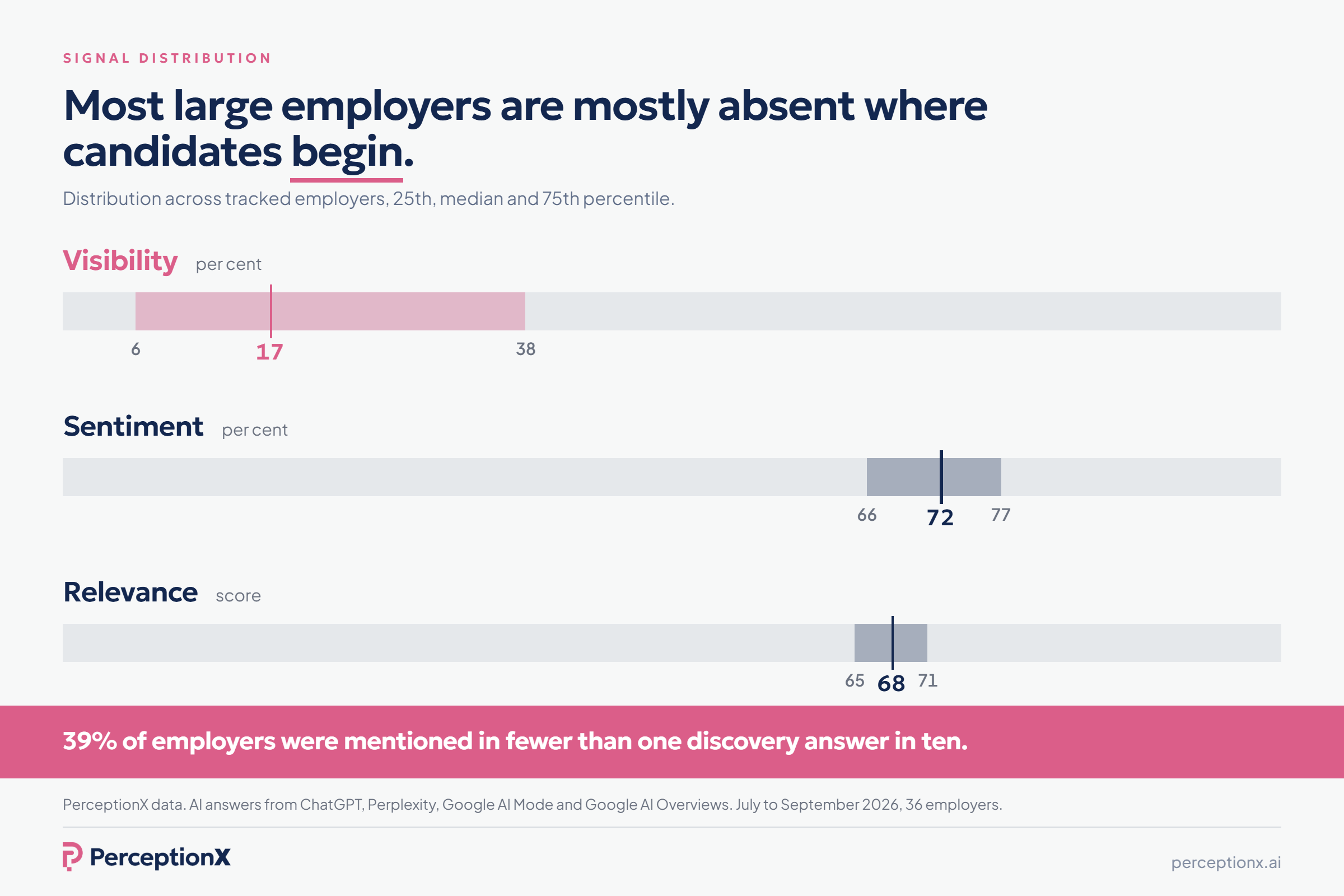
When candidates ask an AI assistant which companies are worth working for in their field and market, the employers PerceptionX tracks were mentioned in 17% of those answers at the median between July and September 2026. Four in ten were mentioned in fewer than one answer in ten. These are well-known companies with funded employer brand programmes and careers sites that took eighteen months to build.
So the question is a fair one, and it gets asked in roughly these words: how do we improve our employer brand in ChatGPT, or make our recruitment brand show up in AI at all?
What follows is what the answers are actually built from, why the usual playbook does not move them, and what does.
One caution before the method. Nobody can guarantee placement in an AI answer. Any agency promising it is selling something they cannot deliver. What you can do is change the evidence the answer is assembled from, and measure whether the answer changed.
The mistake: treating it like SEO
The reflex is to reach for the SEO playbook: optimise the careers site, add schema markup, publish more content, and wait to be indexed.
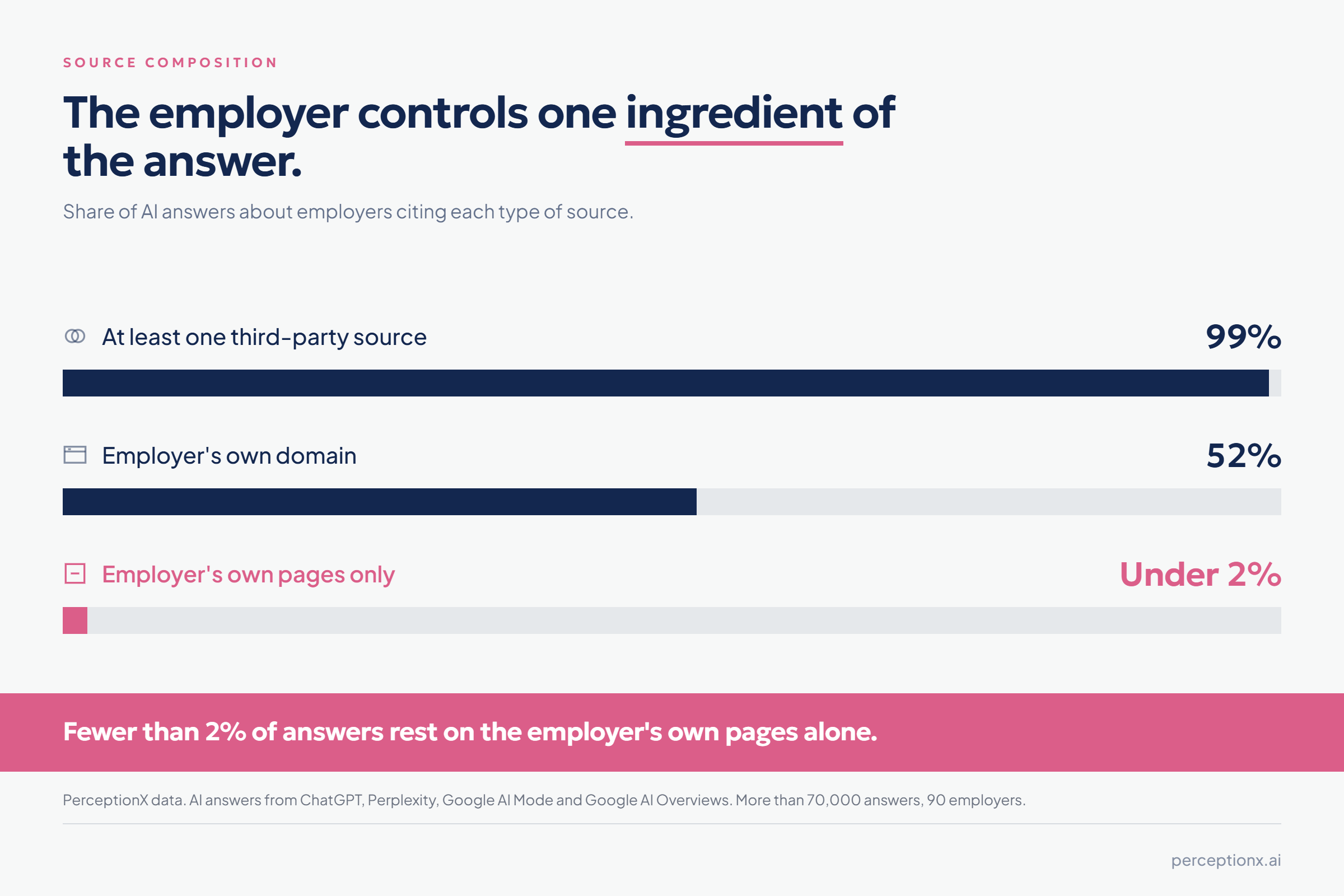
That is aimed at the wrong target. An AI answer about employers is not a ranked list of pages. It is a synthesis of third-party sources, and the employer's own site is a minor ingredient. Across more than 70,000 AI answers about 90 employers, 99% drew on at least one third-party source, and fewer than 2% relied on the employer's own pages alone.
The careers site still matters. It is just not the lever most teams think it is. You do not write your way into the answer from your own domain.
Candidates ask two different kinds of question, and the sources differ
This is the finding that should change what your team does next.
PerceptionX puts four kinds of question to the AI surfaces candidates use. Two of them matter here. Discovery questions are how a candidate finds employers they had not considered: which companies are good to work for in this field, who is hiring for this role in this market. Experience questions are how a candidate judges an employer they already have in mind: what is it like to work at Company X.
The sources behind those two kinds of answer are not the same. The table below shows the share of AI answers in which each source appeared, between July and September 2026.
| Source | Discovery answers | Experience answers |
|---|---|---|
| Directories and curated lists | 38% | 13% |
| 31% | 27% | |
| Glassdoor | 24% | 62% |
| 21% | 17% | |
| Indeed | 20% | 50% |
| YouTube | 18% | 24% |
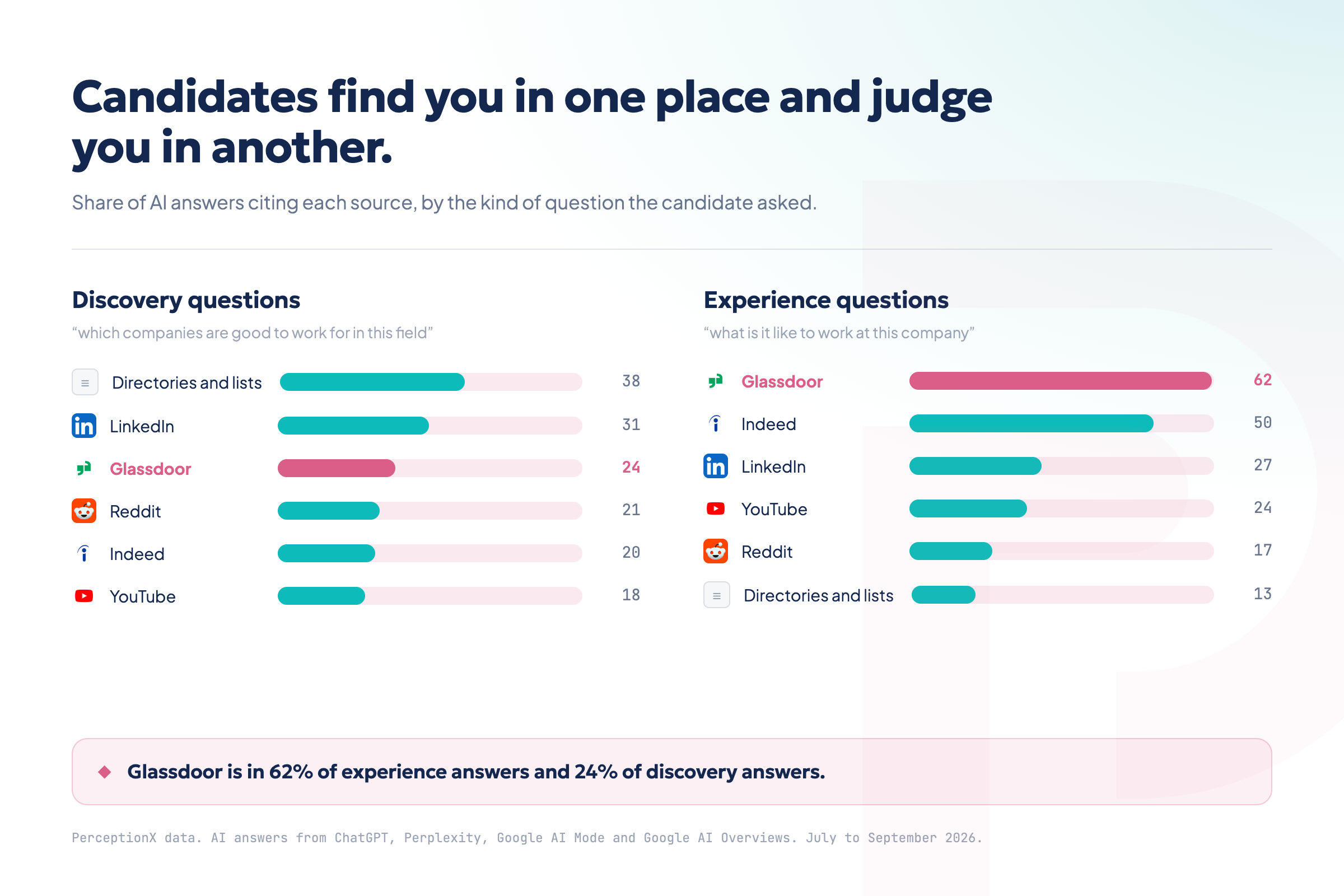
Read that table one row at a time and the problem is obvious. Glassdoor is in 62% of experience answers and 24% of discovery answers. Directories run the other way: 38% and 13%. Most employer brand programmes are built around review sites, which means the work is aimed almost entirely at the second column, where candidates who already know you decide whether you are any good. It does very little for the first column, where candidates find out you exist at all.
If nobody is discovering you, your Glassdoor rating is a question that never gets asked.
So what puts an employer into a discovery answer?
Honest answer: no single thing, and anyone who tells you otherwise is guessing.
We checked. Across the tracked set, an employer's visibility in discovery answers shows no reliable relationship with its sentiment, with the freshness of its sources, or with how heavily review sites feature in its answers. The employers that appear most are not the ones with the best ratings or the most content. There is no one number to push.
What the source mix does tell you is where the model looks when it is building a shortlist, and that is actionable enough. Four places, in the order the data puts them.
1. Third-party lists and directories. The single largest category in discovery answers at 38%. These are industry lists, "best places to work" compilations, sector directories, curated roundups, ecosystem databases. Most employers have no idea which ones cover their sector and market, and no process for being included in them. This is unglamorous, largely free, and the highest-leverage gap we see.
2. LinkedIn. 31% of discovery answers. Not the company page follower count; the substance that sits in public and gets indexed. Employee posts, leadership commentary, articles about the work.
3. Reddit. 21% of discovery answers overall, and far higher in some markets: about a third of answers in the Philippines against 2% in Switzerland. You cannot manufacture a Reddit presence and should not try, but you should know what is there and whether it is accurate.
4. YouTube. 18% of discovery answers, and heavily weighted to particular markets, appearing in roughly three in ten answers in Brazil, Mexico and South Korea. Employers with no video presence are simply absent from a source that carries real weight in those places.
A fifth point that is not a source: the model has to have a reason to name you for a specific role in a specific country. Employers described only in general corporate terms tend to be absent from role-specific and market-specific questions, because there is nothing to connect them to the query.
The market problem
Everything above shifts at the border, which is why a global plan does not work. The table below shows the share of AI answers about employers in which each review site appeared, by country.
| Country | Glassdoor | Indeed | Local site |
|---|---|---|---|
| United States | 44% | 33% | n/a |
| United Kingdom | 49% | 31% | n/a |
| Germany | 36% | 15% | kununu 37% |
| Switzerland | 29% | 24% | kununu 50% |
| India | 46% | 20% | AmbitionBox 32% |
| Japan | 16% | 5% | n/a |
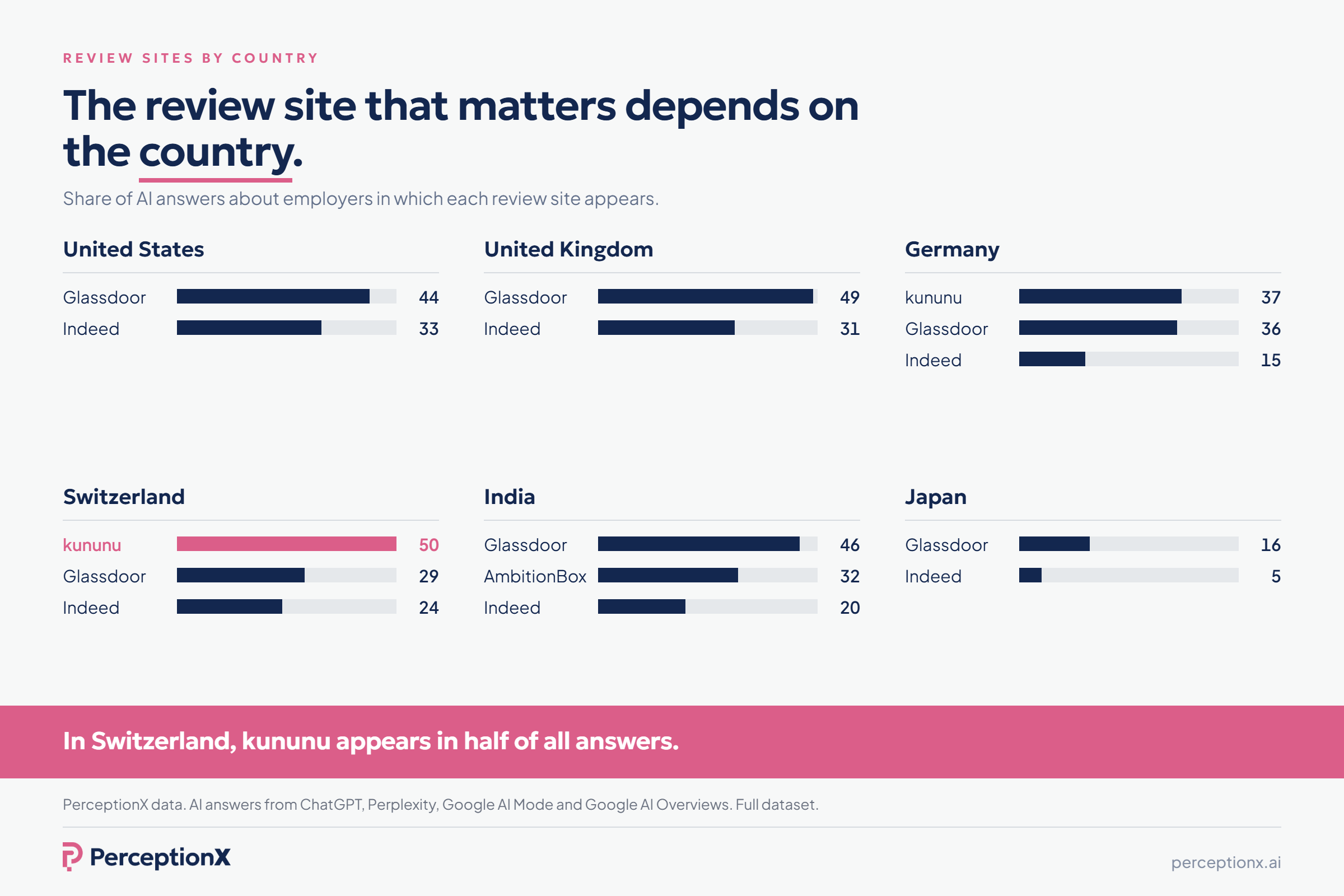
A team running one global source strategy is running the right strategy for two markets and the wrong one everywhere else. Every country needs its own source map, which is a smaller job than it sounds: identify the sources that actually appear in answers in that country, and work on those.
The surfaces disagree too
There is no single "AI". For the same discovery questions in the same period, the share of answers naming the tracked employer differed by surface.
| AI surface | Employer mentioned |
|---|---|
| Google AI Mode | 24% |
| Google AI Overviews | 18% |
| ChatGPT | 14% |
| Perplexity | 13% |
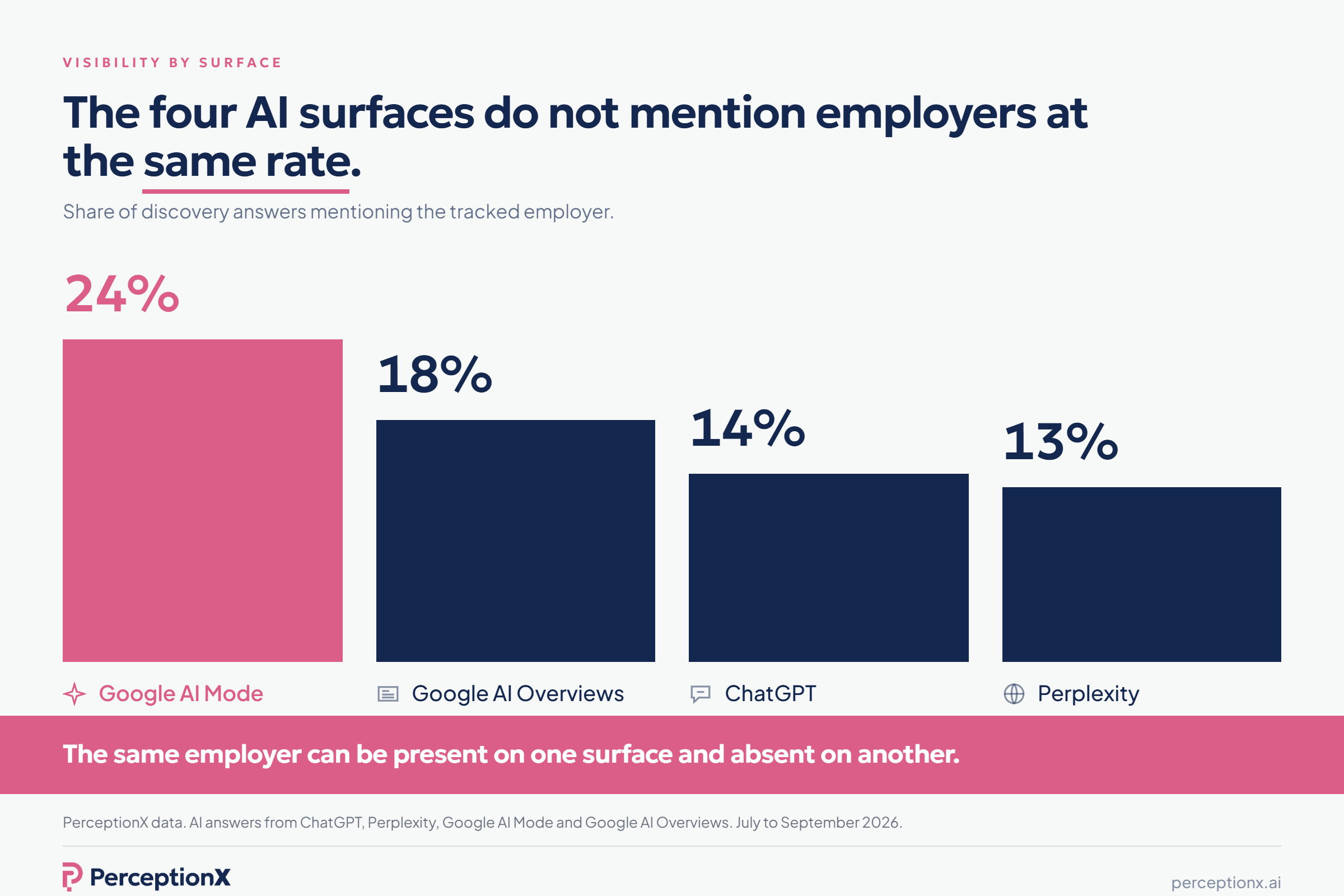
Worth knowing before anyone declares the problem solved on the basis of a few prompts typed into one assistant.
A sequence that works
1. Measure first, at the level the answer is given. Not "are we in ChatGPT" but: in this country, for this function, on this surface, are we named, and if not, which sources did the answer use instead? Absence is the finding; the source list is the brief.
2. Fix the discovery layer before the experience layer. Find the lists and directories that appear in discovery answers for your sector and markets, and get into the ones you legitimately qualify for. Then look at whether there is enough public, role-specific, market-specific substance about your company for a model to connect you to the question.
3. Do the review-site work anyway, but know what it buys. It shapes what is said about you once you are found. It does not get you found.
4. Re-measure a quarter later. These answers are rebuilt continuously from sources that change. One reading tells you where you stand; two tell you whether anything you did worked.
The uncomfortable part
You cannot buy your way in, and you cannot write your way in from your own domain. What sits behind these answers is other people's accounts of you: lists you qualified for, employees who posted something worth reading, communities that discussed you, press that covered the work.
Which is the old definition of reputation, arriving through a new door. The difference is that it is now measurable, per country, per function, per surface, per quarter. The full measurement framework is set out in How to Measure Employer Reputation, and the distinction between the brand you publish and the reputation you hold is covered in Employer Brand vs Employer Reputation.

Find out how AI is shaping your employer brand — and what you can do about it.