Candidate Experience Metrics: 9 to Track and How

Candidate experience metrics are the measures that show how job seekers feel about, and move through, your hiring process, from the first time they research you to the day they accept or decline an offer. They combine what candidates say, such as satisfaction scores and survey feedback, with what they do, such as completing applications, dropping out or accepting offers. Together they show where the hiring process wins people over and where it loses them.
This guide sets out the candidate experience metrics that matter, how to calculate them, how to collect the data and how to act on it, including the part of the candidate experience that now happens before anyone applies.
Why candidate experience metrics matter
Candidate experience affects who you hire, how fast and at what cost. A slow, confusing or silent process loses strong candidates to faster competitors, raises time to hire and lowers offer acceptance.
It also shapes your employer reputation: candidates who have a poor experience tell others, often in reviews that future candidates and AI assistants read. That negative word of mouth reaches potential hires long before they meet your hiring teams.
A positive candidate experience works the other way. It helps you attract top talent, keeps qualified candidates in the process and makes a job offer more likely to be accepted. Clear, timely communication and a process that feels fair are what candidates remember.
Measuring candidate experience turns a vague sense that the process "feels slow" into specific problems you can fix: the stage where most people drop out, the step that takes too long, or the interview format candidates rate lowest.
Most companies already track hiring metrics such as time to hire. On their own, those numbers say little about how candidates felt. Candidate experience metrics give recruiters and hiring managers a clear picture of both, so decisions about the recruitment process rest on data rather than opinion.
How to measure candidate experience
To measure candidate experience, combine what candidates tell you in short surveys with what they do in your hiring funnel, then track both by stage over time. Measuring candidate experience this way shows how people feel about the process as well as where they leave it.
The candidate experience KPIs in this guide fall into three categories.
- What candidates say: candidate experience surveys, candidate NPS and open candidate feedback.
- What candidates do: completion, drop-off, speed and acceptance data from your recruiting funnel.
- What candidates read: reviews of your interview process and what AI assistants tell job seekers about you.
No single number tells the whole story. Use a small set from each category, and measure at key touchpoints from the first job post a candidate sees to the final interview and the decision.
How to measure candidate experience step by step
- Map the stages. List every step of the candidate journey, from the first job post a candidate sees to the final decision, including the research they do before applying.
- Choose a small set of metrics. Pick at least one measure from each category for every stage, so you capture both what candidates say and what they do.
- Set up the data. Send short surveys automatically after key stages, and pull completion, drop-off and timing data from your applicant tracking system.
- Record a baseline. Run the same measures for a full hiring cycle before changing anything, so later results have something to be compared with.
- Segment the results. Split each metric by stage, role, market and recruiter. An average hides the stage or team where the experience breaks down.
- Act and measure again. Fix the weakest stage first, then check whether the metric moves in the next cycle.
Candidate satisfaction metrics
Candidate satisfaction metrics are the measures that capture how candidates rate your hiring process in their own scores and words. Three do most of the work.
- Candidate NPS: whether candidates would recommend applying to you, asked of hired and rejected candidates alike.
- Satisfaction by stage: a rating collected after the application, after interviews and after the decision, so a weak stage is visible instead of being lost in an overall average.
- Drop-off: the check on the survey results. Candidates who withdraw rarely answer surveys, so a stage with good ratings and high drop-off still has a problem.
Each one is explained in the list of metrics below.
The key candidate experience metrics
1. Candidate net promoter score (cNPS)
Candidate NPS asks candidates one question: how likely are you to recommend applying to this company to a friend, on a scale of 0 to 10? Scores of 9 or 10 are promoters, 7 or 8 are passives and 0 to 6 are detractors.
It is adapted from the customer net promoter score and is the most common metric in candidate experience measurement, because it is a single question that is quick to answer and easy to compare over time.
How to calculate candidate NPS
How to calculate it: cNPS = % of promoters minus % of detractors. The result ranges from -100 to +100. Ask both hired and rejected candidates, and track it by stage, role and market.
To measure cNPS well, send short NPS surveys at key touchpoints: after the job application, after the interview stage and after the final decision. Track cNPS for hired candidates and for candidates rejected at each stage, because how you treat people who do not get the job shapes how they talk about you.
Segment your cNPS data by role, market, recruiter and hiring manager. Add one or two open survey questions, such as what would have made the process better, for deeper insights into why candidates gave the score they did.
What is a good candidate NPS score?
A good candidate NPS score is a positive one that improves over time. Industry benchmarks vary by sector, role and market, and they are often based on different survey methods, so the most reliable comparison is your own cNPS score over time.
Look at the score by stage. A high percentage of detractors at one stage shows where to act first.
2. Candidate satisfaction score
A short survey after key stages, such as the application, interviews and the final decision, asking candidates to rate their experience and the clarity of communication. Use a consistent scale so results can be compared over time.
Candidate surveys work best when they are brief, sent soon after the stage and finish with one open question.
3. Application completion rate
The percentage of candidates who start an application and finish it. A low completion rate usually means the application process is too long, asks for information twice or does not work well on mobile devices.
Test every job application on a phone, and check that the job description sets clear expectations about the role, the pay and the process before candidates begin.
How to calculate it: completed applications divided by started applications, as a percentage.
4. Candidate drop-off rate by stage
The share of candidates who withdraw or go silent at each stage of the hiring process. Spikes at a particular stage point to the problem: a slow screening process, a long assessment, slow scheduling or an unclear interview format.
Track how many candidates enter each stage and how many move on to the next. That shows exactly where in the recruiting process strong applicants lose interest.
5. Time to hire and time in stage
Time to hire measures the days from a candidate entering the process to accepting an offer. Time in stage shows where delays happen. Long gaps between stages are one of the biggest drivers of drop-off and poor candidate experience.
Calculating time to hire
Count the days from the date a candidate applies, or is first contacted, to the date they accept the job offer, then average it across hires for each role. Calculating time in stage works the same way for each step of the process.
Compare roles and markets. A stage that is time consuming for candidates but adds little to the decision is usually the first one to cut.
6. Response time
How quickly candidates hear back after applying, after each interview and after a decision. Silence is the most common complaint candidates make. Set response-time standards and measure against them.
Contact candidates at each step, even when there is no decision yet. Timely updates keep good candidates engaged.
7. Offer acceptance rate
The percentage of offers accepted. A falling acceptance rate can signal problems with pay, the employer brand or the experience of the final stages.
How to calculate it: offers accepted divided by offers extended, as a percentage.
When candidates decline, ask why. Their answers often explain a low offer acceptance rate faster than any other data.
8. Interview experience rating
Candidates' ratings of interviewers and interview formats: preparation, fairness, clarity and respect for their time. This is often where candidate experience is won or lost.
9. Review sentiment about the hiring process
What candidates say about your interview process on review sites and job platforms. This is public, it is read by future candidates and it is one of the sources AI assistants draw on.
Other hiring metrics to track alongside them
Interview to offer ratio
The number of interviews held for each offer made. A high ratio means many candidates go through interviews without success.
That often points to a weak screening process, or to a job post that attracts the wrong profile rather than the right candidates. Every unnecessary interview is time candidates spend for nothing.
Qualified candidates per opening
How many applicants for a role meet its core requirements. It shows whether your job posts and sourcing reach quality candidates, or bring in volume that slows the process for everyone.
Career site bounce rate
The share of visitors who leave a job page on your career site without going further. A high bounce rate can mean the page is unclear, slow to load or hides the apply button.
It is part of the pre-candidate experience, along with how your marketing efforts and employer brand present you to people who have not yet applied.
Candidate experience benchmarks
Candidate experience benchmarks are reference points for judging whether a metric is strong or weak. Published benchmarks vary by sector, role, market and survey method, so your own trend over time is the more reliable guide.
External figures are useful context, but they rarely match how you collect your own data. Who was surveyed, at which stage and with which question all change the result. Treat them as a rough guide and build internal baselines instead.
How to set internal baselines
- Fix the definitions. Decide exactly how each metric is calculated and when each survey is sent, then keep both constant.
- Measure a full hiring cycle. Record each metric for a whole cycle before making changes. That is your baseline.
- Compare like with like. Set a separate baseline for each stage, market and role family, not one company-wide figure.
- Review on a fixed schedule. Compare each period with the baseline and with the same period a year earlier, because hiring volumes are seasonal.
Comparing stages, markets and roles
Internal comparisons often say more than any outside figure.
- Stages: compare satisfaction and drop-off from one stage to the next. The stage with the lowest rating or the steepest fall is the first to fix.
- Markets: compare the same metric across countries, allowing for local norms such as notice periods and how readily people answer surveys. A market that trails the others on response time or interview ratings needs local attention.
- Roles: compare similar roles with each other. High-volume hiring and specialist hiring run on different timelines, so judge each against its own baseline.
The same approach applies to wider perception data. Our guides to employer branding analytics and to running an employer brand survey cover how to analyse it and how often to repeat the measurement.
Candidate experience metrics at a glance
| Metric | What it shows | Data source |
|---|---|---|
| Candidate NPS | Overall advocacy for your hiring process | Candidate survey |
| Candidate satisfaction | Experience at each stage | Stage surveys |
| Application completion rate | Friction in the application process | Applicant tracking system |
| Drop-off by stage | Where candidates are lost | Applicant tracking system |
| Time to hire and time in stage | Speed and bottlenecks | Applicant tracking system |
| Response time | Communication quality | ATS and email records |
| Offer acceptance rate | Strength of the final stages and offer | Applicant tracking system |
| Review sentiment | Public perception of your process | Review sites and job platforms |
The candidate experience before the application
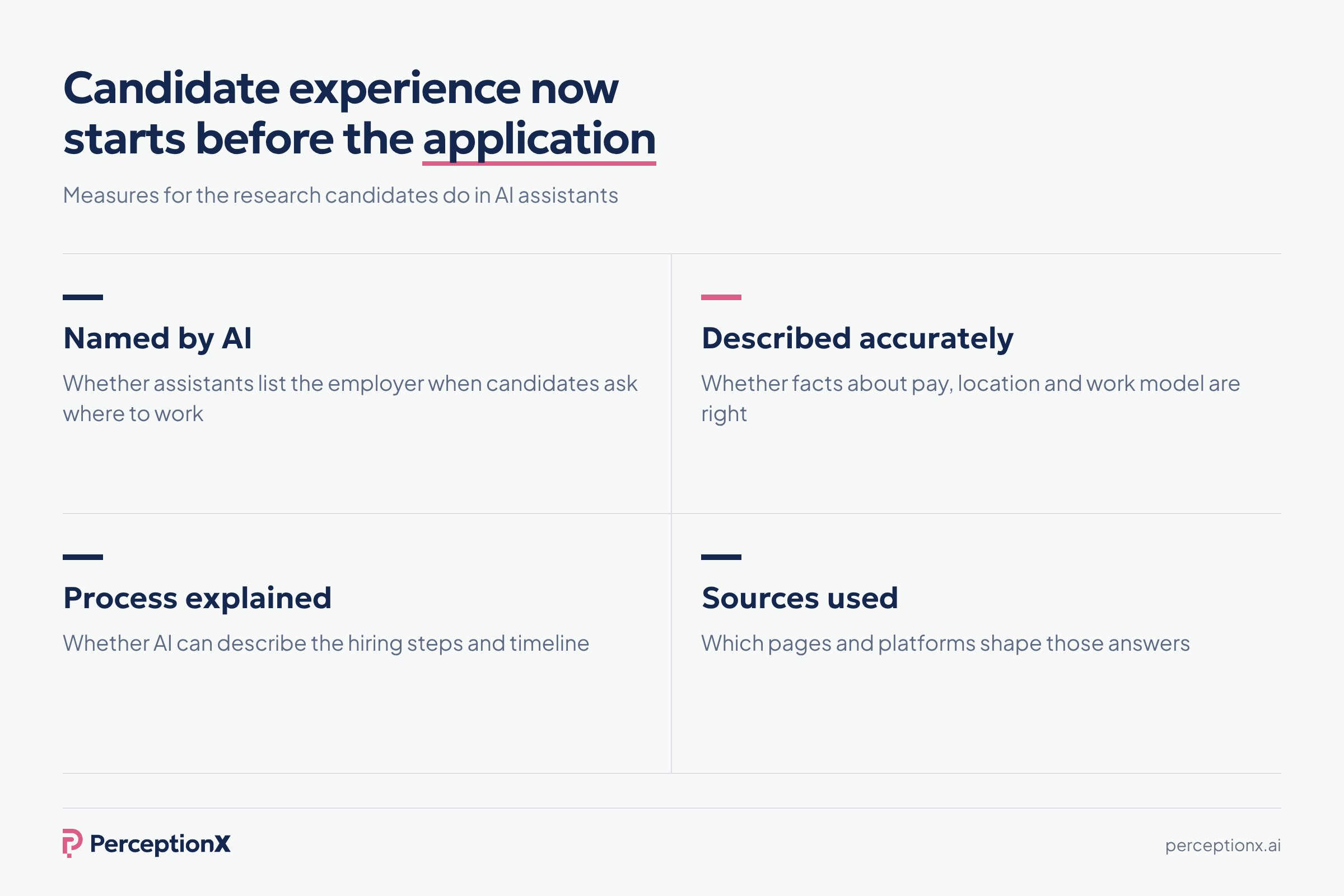
Most candidate experience metrics start when someone applies. But much of the experience now happens earlier, when candidates research the employer. In PerceptionX research across seven countries, 72% of AI-using job seekers used AI before deciding whether to apply, and 58% had caught AI giving inaccurate information about an employer. A candidate who reads a wrong answer about pay or the interview process starts with the wrong expectations, or never applies at all.
That is why the pre-application experience belongs in candidate experience measurement: how often AI assistants name you, how accurately they describe your hiring process and which sources they use. Our guide to what candidates ask AI when researching employers covers the questions to check. At PerceptionX, the Employer Perception Score is the measure we use for this stage: how AI assistants describe an employer to candidates.
How to collect candidate experience data
- Short surveys at key stages, sent automatically after the application, after interviews and after the final decision. Keep each to a few questions.
- Survey rejected candidates too. Their feedback is often the most useful, and how you treat them can significantly impact your reputation.
- Use your applicant tracking system for completion, drop-off, time in stage and acceptance data.
- Monitor review sites and job platforms for comments about your interview process, in every market where you hire.
- Check AI answers about your hiring process and benefits regularly, by market.
How to improve candidate experience using the metrics
- Find the biggest drop-off. Start where you lose the most good candidates.
- Shorten and simplify. Cut application questions, combine interview stages and fix mobile problems.
- Set communication standards. Commit to response times and keep candidates informed at every stage.
- Train interviewers. Interview ratings improve fastest when interviewers are prepared and consistent.
- Publish the process. Explain the hiring process, timelines and pay ranges on your careers site, so candidates and AI have accurate information.
- Close the loop. Share results with hiring managers and track whether each change moves the metrics.
Candidate experience metrics sit alongside the wider measures in our guide to employer branding metrics, from perception to cost per hire.
Key takeaways
- Candidate experience metrics combine what candidates say with what they do.
- Core metrics include candidate NPS, satisfaction, completion, drop-off, time to hire, response time, offer acceptance and review sentiment.
- Survey hired and rejected candidates, and measure by stage, role and market.
- Published candidate experience benchmarks vary, so set internal baselines and track your own trend.
- The candidate experience now starts before the application, in what AI assistants tell candidates about you.
Frequently asked questions
What are candidate experience metrics?
Candidate experience metrics measure how job seekers feel about and move through your hiring process. They include candidate net promoter score, satisfaction scores, application completion rate, drop-off by stage, time to hire, response time, offer acceptance rate and review sentiment about the hiring process.
How do you calculate candidate NPS?
Ask candidates how likely they are to recommend applying to your company on a scale of 0 to 10. Subtract the percentage of detractors (0 to 6) from the percentage of promoters (9 or 10). The result ranges from -100 to +100.
How do you measure candidate experience?
Measure candidate experience by combining short surveys at key stages, including for rejected candidates, with applicant tracking system data on completion, drop-off, time in stage and offer acceptance, plus monitoring of review sites and what AI assistants say about your hiring process. Record a baseline first, then track each metric by stage, role and market.
What is a good candidate experience benchmark?
A good candidate experience benchmark is your own baseline, measured the same way each period and compared by stage, market and role. Published benchmarks vary with sector, role and survey method, so use them as rough context and judge progress by your internal trend.
Which candidate experience metrics matter most?
The candidate experience metrics that matter most are candidate NPS, satisfaction by stage, drop-off rate by stage, response time and offer acceptance rate. Together they show how candidates feel, where they leave and whether the final stages win them over.
What is a good candidate NPS score?
A good candidate NPS score is a positive one that rises over time. Because industry benchmarks use different methods, compare your cNPS against your own past results, by stage, role and market.
What is a good candidate experience?
A good candidate experience is clear, quick and respectful: candidates understand the process, hear back promptly, are interviewed fairly and leave with a positive view of the company whether or not they get the job.

Find out how AI is shaping your employer brand — and what you can do about it.