What Is an Employer of Choice? How to Become One

An employer of choice is a company that the people it wants to hire actively prefer over other employers, because of what it offers, how it treats its people and what it is known for. Being an employer of choice means top talent applies, accepts offers and stays, often without needing to be persuaded.
It is not a title a company can give itself. It is earned in what employees experience and confirmed in what candidates hear about you.
This guide explains what makes an employer of choice, why it matters, how to become one in practical steps and how to tell whether you are one, including what AI assistants now tell candidates when they compare employers.
What does it mean to be an employer of choice?
An employer of choice stands out in its talent market on the things candidates care about most: pay and benefits, career growth, culture, leadership, flexibility and purpose.
Potential employees judge it on the whole package: the work environment, the organizational culture and how the company supports their well being.
Crucially, it stands out to the specific people it needs to hire. A company can be an employer of choice for engineers in one city and an afterthought for sales staff in another.
Employer of choice status shows up in hiring outcomes. These employers attract more qualified applicants per role, fill positions faster, see more offers accepted and keep their people longer.
Their current employees recommend them, and their reputation does much of the recruiting work.
Employer of choice vs employer brand vs best places to work
The terms are related but not the same. Your employer brand is how you present yourself as a place to work. "Best places to work" lists and awards are external recognition, usually based on employee surveys or applications.
Being an employer of choice is the outcome that matters: the people you want to hire actually prefer you, whether or not you hold an award.
Awards can help, but plenty of employers of choice never enter them, and some award winners struggle to hire.
Why being an employer of choice matters
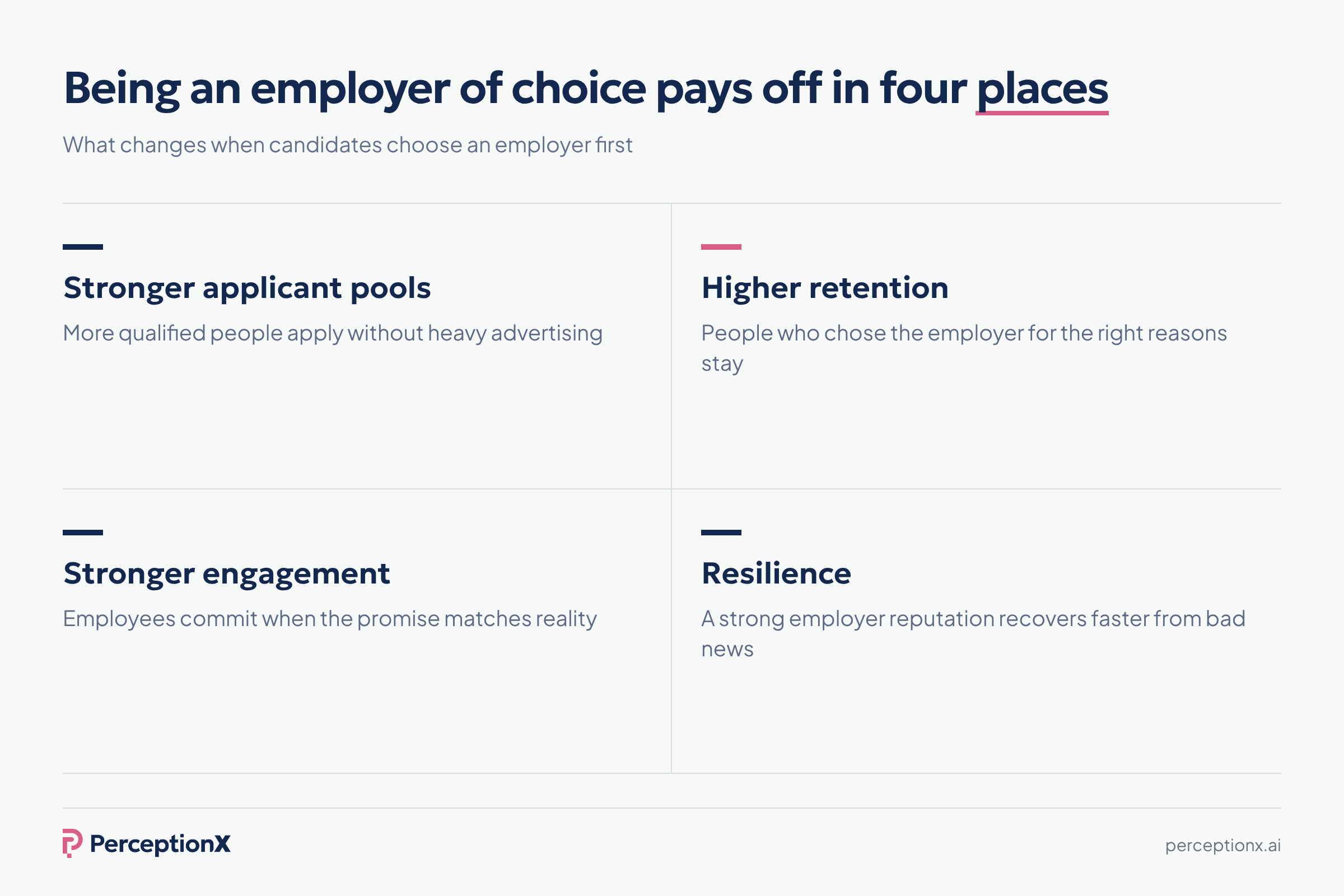
- Better candidates: strong employers attract top talent and passive candidates who are not actively looking.
- Lower hiring costs: less spend on job boards and agencies when people already want to work for you.
- Faster hiring: shorter time to fill and fewer declined offers.
- Higher retention: employees who chose you for the right reasons tend to stay.
- Stronger employee engagement: people are more committed when the employer lives up to its promise.
- Resilience: a strong employer reputation recovers faster from a bad news cycle.
The cost of not being an employer of choice
When you are not the preferred option, it shows up across the hiring process: fewer qualified applicants, more reliance on agencies and job boards, offers declined for higher pay elsewhere, and new hires leaving in their first year.
Each of those adds cost and slows the business down. It also affects current employees, who notice when the best candidates choose competitors and when colleagues leave.
Over time, a weak position becomes harder to fix, because word of mouth and reviews reinforce it.
Characteristics of an employer of choice
Competitive compensation and employee benefits
Employers of choice pay fairly for their market and explain how pay works. Many publish salary ranges in job postings. Benefits match what their people actually need, from health cover and parental leave to flexibility and wellbeing support.
Career development and growth opportunities
Candidates want to know they will learn and progress. Employers of choice offer clear career paths, internal mobility, learning and development, and promotion processes people understand and trust.
A positive workplace culture
Company culture is the theme candidates hear about most. Employers of choice have cultures employees describe in specific, positive terms in reviews and conversations: respect, collaboration, inclusion and good management.
Strong leadership and leadership development
People join companies and leave managers. Employers of choice invest in leadership quality, train managers and listen to what employees say about how they are led.
Flexibility and wellbeing
Clear policies on remote and hybrid work, reasonable workloads and genuine support for work life balance and mental health are now baseline expectations for many candidates.
Purpose and values that hold up
A mission people believe in, and values that show up in decisions, make the employer meaningful as well as attractive.
Employee recognition and a diverse workforce
People stay where their work is noticed. Regular, specific recognition, fair promotion processes and an inclusive culture, where employees from every background can do their best work, are consistent traits of employers that people choose.
Diversity, equity and inclusion only build reputation when employees can see them in practice, not just in policy.
Employee wellness, mental health and work life balance
Reasonable workloads, mental health support, generous leave and respect for time off are increasingly part of what candidates compare. Employers of choice treat wellbeing as part of how work is designed, not an add-on.
Social responsibility and community involvement
Many job seekers, especially younger ones, look at what a company does beyond its own walls. Credible social responsibility programmes, community involvement and volunteering time show an organization's commitment to its values and give employees meaningful work to be proud of. They only help when they are real and consistent with how the business operates.
Job security and trust
In an uncertain job market, job security and honest communication about the company's direction matter more than ever. Employers of choice trust employees with information about company goals and business performance, and explain difficult decisions openly. That trust is a significant factor in whether talented employees stay through hard times.
How to become an employer of choice in 7 steps
- Define who you need to be the employer of choice for. Pick the talent segments and markets that matter most to the business. You cannot be everyone's first choice.
- Find out how you are seen today. Run an employer brand audit: employee surveys, exit interviews, candidate feedback, review sites and what AI assistants tell candidates in each market.
- Fix the employee experience first. Address the issues current employees raise most: pay fairness, management quality, workload or career growth. No employer brand campaign survives a poor employee experience.
- Build a specific employer value proposition. Describe what you offer in concrete terms, test it with employees and make sure it is different from the companies you compete with for talent. Our guide to the employee value proposition covers how.
- Make the evidence public. Publish pay ranges, explain the hiring process, show real career paths and let employees tell their own stories on the careers site.
- Manage what others say about you. Keep job platform and review site profiles current, respond to reviews and encourage honest feedback from current employees, including on local review sites in each market.
- Measure and keep improving. Track engagement, retention, offer acceptance, candidate experience and how candidates and AI describe you, and act on what you learn every quarter.
How to engage employees and increase employee engagement
Employee engagement is both a cause and a sign of being an employer of choice. Engaged employees stay longer, perform better and speak well of the company. To increase employee engagement:
- Ask and act. Run regular surveys on employee satisfaction, job satisfaction and employee perceptions, and show what changed as a result.
- Encourage employees to grow. Offer training programs, mentoring and chances to learn new skills, and make career progression transparent.
- Recognise contributions. Make employee recognition specific, timely and visible, not just part of annual performance reviews.
- Involve people in decision making. Employees feel valued when they have a say in how their work is done.
- Keep communication open. Open communication from strong leadership builds the trust that keeps existing employees committed.
When employees feel heard, developed and recognised, higher engagement follows, and so does retention.
Employee benefits and perks that matter
Benefits are one of the clearest ways to show employees they are valued. Total compensation now includes much more than salary. The benefits candidates compare most often include:
- Health cover and employee wellness programmes, including mental health support and mental health days.
- Paid time off, parental leave and flexible schedules.
- Learning budgets and development opportunities.
- Retirement savings and financial wellbeing support.
- Wellness perks that people actually use, rather than ones that look good in a job description.
The best benefits match employee expectations in each market. Ask what your people value before adding new perks, and explain the full package clearly in every job offer.
Employer of choice in the public sector
The idea is just as important in the public sector, where employers often cannot match private sector pay. Public sector organizations compete on other factors: job security, meaningful work, pensions, flexible working and the chance to serve the community. Being an employer of choice there means making those strengths visible and specific, so talented people see the full value of the role and not just the salary.
Employer of choice strategy: where to focus first
Few organisations can fix everything at once. A practical employer of choice strategy prioritises in this order:
- Retention problems first. If good people are leaving, attraction work is wasted. Use exit and stay interviews to find out why.
- Then the candidate experience. Make the hiring process fast, clear and respectful, because every candidate becomes a source of word of mouth.
- Then visibility. Make sure the specific, true story of working for you is easy to find on your careers site, on review sites and in what AI assistants say.
- Then recognition. Awards and certifications are worth pursuing once the fundamentals are in place, because they amplify a story that is already true.
Employer of choice examples
Employers widely seen as employers of choice tend to share a pattern: one or two specific, verifiable practices that employees talk about.
Publishing salaries openly, offering on-site childcare, writing an open company handbook or handling a difficult layoff with real care all became part of how those companies are described. Our guide to employer reputation examples looks at several in detail.
How to know if you are an employer of choice
Awards and lists are one signal, but the most reliable evidence is in your own data and in what the market says. Look for:
- Rising qualified applicants per role and a growing share of hires from referrals and direct applications.
- High and improving offer acceptance.
- Strong retention, especially in the first year.
- Positive, specific employee reviews and a high employee net promoter score.
- Being named when candidates ask which employers to consider in your industry and market.
That last signal has become much more important. Candidates increasingly ask AI assistants which companies are good to work for.
In PerceptionX research across seven countries, 40% of job seekers used AI to find employers they had not considered, and 82% said an AI answer had changed their mind about a company as a place to work.
If AI does not name you, or describes you inaccurately, you are not an employer of choice in the place candidates now start.

Employer of choice in the age of AI
AI assistants build their view of an employer from career sites, review sites, job platforms and forums.
In October 2026, PerceptionX data showed an employer's own site in more than half of AI answers about employers, while for questions about what it is like to work somewhere, Glassdoor appeared in 63% of answers and Indeed in 44%.
Becoming an employer of choice now means making sure those sources tell an accurate, specific and positive story, because that is what AI repeats to candidates.
PerceptionX is the only employer reputation partner built for how candidates now research employers. It brings together three things: technology that measures what AI tells candidates about you, specific recommendations on what to change, and advice from practitioners who have measured employer brand for years.
It shows what ChatGPT, Google and other AI assistants tell job seekers about working for a company: whether they recommend it, what they say about it and which websites those answers come from, in every market and for every type of role.
That shows employers whether they are named as a top choice, and why. Our scores are independent: they come from what AI actually says, not from what employers tell us.
For the wider picture, see our guide to employer reputation.
How to keep your status
Being an employer of choice is not permanent. Leadership changes, rapid growth, restructuring and pay that falls behind the market can erode it within a year.
Keep measuring employee engagement, retention, candidate experience and what AI and review sites say about you every quarter, and act on what changes. Our guide on how to measure employer brand sets out a simple scorecard.
Why it matters for business success
Becoming an employer of choice is not only an HR practice. It is part of the overall strategy for business success. Companies that attract and retain talent remain competitive, because they can hire the skills they need faster and keep the knowledge they have built. Talent attraction and the ability to retain employees are critical factors in organizational success and in an organization's success over the long term, and they depend on both the workforce experience and how the company is seen from the outside.
That is why the organization's values, its corporate culture and the way it treats people have to line up. When they do, employer branding stops being a campaign and becomes a reflection of what is true.
Key takeaways
- An employer of choice is preferred by the people it wants to hire, and earns that through the employee experience.
- Pay, growth, culture, leadership, flexibility and purpose are the characteristics that matter most.
- Become one by fixing the experience, defining a specific EVP, publishing the evidence and managing what others say.
- Measure it in hiring outcomes and in what candidates and AI assistants say about you.
Frequently asked questions
What is an employer of choice?
An employer of choice is a company that the people it wants to hire actively prefer over other employers, because of its pay and benefits, career growth, culture, leadership, flexibility and purpose. The status is earned through the employee experience and confirmed by what candidates hear about the company.
How do you become an employer of choice?
Define which talent you want to attract, audit how you are seen today, fix the biggest issues in the employee experience, build a specific employer value proposition, publish the evidence, manage your review site and job platform profiles, and measure progress every quarter.
What are the characteristics of an employer of choice?
Fair and transparent pay, meaningful benefits, real career growth, a culture employees describe positively, good management, clear flexibility and wellbeing support, and a purpose and values that show up in decisions.
How do you measure employer of choice status?
Look at qualified applicants per role, offer acceptance, first-year retention, employee net promoter score, review sentiment and whether AI assistants name you when candidates ask which employers to consider in your industry and market.
Is employer of choice the same as employer brand?
No. Employer brand is how a company is perceived as a place to work. Being an employer of choice is the outcome of a strong employer brand backed by a strong employee experience: the people you want to hire prefer you.
What are the benefits of being an employer of choice?
More qualified applicants, faster hiring, higher offer acceptance, lower recruiting costs, better retention and stronger employee engagement. Employers of choice also recover faster from difficult moments because their reputation rests on real experience.
Is employer of choice an award?
Some organisations run "employer of choice" awards or certifications, but the term usually describes a position, not a prize: being the employer the people you want to hire actually prefer. Awards can support that position once the fundamentals are in place.
How long does it take to become an employer of choice?
Usually one to three years of consistent change. Improvements to the employee experience come first, then reviews, word of mouth and AI answers follow as new evidence replaces the old.
Why do employees prefer an employer of choice?
Because it offers what matters to them: competitive compensation, career development, a positive workplace culture, strong leadership, flexibility and wellbeing support, and values it acts on. Employees feel valued and can see a future there.

Find out how AI is shaping your employer brand — and what you can do about it.